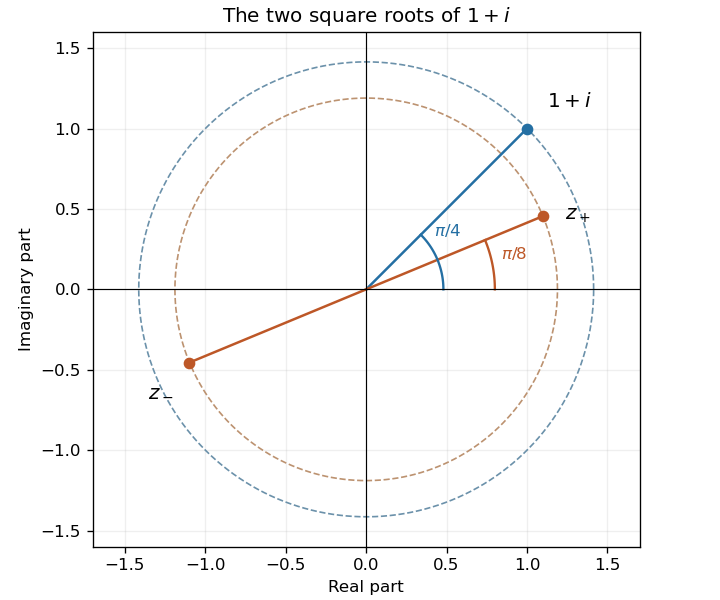
The point has modulus and argument modulo . Taking complex square roots halves the argument and takes the square root of the modulus:The two roots are opposite points in the complex plane, explicitly .

Take the imaginary part of De Moivre's theorem, . With and ,The required equation cancels the fifth powers and becomes . Thus , giving all real solutions
Use the exponential definitions of complex sine function and complex cosine. Multiplying the equation by gives , hence . Since exponentials never vanish, this is equivalent to . All branches of the complex logarithm giveThe derivation does not divide by , so it introduces no lost zero-denominator cases.
Articles by others on the same topic
There are currently no matching articles.