A differentiable gradient field must have equal mixed derivatives. Here but , which are not identically equal on any open region. Equivalently,Thus no scalar potential exists for this field on an open region. Vanishing of the curl on a special lower-dimensional set would not supply a three-dimensional potential.
The component integrates to . Matching the component gives , and matching the component then gives the remaining derivative zero. ConsequentlyDirect differentiation recovers all three components, proving this is a gradient field globally on .
Write the surfaces as level sets and . Their gradients are normal vectors to their tangent planes. At the specified point they are and , with dot product and squared norms . The angle between intersecting regular surfaces is the angle between their tangent planes, soBoth gradients are nonzero, ensuring that the tangent planes are defined.
Write . For , direct Cartesian differentiation gives the divergence and curl of a radial vector field:The volume element in spherical coordinates therefore gives, for ,For the direct surface integral, the outer sphere has outward normal and contributes . The inner boundary's outward normal relative to the shell is , so it contributes . HenceFor , the field has zero ordinary divergence everywhere in this shell. The separate surface contributions are and , so both full integrals are zero. This radial power-law flux through a spherical shell was obtained by direct differentiation and integration; the excluded origin is never part of the volume.
A homogeneous linear system has a nonzero solution exactly when its coefficient matrix is singular. Expansion of the determinant givesThus the allowed values are . Solving the first two equations and checking the third givesIn each case gives a nonzero solution and spans the one-dimensional null space; gives only the zero vector.
Since , its even powers are and its odd powers are . Splitting the matrix exponential into these two absolutely convergent subseries gives the matrix exponential for a scalar square:At , the coefficient has limiting value one and , so . The result is a planar rotation through angle .
Now , so splitting its matrix exponential into even and odd powers yields hyperbolic functions:The limiting coefficient at is again one, and . The eigenvectors and have factors and , respectively, showing how this hyperbolic transformation differs from a rotation.
The Lagrange multiplier equations are , , together with . If , then and ; if , then and . ThusThe constraint is compact and its gradient never vanishes, so these exhaust the possible global extrema. Equivalently, substituting , gives along the boundary.
Minimize the squared distance subject to . The Lagrange multiplier condition gives and . Enforcing the line constraint gives , henceThe displacement to this point is parallel to the line's normal vector , so it is the orthogonal projection. The squared distance restricted to the line has positive quadratic coefficient , proving this stationary point is the unique global minimum.
Let denote the stated cost per area of the cylindrical wall. Charge for the curved wall and cap as specified; no floor cost is supplied. The volume and cost are and . To minimize cost at fixed volume, apply a Lagrange multiplier to . Differentiation with respect to gives . The derivative then gives , reducing to . Thus the optimal cylinder and hemispherical cap with unequal surface costs hasFor a global check, eliminate to obtain . Its second derivative is positive for , and its critical radius gives , so the constrained optimum lies inside the physically feasible range and is the unique minimum.
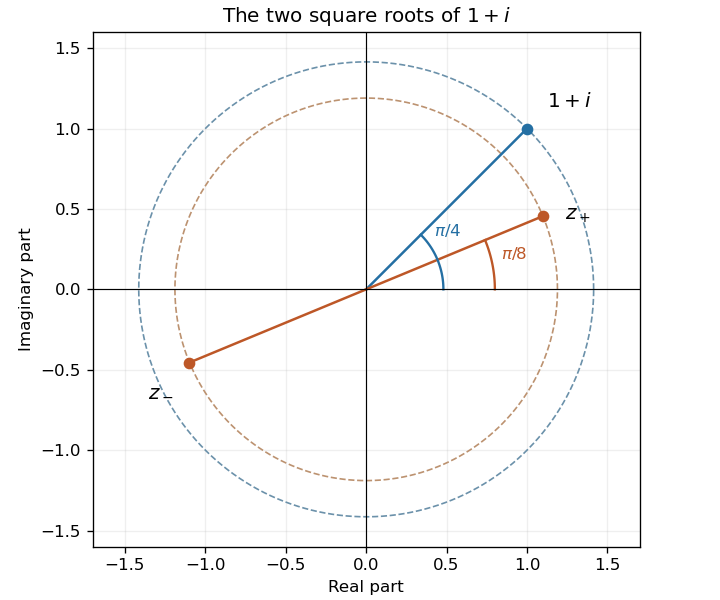
The point has modulus and argument modulo . Taking complex square roots halves the argument and takes the square root of the modulus:The two roots are opposite points in the complex plane, explicitly .
Take the imaginary part of De Moivre's theorem, . With and ,The required equation cancels the fifth powers and becomes . Thus , giving all real solutions
Use the exponential definitions of complex sine function and complex cosine. Multiplying the equation by gives , hence . Since exponentials never vanish, this is equivalent to . All branches of the complex logarithm giveThe derivation does not divide by , so it introduces no lost zero-denominator cases.
The sphere consists of points whose displacement from its center has fixed norm. Its vector and Cartesian equations areEquivalently, with .
The coefficient vector is a normal vector, so a vector equation of the plane isA parametric version is , since both independent direction vectors are perpendicular to .
The distance from a point to a plane is the absolute residual of the plane equation divided by its normal's length. Here and , so
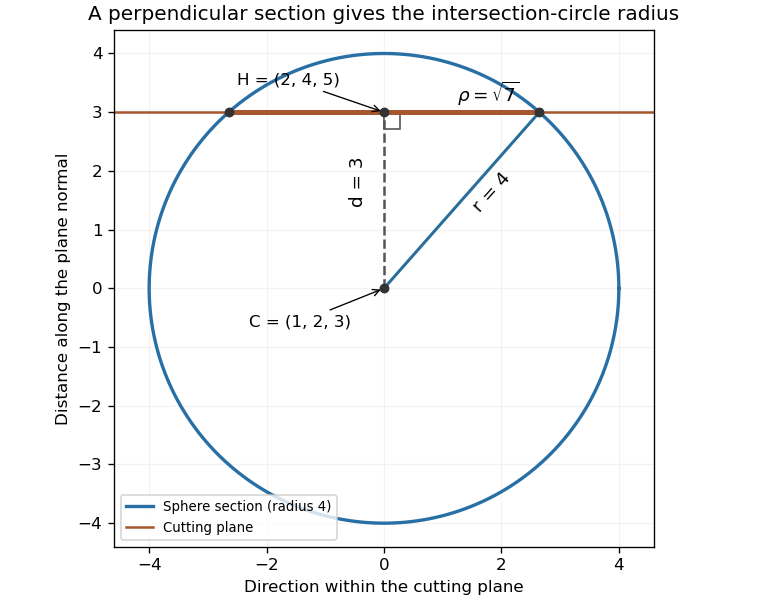
The center of the sphere-plane intersection is the perpendicular projection of the sphere's center onto the plane:The distance from to the plane is , so the intersection is a genuine circle. A right triangle with hypotenuse equal to the sphere radius givesIts plane is the given plane; displacements within it are perpendicular to .
The required Legendre transform is the Helmholtz free energy, up to an additive constant. Its differential is , so and . Equality of mixed partial derivatives for a smooth thermodynamic state gives the Maxwell relationNext use the total differential . Along a fixed-pressure path, divide by to get . Substitute the Maxwell relation to obtainMultiplying by gives the usual difference between the heat capacity at constant pressure and the heat capacity at constant volume.
At fixed entropy, the total differential in coordinates is . Dividing by along that path gives . The same argument in coordinates gives . These are the two required intermediate identities.
To prove the final result without cancelling a possibly vanishing thermal-expansion derivative, write , , , . In a regular thermodynamic region with , fixed pressure gives , while fixed entropy gives . The chain rule then gives and . Both cross-products equal , provingThe heat-capacity and compressibility ratio identity rewrites this as : keeping entropy fixed rather than temperature fixed changes the mechanical stiffness by the same factor as the two thermal responses.
Here , and direct integration constructs a global potential for this exact differential form. Integrate with respect to to obtain ; matching gives . ThusBoth derivatives recover the supplied coefficients.
The form is not exact, because and . For an integrating factor depending on one coordinate, the condition with gives . ThusFor example, on , the multiplied form is , with potential . On , a corresponding potential is . The factor is local to these domains and is singular on the excluded line .
The origin is excluded by the denominator. On the punctured plane, direct differentiation givesHence the form is exact on its whole stated domain, with . Although the punctured plane is not simply connected, the explicitly constructed single-valued potential establishes global exactness directly; a topological sufficiency criterion is unnecessary here.
A real normal matrix satisfies . For a symmetric matrix, and both products equal . For an antisymmetric matrix, and both equal . For an orthogonal matrix, both products are the identity. Thus each of the three classes consists of normal matrices.
The upper block has trace zero and determinant , so its characteristic polynomial is . The third coordinate has eigenvalue two. Angle-addition identities give the normalized eigenvectorsThese formulas apply to every real , including values where an expression obtained by dividing by would fail. Geometrically the planar block is a reflection: it fixes the axis at angle and reverses its perpendicular direction.
The dot product is . Each planar vector is perpendicular to because its third component vanishes. Each has norm one, so the three vectors form an orthonormal eigenbasis. This also follows from the spectral theorem for the real symmetric coefficient matrix.
For a strictly decreasing function, in the interior of . Integrating over the unit interval and summing from to gives the integral comparison for a nonincreasing nonnegative function:Geometrically, right-endpoint rectangles lie below the curve and left-endpoint rectangles above it. If “decreasing” permits flat pieces, use non-strict inequalities unless strictness is ensured on some interval. When , the endpoint value is also needed; the power function below is defined there.
For with , the integral comparison on gives , where . Add the missing endpoint term on each side to obtainThe lower bound uses the right inequality for and adds ; the upper uses the left inequality and adds one.
For fixed , the partial sums are increasing and bounded above by . The monotone convergence theorem for sequences therefore proves convergence to a finite sum . Passing to the limit in the two bounds givesThe squeeze theorem now yieldsSince , this is the real-axis singular limit of the Riemann zeta function at one. The limiting sum is taken at fixed before sending to zero; setting inside the convergent-series argument would instead give the divergent harmonic series.
The partial fraction decomposition isIntegrating between one and two givesAll logarithm arguments are positive on this integration interval.
Use integration by substitution with , so and . Reversing the transformed limits givesThe original integrand is finite at both endpoints.
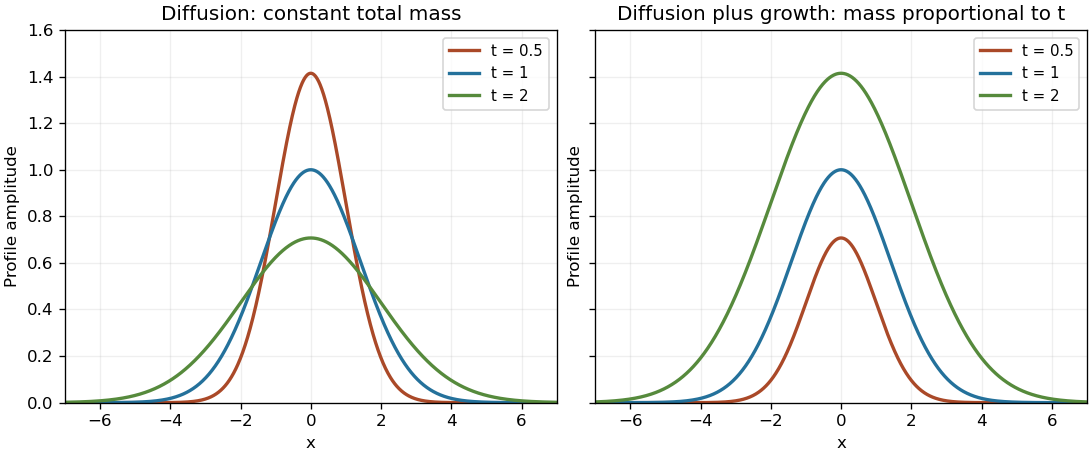
Work with and write . The chain rule givesThus : it is a constant multiple of the one-dimensional Gaussian heat kernel.
For the modified equation, put . Substitution gives . The heat-equation terms cancel, and permits division to obtain . Solving this separable differential equation givesThe zero solution is included by . This is the scalar integrating factor for a reaction-diffusion equation with reaction coefficient , because the modified equation is . Its sign produces growth. Indeed is constant, while increases linearly for ; neither profile is being assigned unit normalization here.


Articles by others on the same topic
There are currently no matching articles.