For , the kernel is smooth between the two positive endpoints. The Leibniz integral rule gives both endpoint terms and the parameter derivative:The remaining integral equals , soThe substitution gives the same result directly from limits . Negative would make the original interval cross the nonintegrable singularity, so it is not part of this ordinary-integral domain.
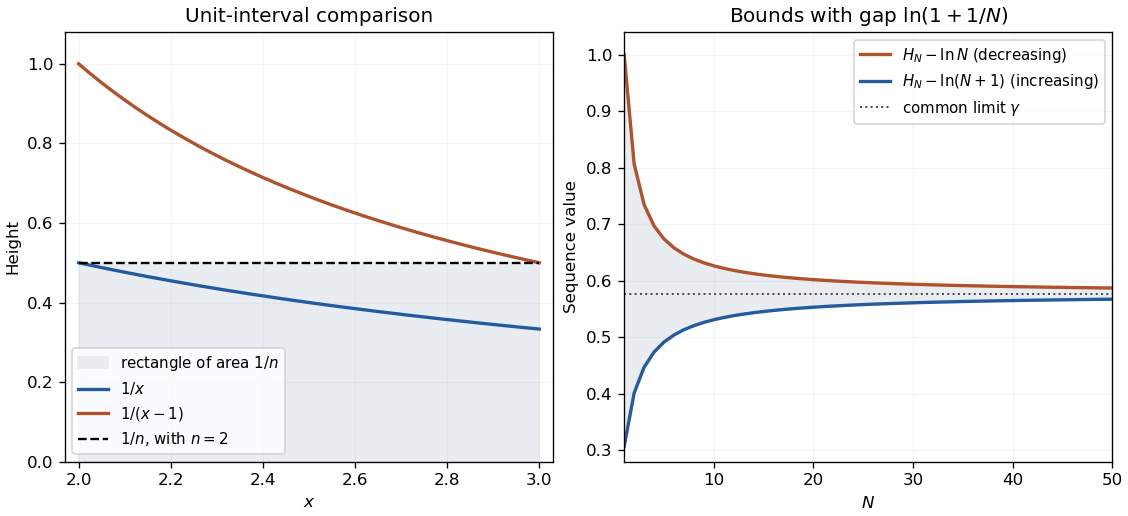
For , monotonicity gives . Integrating over that unit interval proves the strict inequalities, equivalently for .
Let be the harmonic number and define , . The same integral comparison gives and . Also and . The monotone convergence theorem for sequences therefore gives a common finite limit, Euler's constant .
The integral bounds for Euler's constant start at and . Strict monotonicity, already at the next index, makes the limit bounds strict:Positivity is explicit because . This establishes the required limit without assuming its decimal value.

Articles by others on the same topic
There are currently no matching articles.