For real , the angle lies in and has sine . Thus the principal arcsine in the expression equals the arctangent of . Its derivative isThe chain rule gives the same result directly, using with a positive square root.
The lower-order terms cancel, so the numerator must be expanded through sixth order. The Taylor series give and . ThereforeThe first nonzero term is , with the quotient continuously extended to zero if needed.
With the change of variables , one has , and . The transformed improper integral is integrable at its zero endpoint and becomesHence
Write . Since is a unit vector, and . Thus this Householder reflection satisfiesGeometrically, the mirror preserves the component tangent to its plane and reverses the normal component; doing it twice restores the original vector.
Expanding the two products of Householder reflections givesThe commuting plane reflections criterion follows: the operator vanishes if the normals are orthogonal, or if they are parallel. Conversely, if and the operator vanishes, applying to gives , proving parallelism.
This establishes equality of the reflected directions for every incident ray exactly in those two cases. For one fixed ray the claim needs that qualification: if nonparallel normals are not orthogonal, a ray along has zero normal component for both mirrors and is unchanged in either order. Algebraically it lies in the kernel of the commutator; it is a special direction rather than a pair of commuting reflection operators.
For an arbitrary vector , expansion in the orthonormal basis gives , with summation over . Since this holds for every , the resolution of the identity in an orthonormal basis isLet , and similarly for . The three orthogonal projection matrices sum to and have pairwise products zero. ThusAny ray meeting all three ideal perpendicular mirrors therefore returns in the opposite direction, independently of reflection order. This is the geometry of a corner reflector, a kind of retroreflector used in lunar laser ranging.
Integrating the first component with respect to suggests . Matching the other components gives . Direct differentiation verifiesThus the vector field is conservative, with the displayed scalar potential.
The component of the curl is , which is not identically zero; at the origin it is one. Hence the field is not conservative on and has no global scalar potential.
Integrating the first component and checking the remaining partial derivatives givesThis explicit scalar potential proves that the field is conservative.
Parametrize the straight path by , . Then , so direct evaluation of the line integral givesThe fundamental theorem for line integrals supplies an independent check: this is .
On the first segment only varies and . On the second only varies and . On the last segment , so the line integral isThe agreement is the expected path independence of a conservative vector field.
Where , the implicit function theorem makes the surface a local graph with and . Its upward vector area element is . Therefore the vector area element of an implicit surface isDividing by fixes the upward orientation even if the initially chosen gradient points downward. The restriction excludes a locally vertical graph, where this particular projected-area representation cannot be used.
Choose . Since on the stated open domain, its upward vector area element isThe graph becomes unbounded near parts of ; the flux integrals below are understood as limits from .
Subtract the integrands before integrating: . With the upward vector area element,This extends continuously to the lower edge, soThe individual flux integrals also converge: gives , and hence . Reversing the surface orientation changes both signs and leaves the requested magnitude unchanged.
In the plane , the right half of the cross-section has coordinates , , . Reflect across the axis for the other half. The cardioid has a cusp at for , crosses at for , and reaches for . The small upper lobes reach ; the widest section is below the equator.
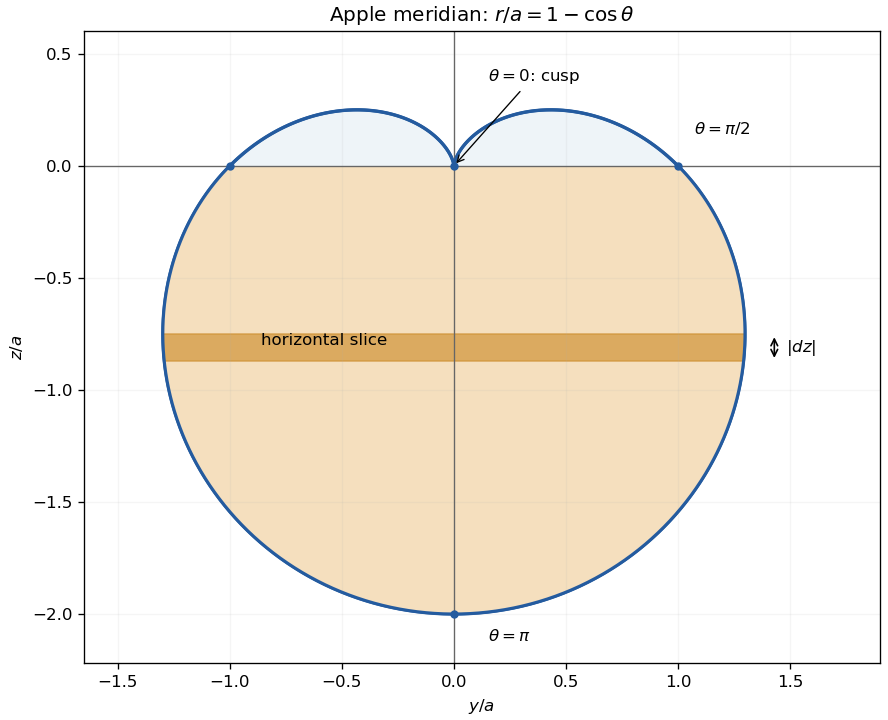

For horizontal slices of a surface of revolution in spherical coordinates, use disk area times vertical thickness. Here the cylindrical radius is and the height is . For , . Hence a positive angular increment givesThese are horizontal disks in the lower part of the solid. A spherical angular-wedge element describes a different infinitesimal slice.
Integrate the horizontal-disk expression over . With and ,Evaluating the integral of this polynomial gives
For , the kernel is smooth between the two positive endpoints. The Leibniz integral rule gives both endpoint terms and the parameter derivative:The remaining integral equals , soThe substitution gives the same result directly from limits . Negative would make the original interval cross the nonintegrable singularity, so it is not part of this ordinary-integral domain.
For , monotonicity gives . Integrating over that unit interval proves the strict inequalities, equivalently for .
Let be the harmonic number and define , . The same integral comparison gives and . Also and . The monotone convergence theorem for sequences therefore gives a common finite limit, Euler's constant .
The integral bounds for Euler's constant start at and . Strict monotonicity, already at the next index, makes the limit bounds strict:Positivity is explicit because . This establishes the required limit without assuming its decimal value.
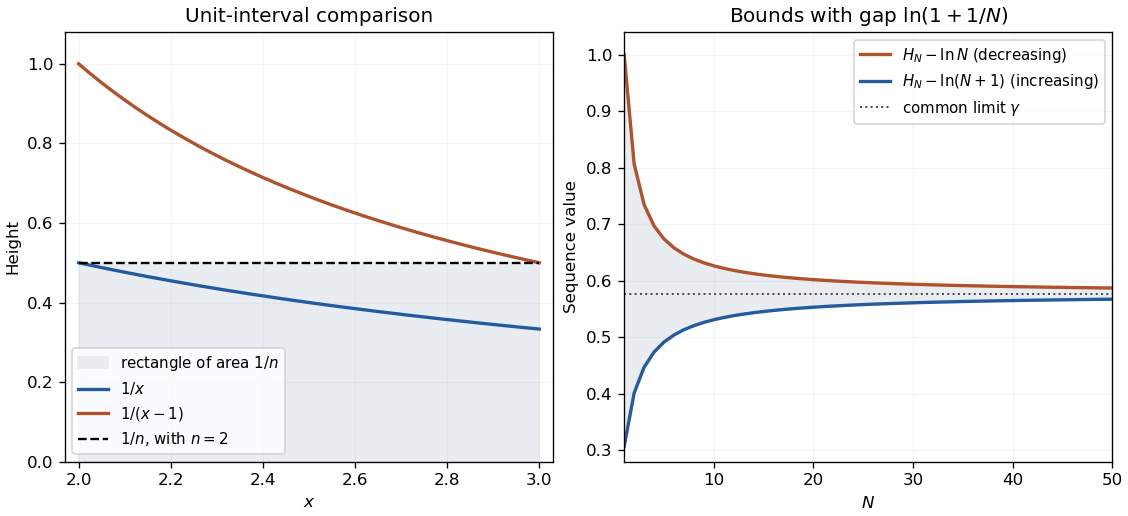
Integral comparison and nested bounds for Euler's constant
. Original graph: the height lies between and on , illustrated for . The second panel shows the decreasing upper and increasing lower sequences; their gap tends to zero. Details.
With and , the cross derivatives agree: . This is an exact first-order ordinary differential equation. Integrating with respect to gives a potential ; matching gives . The implicit solution is
Here whereas , so the equation is not exact. The identity gives the integrating factor for a differential one-form . Multiplying makes the left-hand side the exact differential of . ThusFor real graph solutions, the right-hand side must be nonnegative; a smooth choice of square-root branch is made on the interval concerned. Finding the factor did not require dividing by at zero.
The cross derivatives are both , so the equation is exact. The function differentiates to the given one-form. HenceDifferentiating this implicit equation checks both coefficients of the exact differential directly.
Assuming the egg colours are independent with the same probability , the number of white eggs has the binomial distribution with four trials. The possibilities are
| Contents | Probability |
|---|
The binomial coefficients count which eggs are white. Marginal colour probabilities alone would not determine nest probabilities without the independence assumption.
For , the five probabilities in increasing white-egg order are . The largest is , so the most common nest has three white eggs and one brown egg, .
The function is a probability density function, rather than a cumulative distribution: its integral over both intervals must be one. Thus and
The density is symmetric about , giving expected value . Its second moment is . ThereforeEquivalently, each equally weighted interval has variance and its centre is from the overall mean, giving by the law of total variance.
Separate variables away from the equilibrium solutions. Partial fractions giveThus the constant-coefficient Riccati equation has real solution familyon intervals where the denominator is nonzero. The value includes . Setting recovers the printed expression after factoring out . For real that substitution covers positive only; negative gives additional real branches between the equilibria, and the constant solutions must not be discarded when separating variables.
For the printed family, put . Its logarithmic derivative is , so integrates toThis includes and is valid on each interval on which the corresponding is finite. For the full real family, write and , with . The pure exponentials include the two equilibrium values of ; arbitrary relative coefficient signs include the branches missing from real in the printed expression.
When the two roots coincide, . Separation gives , and the equilibrium must be added. Integrating givesThe nonconstant pair is restricted to an interval excluding . Equivalently every nonzero linearizing function is , with wherever its denominator is nonzero.
Differentiate without dividing by :Thus the linearization of a Riccati equation givesIts characteristic polynomial is , explaining both the distinct-root exponentials and the repeated-root factor . Nonzero solutions reconstruct between their zeros; the identically zero also satisfies the linear equation.
A convergent series has partial sums tending to a finite limit . Explicitly, for every there is an integer such that whenever . The convergence of the individual terms to zero is necessary but is not sufficient for convergence of the series.
The telescoping series has partial sum . Therefore the necessary and sufficient condition is that have a finite limit . The sum is then .
The comparison test for series states that if for all sufficiently large , convergence of implies convergence of . Equivalently, divergence of the smaller nonnegative series forces divergence of the larger one. Finitely many initial terms do not affect either convergence conclusion.
Subtract the right side from the left and write . Then and for , so the strict inequality follows. Set and multiply by to obtainThis decreasing-power difference supplies a telescoping bound for a p-series.
Put . The preceding inequality bounds for . For , summing the telescoping series givesThese nonnegative partial sums increase and are bounded, so the monotone convergence theorem for sequences proves convergence for every . This is the telescoping bound for a p-series, an alternative to the integral test.
Applying the multivariable chain rule at fixed givesThe held-fixed variables distinguish the two coordinate descriptions; the same scalar function is being differentiated.
Differentiate the first-order chain rule again, including derivatives of the coordinate coefficients. The second derivatives under a two-variable coordinate change areandThe last two terms account for derivatives of the coordinate functions; they vanish for an affine map. Smoothness justifies equality of the two mixed partial derivatives.
For polar coordinates with , and . Write , . Applying these operators twice, including their variable coefficients, gives the Cartesian second derivatives in polar coordinates:In particular their sum is the Laplacian in polar coordinates, .
The substitution gives . For this function , , and , whose sum is zero. Thus it satisfies the polar form of Laplace's equation for . The apparent coordinate singularity at does not make the original Cartesian polynomial singular; it is a smooth harmonic function through the origin.
Articles were limited to the first 100 out of 107 total.
Articles by others on the same topic
There are currently no matching articles.