The Euclidean distance is . Along the parametric curve,This is at least , with equality exactly when . Therefore
The hyperbolic functions identity eliminates from the parametric curve:The restriction is essential: , so the parametrization traces only the right branch of the full hyperbola. Conversely, every point on that right branch is reached by taking .
Solving for gives with . For large , the square root is , so the two asymptotes areThe curve lies between these lines on the right side and has its nearest point, with vertical tangent, at . As increases it travels from the lower unbounded end through that vertex to the upper unbounded end. The left hyperbola branch is not part of the given curve.
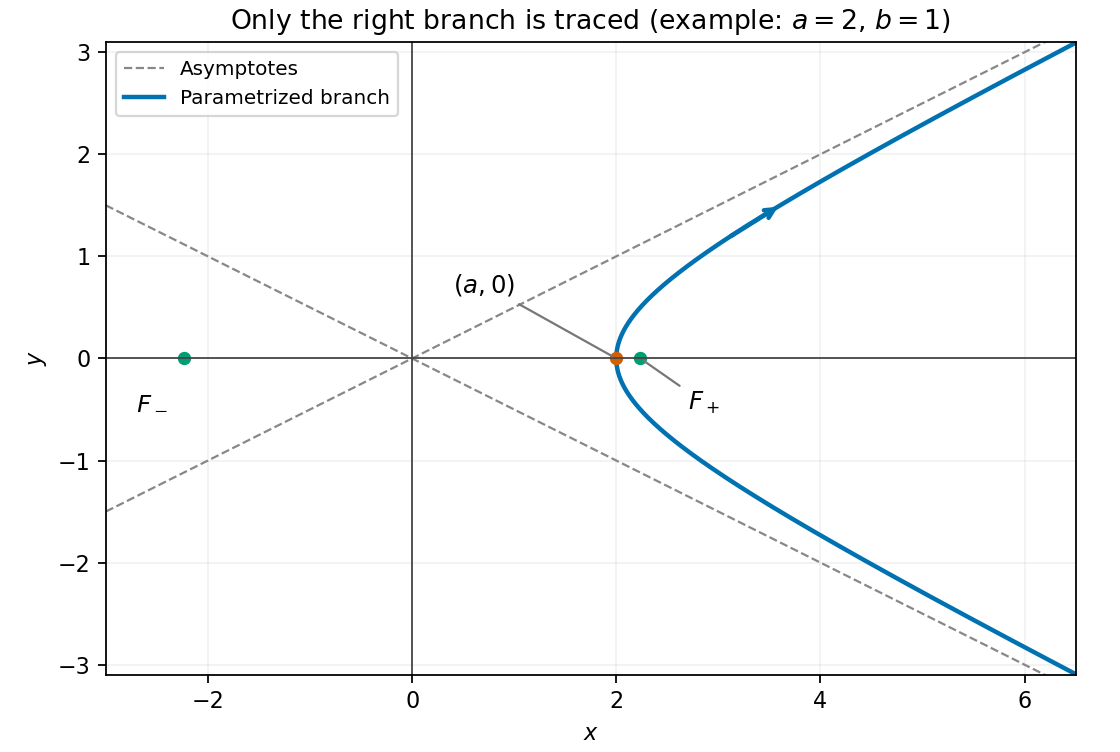

Put and denote the distances to and by and . Direct expansion using givesSince and , both expressions inside the final square roots are positive. Hencefor every point of this right branch. This is the focal-distance identity for a hyperbola; on the left branch the signed difference would reverse, while its absolute value would remain .
Articles by others on the same topic
There are currently no matching articles.