For the heat equation , separation of variables with homogeneous Neumann boundary condition at both ends gives spatial modes and decay factors . The mode is constant and does not decay.
The initial profile already contains only two such modes:Evolving each mode therefore yieldsThe endpoint derivatives vanish, and substitution checks both the equation and the initial profile. The spatial integral remains : no heat escapes through insulated ends, so the limiting uniform temperature is .
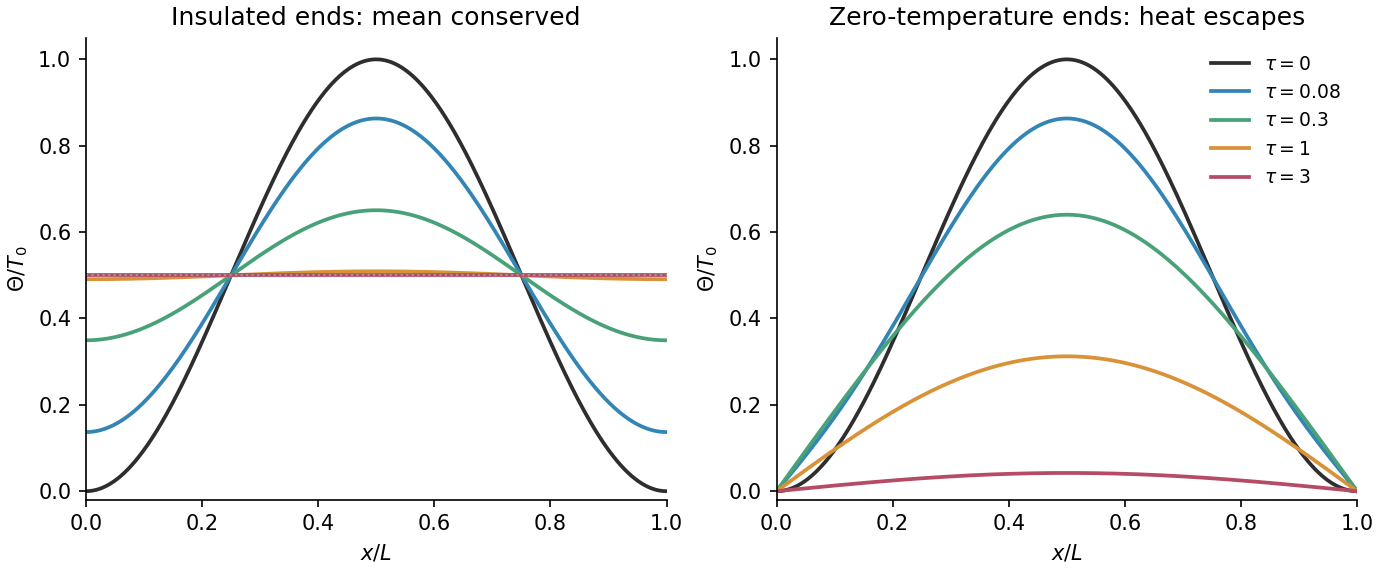
Insulated and zero-temperature endpoints evolve the same initial heat profile differently
. Original mode calculations. Both panels start from the same squared sine. Insulated endpoints conserve the mean temperature and approach ; zero-temperature endpoints remove heat and the profile decays to zero. Times are expressed as . Details.
With homogeneous Dirichlet boundary condition, the eigenfunctions are and all modes decay. WriteReflection about the midpoint makes every even- coefficient zero. For odd , putting and using the product-to-sum identity givesIn particular and . ThusThis uses the Fourier sine series of a squared sine. The coefficients are , so the initial series converges uniformly; for the exponential factors also justify termwise differentiation to check the heat equation. Every mode vanishes at both endpoints, and the initial series gives the specified profile. Unlike part (a), there is no constant mode: the temperature tends to zero, with leading long-time term
Articles by others on the same topic
There are currently no matching articles.