Use cylindrical radius . The upper cone is and the lower elliptic paraboloid is , both with . They meet along the unit circle in . The enclosed solid isThus the coordinate ranges on the complete surface areThese separate ranges do not mean every point of their Cartesian product lies on the surface. A vertical cross-section has a straight upper cone profile and a curved lower paraboloid profile.
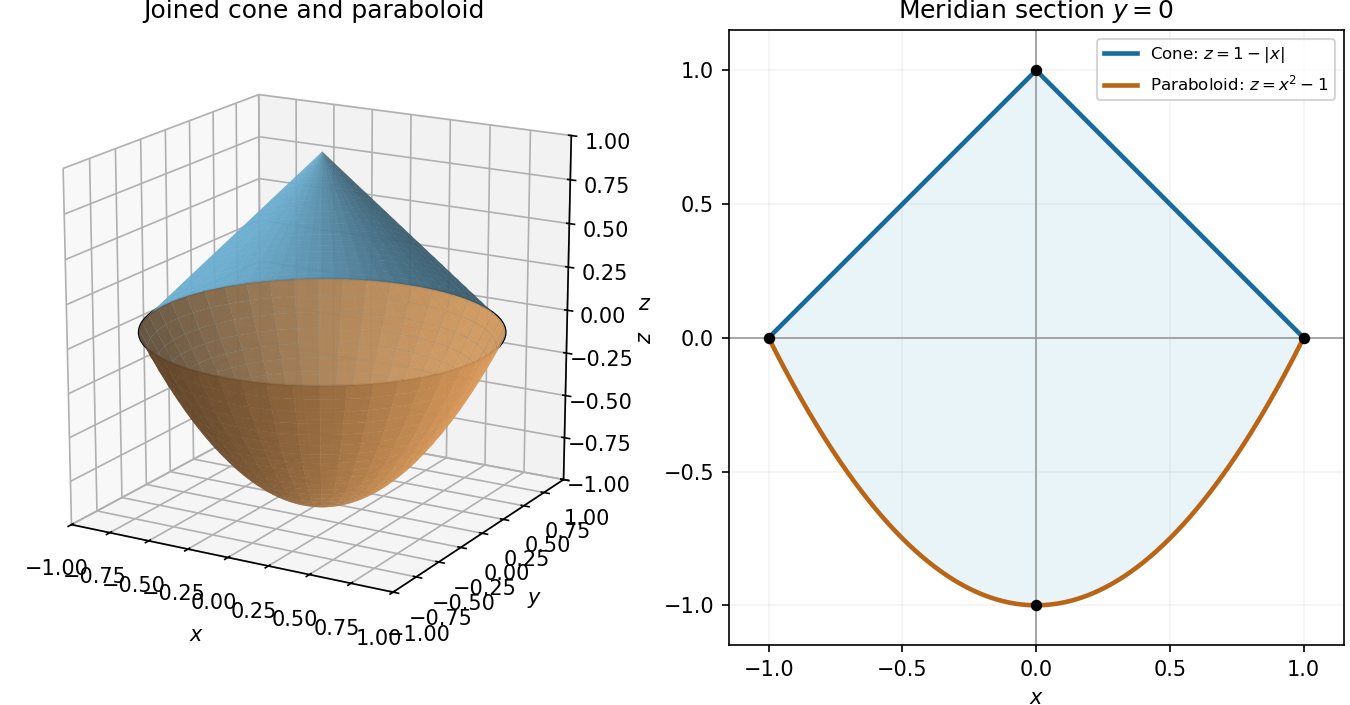

Both patches project onto the unit disk in the -plane. Their outward oriented surface elements areThe cone's apex has zero area and does not affect the surface integral. For , the vector field is , soThe terms involving vanish by reflection symmetry of the disk. Thus the total outward flux isThis calculation evaluates the two surface integrals directly.
For , the vector field is . On the cone,The first term has zero integral by symmetry. Using polar coordinates for the remaining double integral givesOn the paraboloid ,Again the term cancels by symmetry, givingTherefore direct surface integral yieldsNo separate disk at is included: that rim joins the two surfaces and is not an additional face of the closed boundary.
Articles by others on the same topic
There are currently no matching articles.