Expanding the cross product componentwise givesIts dot product with each original vector is zero, as required.
First . Taking the remaining cross product givesThe order of the two cross products matters because the operation is not associative.
The equation is not separable, because cannot be written as a product of a function of and a function of on an open region. For example, the ratio depends on for distinct fixed , whereas a separated product would give a constant ratio.
It is not homogeneous in the sense of a homogeneous first-order differential equation: the right-hand side is not a function of alone. It is also not a homogeneous linear differential equation, since moving the term to the left leaves a nonzero forcing.
It is linear, since it has the standard linear ordinary differential equation formThus the classifications are (a) no, (b) no, (c) yes.
The coefficient matrix has determinant , so it is an invertible matrix. Its homogeneous linear system therefore has only the zero solution:One can also subtract the first equation from the second to get , then subtract the first from the third to get , giving and finally . Thus there are no nonzero solutions.
The chain rule gives and . The partial differential equation becomesFor this to hold for every twice differentiable , the coefficient must vanish:For an affine alone any would work, but the requirement is for arbitrary .
The product-to-sum formula gives the finite Fourier seriesThus the only nonzero Fourier coefficients are .
Let be the enclosed region with piecewise smooth closed boundary , oriented by its outward unit normal . For a continuously differentiable vector field on a neighbourhood of , the divergence theorem statesThe outward flux integral equals the volume integral of the divergence.
Use the Maclaurin series and . Multiplication givesThe same terms follow from the two sine harmonics in the Fourier series found above.
Apply integration by parts with and . Since and ,The original PDF specifies this integral; the local OCR replaces the entire question by unrelated text.
First and . Differentiating again gives the four second-order partial derivatives:The two mixed partial derivatives agree, as expected for this smooth polynomial.
Three vectors form a basis of three-dimensional space exactly when their scalar triple product is nonzero:It is the determinant of the matrix with these columns, so this condition is equivalent to linear independence and spanning the whole space.
Take the dot product of the expansion of with . The terms containing and vanish, leaving . Cycling the same argument yieldsThe three cross-product numerators use the reciprocal basis.
Take the cross product with . Since , the equation impliesAs , the displacement is parallel to . ThereforeThis is a necessary condition; substitution must still determine which points on this straight line satisfy the full equation.
Substitute into the original equation and cancel . Because is nonzero, the scalar condition isIf , there is one value, . If and , every real works. If and , the scalar equation is inconsistent and there is no solution.
Thus “undefined” in the last case means that no parameter value solves the equation; it must not be used to conceal the distinct case with infinitely many solutions.
In the nonsingular case the unique solution isGeometrically this is a single selected point of the straight line through parallel to .
When and , the solution set is that entire straight line, . The remaining case has empty solution set. In matrix terms the equation is , a rank-one matrix update of the identity matrix.
At , the gradient is . The position vector has length , so its normalized direction is . Hence the directional derivative is
For a stationary point, the two factors from part (a) must vanish. If , the second equation gives ; if , the first gives . Thus the axis points are .
If both coordinates are nonzero, solve and , giving . These four points complete the list of nine stationary points.
For classification, the Hessian matrix isAt its eigenvalues are , and at the four unit-axis points they are . These five points are saddle points of a scalar function, all with value zero.
At and the eigenvalues are one and two, so both are strict local minima of value . At and they are minus one and minus two, so both are strict local maxima of value . This follows from the second-derivative test. These extrema are local: the polynomial is unbounded above and below on the full plane.
The zero level set is especially simple:The two axes and the unit circle divide the plane into regions where the signs alternate. Inside the circle, has the opposite sign to ; outside it has the same sign. Closed level curves surround the two interior local minima and two interior local maxima; the zero curves cross at the five saddle points of a scalar function. Farther out, the nonzero level curves are open within the displayed square.
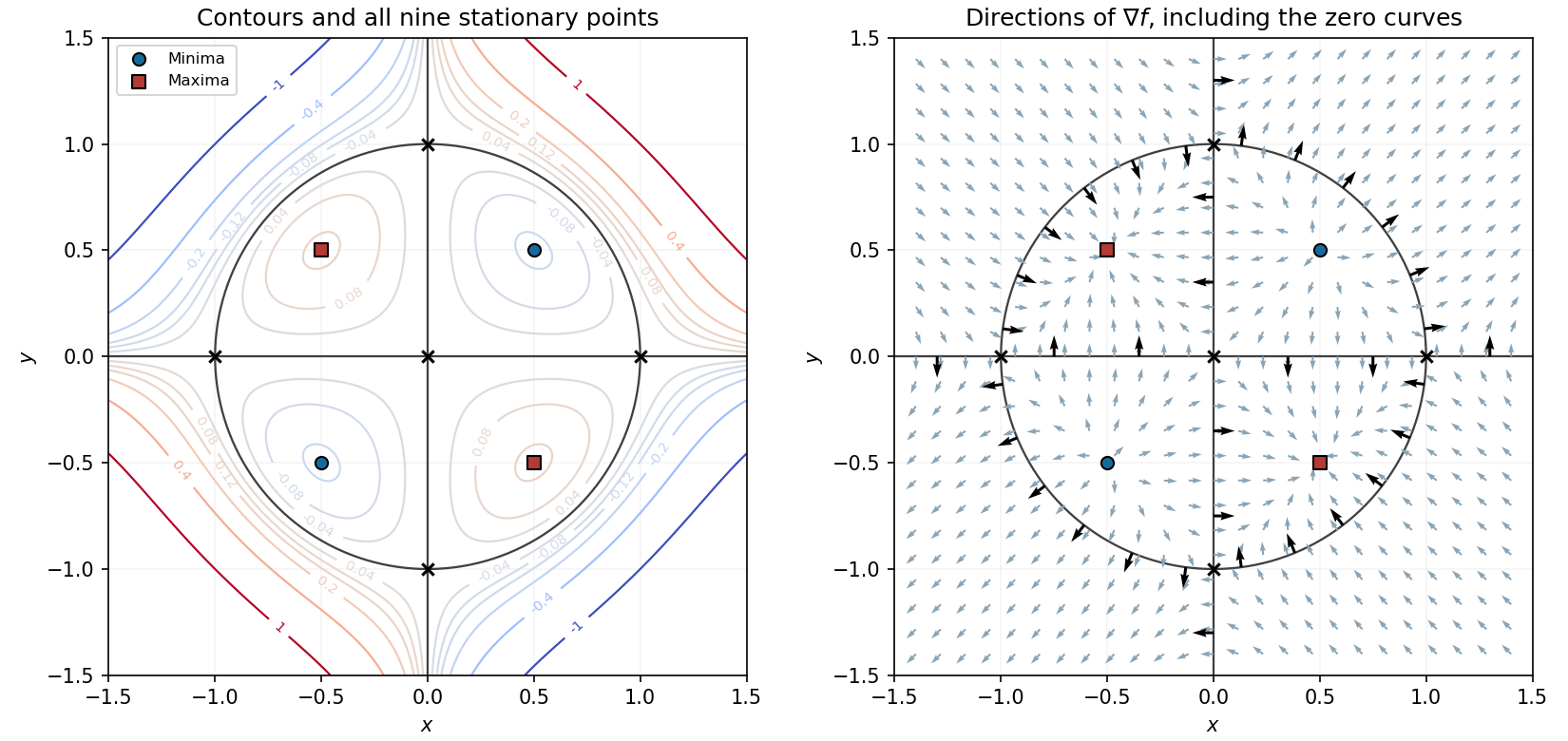

Near each local minimum, the gradient points outward; near each local maximum, it points inward. The five remaining points have saddle directions, determined by their indefinite Hessian matrices.
On the -axis the exact gradient is , and on the -axis it is . Thus arrows are perpendicular to the axes and reverse direction at the origin and the unit-axis stationary points.
On the unit circle, substitute into the gradient to obtainIt is radial outward in quadrants I and III, radial inward in quadrants II and IV, and zero at the four axis intersections. These arrows, together with the nearby saddle and extremum patterns, are shown in the right panel of the contour figure. The gradient is normal to every regular level curve and points toward increasing values of .
For , the tangent vector is and . ThusThe unequal values for the same endpoints already rule out a conservative vector field.
Put . The second coordinate is exactly , so this is the same parabola as in part (i), with a different increasing parametrization. Since runs from zero to one and , the line integral isEquivalently, substitute the original parameter to get . This demonstrates that a line integral depends on the oriented path, not on its speed of traversal.
The curl of is . Thus for it cannot be a gradient field, while for it is zero and all its vector-field potentials are constants. This zero-vector case is allowed by the question.
For the radial vector field , write . Choose a radial primitiveFor , the chain rule givesHence all vector-field potentials on a connected domain where the field is defined areThe assumed existence of the needed derivatives and integrals justifies this construction. If the domain includes the origin and the field is regular there, choose and extend the primitive there. Any two vector-field potentials differ by a constant on each connected component.
Let count successful lemon seeds. By independence it has a binomial distribution with five trials and success probability . Therefore
Take the complement of an event: fewer than two successes means zero or one. These mutually exclusive events have probabilities and . Hence
Let be the independent avocado count. There are three disjoint ways to have fewer than two total trees: no trees, only one avocado, or only one lemon. Their probabilities giveThe sum is generally a Poisson binomial distribution, rather than a single binomial distribution, because the two success probabilities may differ.
There are three possible count pairs conditional on two trees. Their probabilities, from the two independent binomial distributions, areThe first two correspond to matching kinds, so the conditional probability isThis form remains valid at endpoints whenever the conditioning event has positive probability; if the denominator vanishes, the conditional probability is undefined. As a check, when the result is , the fraction of two-element subsets containing matching kinds.
Each tree independently has ten equally likely integer yields. Of the ordered pairs, exactly sum to sixty-two. ThusThe uniform distribution on a finite set applies to the individual yields, not to their sum.
For independent seeds the probability of at least one success is . Requiring it to be at least gives . For , taking logarithms and dividing by the negative number reverses the inequality:The smallest permitted integer is thereforeThe ceiling function is necessary because seeds are counted discretely. If , no finite number suffices; if , one seed suffices. The target is interpreted as at least a ninety-five percent chance, since exact equality may not be attainable with an integer count.
On a nonconstant branch with , regard as a function of . The equation becomes the linear ordinary differential equationAn integrating factor is , givingTaking an antiderivative yields the implicit familyOn a regular branch this can also be written . The latter form loses the constant solutions , which must be restored separately.
The implicit relation is a first integral of an ordinary differential equation: along any differentiable solution of the original equation,Conversely, a differentiable graph satisfying this relation solves the original equation wherever . The original equation is undefined when ; points at which also need separate attention before solving explicitly for . This is why dividing immediately by can lose valid solutions and obscure nonuniqueness.
The initial data force , so the implicit relation factors as . Near this permits either the constant branch or the sine branch:Both satisfy the original equation, including its degenerate value at the initial point. They have different slopes there, zero and one, so the initial value problem is not unique. There are no further differentiable local branches through that point: away from the two factors cannot switch, and joining the two different branches at zero would give unequal one-sided derivatives.
Again . Since the initial sine is nonzero, the local branch must satisfy . Selecting the inverse-sine branch through givesThis passes through the specified point and has , which verifies the original equation on this interval.
Here as well, but the branch through is the other inverse-sine branch:Its derivative is , and both the sign of and the original equation agree with this choice.
The characteristic equation of the associated homogeneous linear differential equation is . A constant particular integral is , soThe first boundary condition gives . The second gives . Eliminating yields , hence and . Therefore
Use cylindrical radius . The upper cone is and the lower elliptic paraboloid is , both with . They meet along the unit circle in . The enclosed solid isThus the coordinate ranges on the complete surface areThese separate ranges do not mean every point of their Cartesian product lies on the surface. A vertical cross-section has a straight upper cone profile and a curved lower paraboloid profile.
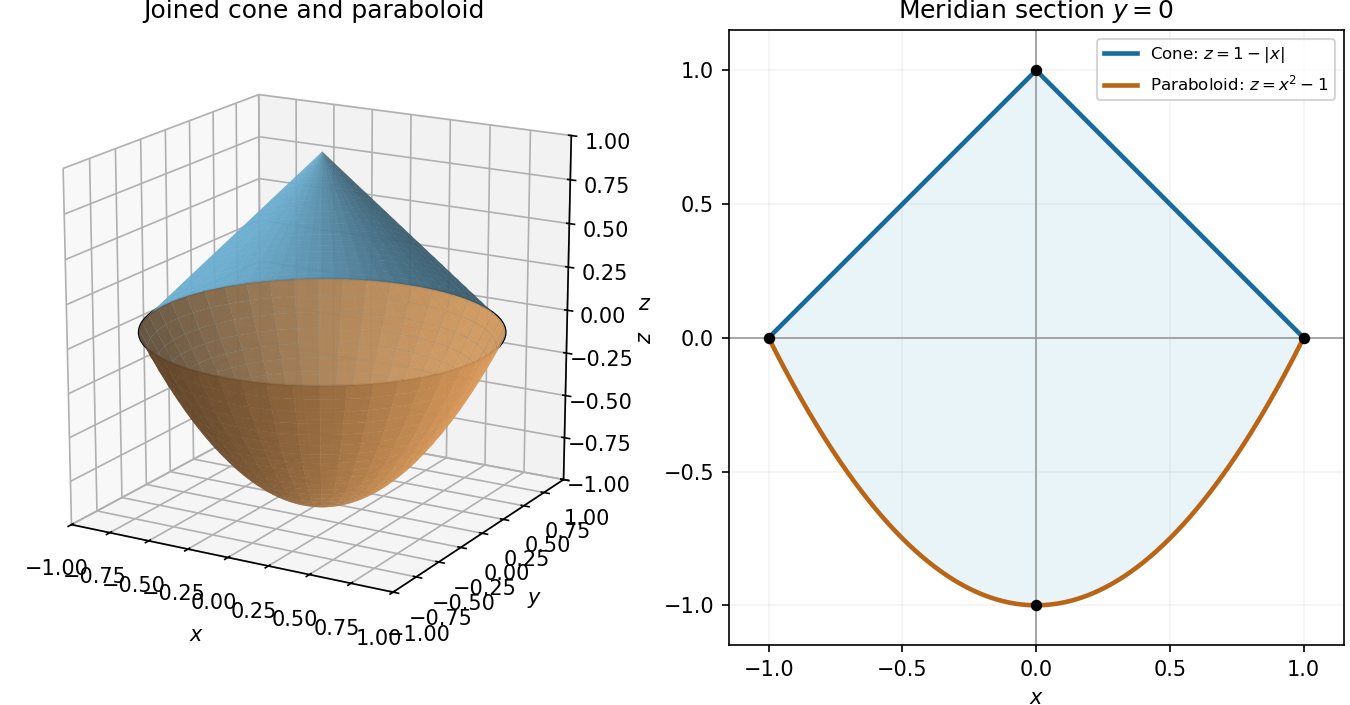

Both patches project onto the unit disk in the -plane. Their outward oriented surface elements areThe cone's apex has zero area and does not affect the surface integral. For , the vector field is , soThe terms involving vanish by reflection symmetry of the disk. Thus the total outward flux isThis calculation evaluates the two surface integrals directly.
For , the vector field is . On the cone,The first term has zero integral by symmetry. Using polar coordinates for the remaining double integral givesOn the paraboloid ,Again the term cancels by symmetry, givingTherefore direct surface integral yieldsNo separate disk at is included: that rim joins the two surfaces and is not an additional face of the closed boundary.
The displayed matrix is not orthogonal: its first column has squared Euclidean norm three, whereas every column of an orthogonal matrix must have squared length one.
For the general assertion, put . In the Einstein summation convention, orthogonality gives and . The entries of satisfyThis is exactly , proving that the matrix product is orthogonal. The Kronecker delta contracts the two middle indices without changing the multiplication order of the matrices.
For , the matrix is invertible, so there is exactly one solution. To exhibit it, subtract the first linear equation from the third to obtain , then subtract twice the second from the first to obtain . Back-substitution givesAt , the first and third linear equations have identical left-hand sides but right-hand sides one and three, so there is no solution.
Articles were limited to the first 100 out of 124 total.
Articles by others on the same topic
There are currently no matching articles.