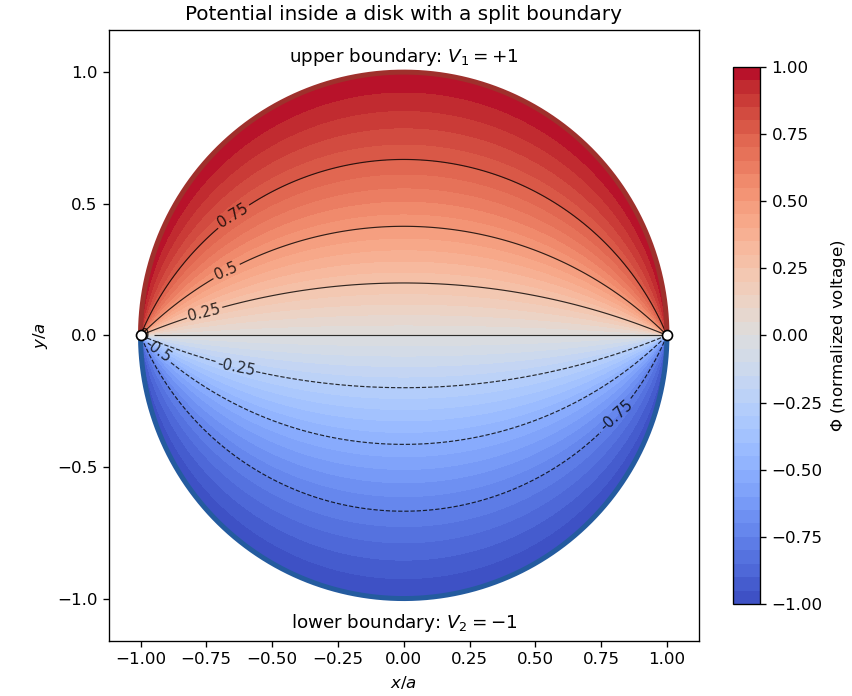
For Laplace's equation in polar coordinates, put . Separation of variables gives and . Periodicity selects integers . For , the radial solutions are ; for , they are , while a term linear in is excluded by periodicity. Their superposition isInside the disk, boundedness at the origin removes the logarithm and all negative powers. The separately biased semicircular boundary values have mean , no nonconstant cosine coefficients, and sine coefficients for odd , zero for even . The disk potential with two semicircular boundary values is thereforePut . The odd logarithmic series sums to . The quotient has positive real part for , so its argument is the principal arctangent of . Taking imaginary parts givesThe boundary limits away from the two voltage jumps are . Along the diameter through a jump the value is the mean; incompatible adjacent boundary limits prevent a continuous extension at the junctions.

Articles by others on the same topic
There are currently no matching articles.