In Cartesian coordinates, . For orthogonal coordinates, let be the position, the scale factors of orthogonal coordinates, and the corresponding unit vectors. Since and , comparison of independent increments gives the gradient in orthogonal coordinates:For the hyperbolic parametrization of oblate spheroidal coordinates, the three coordinate tangent vectors areTheir pairwise dot products are zero. Their squared Euclidean norms are , , and , respectively. Thus the coordinate surfaces meet orthogonally wherever this is a regular coordinate chart, andThe last expression uses the usual latitude range ; without that range a scale factor is its absolute value. Axial or ring degeneracies are excluded from a regular chart.
Separation of variables in the wave equation with fixed endpoints selects and angular frequencies , . The time factors may be chosen as , . By Fourier sine series orthogonality, the initial data giveHence . The factor in is required because differentiating the time sine supplies .
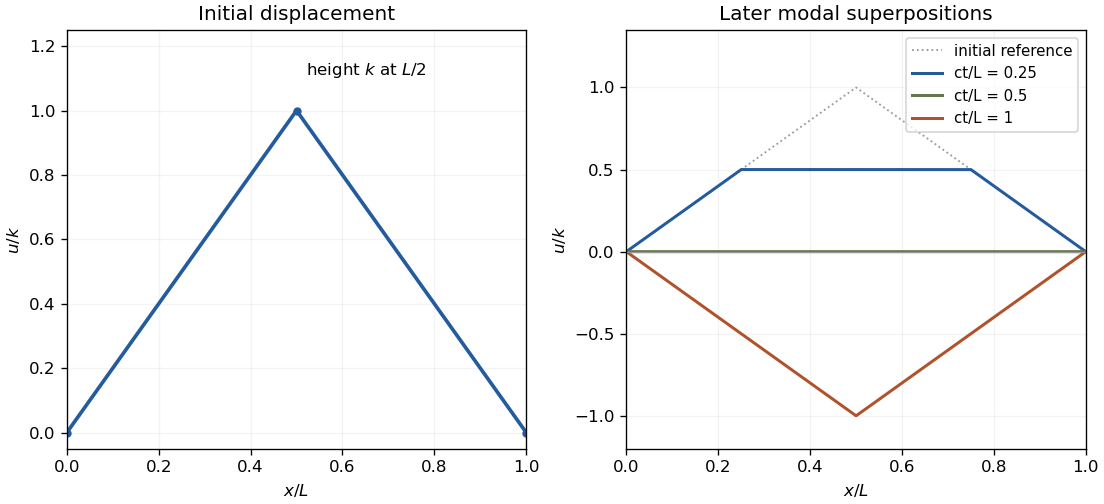
The given displacement is a symmetric triangular tent: it is zero at both endpoints and has height at . Integrating each linear half gives . Release from rest gives , so the midpoint-plucked fixed-end string isOnly odd modes occur, by symmetry about the midpoint. The initial slope corner makes this a finite-energy weak solution; it is a classical solution away from the propagating corner lines.

With the stated angular-frequency convention, the inverse Fourier transform is . Direct integration gives . For , integration by parts has zero boundary terms and gives . ThereforeThis also follows from the Fourier transform of a polynomial multiple, since multiplication by corresponds to .
To prove Parseval's identity, substitute the inverse transform of into . Under the assumed integrability, Fubini's theorem permits interchange, and the inner integral is . HenceApply this with . The spatial Gamma integral is . The transformed squared modulus is , giving the scaled even rational Parseval integral
Decompose . The rank-one matrix update acts as multiplication by along and as zero on its orthogonal complement. ThusThe perpendicular eigenvalue has multiplicity and is absent when . Consequently is always an invertible matrix, while
Put and choose an oriented orthonormal basis with third vector . The Levi-Civita symbol term has action , the negative of . Thus this axisymmetric linear map has block formThe transverse eigenvalues are not real. The only real eigenvalue and its eigenvectors are thereforeThe determinants are and , proving that is always invertible, and is invertible exactly when . The complex transverse pair is important for this determinant even though the question asks for real eigenvalues.
A matrix is diagonalizable if some invertible makes diagonal, equivalently if it has a basis of eigenvectors. If and for , then , so every eigenvalue is zero. There is at least one zero eigenvalue: otherwise and hence would be invertible. A diagonalizable nilpotent matrix has an all-zero diagonal form and therefore is zero itself.
For the specified matrices, direct determinant expansion givesThe Cayley-Hamilton theorem gives . Its entry is nonzero for every real , so is not diagonalizable for any . The matrix has three distinct real eigenvalues and is therefore diagonalizable over . For an explicit check, take columns , , in ; then .
For the normalized second-order equation , an ordinary point has analytic . A regular singular point is a singular point where and extend analytically through . The two finite singular points here are and . At zero, the respective limiting coefficients are ; at , they are . Thus both are regular singular points, with indicial roots and , respectively.
Use the Frobenius method and write , , with coefficients at negative indices defined as zero. The lowest power gives the indicial equation , so or . Equating the coefficient of gives, for ,For and , the first coefficients are . For they are , multiplying . The distinct nonintegrally separated indicial roots give two independent Frobenius series. The half-power solution is a generalized power series, rather than an ordinary Taylor series at zero.
The coefficients in the Taylor series areFor either series, the ratio test gives absolute term ratio or , tending to zero for each fixed real or complex . Both have infinite radius of convergence.
Substituting into the recurrence, and into the recurrence, satisfies every coefficient equation. They give and . Thus on a positive interval not crossing a singular point,Their Wronskian is , nonzero for , , proving independence on each ordinary interval. Both functions are analytic near , so this is an apparent regular singular point: a pole in normalized coefficients need not force a singular solution. The Wronskian can vanish at that singular point without making the two functions linearly dependent on an ordinary interval.
Multiply the original equation by . Since , it becomes with , . This is Sturm-Liouville form. For two real eigenfunctions, multiply the equation for by , subtract the equation for multiplied by , and integrate. The Lagrange identity for a Sturm-Liouville operator givesEach separated homogeneous boundary condition makes the corresponding determinant zero, provided its pair of coefficients is not both zero. For distinct eigenvalues, this proves the orthogonality of Sturm-Liouville eigenfunctions.
For the constant drift, the drift-removing substitution for a Dirichlet Sturm-Liouville problem is . It reduces the equation to with . Nonzero solutions occur exactly atThe zero and negative values give only the zero solution under both endpoint conditions. The self-adjoint expression is . Hence the weight is , and for the displayed normalization,
For the zero initial data, the Green function of an undamped oscillator is for , and zero for . It is continuous at the source and its first derivative jumps by one. The resulting convolution isIt vanishes together with its first derivative at zero and has the required resonant forcing.
For the two-endpoint problem, write , , and . This covers both signs of the supplied nonzero . Left and right homogeneous solutions are and , with Wronskian . The Dirichlet Green function is thereforeIts endpoint values are zero and its first derivative jumps by one. Here , so the denominator does not vanish. Integrating the constant forcing givesEquivalently . The negative interior response is consistent with the negative kernel for this short Dirichlet interval.
Apply the Euler-Lagrange equation to the integrand of , namely . With fixed zero endpoint values, it gives . Multiplying by and using integration by parts gives , so each stationary Rayleigh quotient equals its eigenvalue.
In the half-line problem, , , , so the quotient is . For , , its numerator is and denominator . Hence , minimized at :For the compactly supported linear trial, , the numerator is and denominator . Thus , minimized at , givingThe derivative jump at the cutoff is allowed in the quadratic-form trial space of the Rayleigh-Ritz method: the trial is continuous and has finite form energy.
The exponential ground state of a linearly weighted Sturm-Liouville problem proves which estimate is best. Vanishing endpoint terms giveEquality occurs for , which also satisfies the differential equation with . Thus the exponential trial gives the exact smallest eigenvalue, whereas the linear trial gives a larger upper bound. Finiteness at the singular endpoint supplies the regular branch with ; all the displayed trials have the required vanishing boundary terms.
For fixed endpoint values, stationarity requires the Euler-Lagrange equation . Differentiate along an extremal: its derivative is . Thus when the Beltrami identity makes that quantity constant.
Take as depth measured downward. Conservation of energy from rest gives , hence speed . With arc length , the travel time is . For , the Beltrami quantity is . Thus .
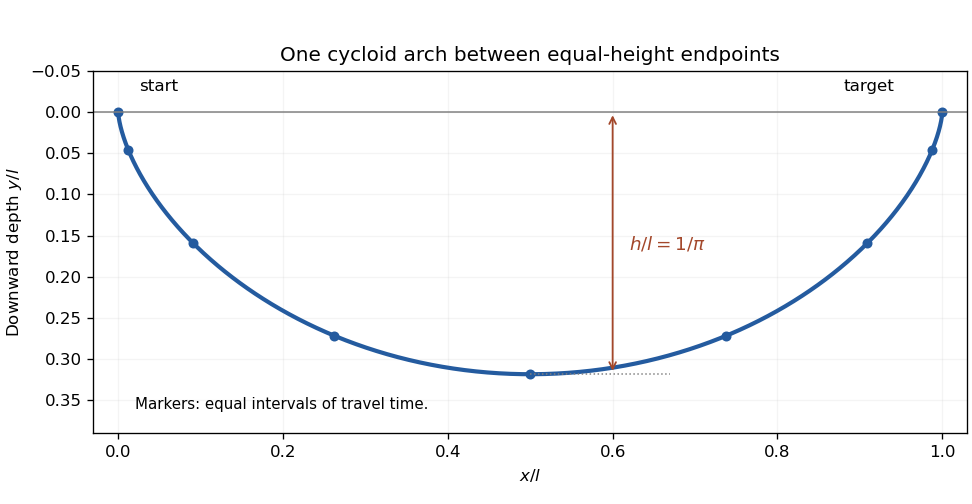
Put and take along the first arch. Since , one obtains . Integrating from the initial cusp gives the cycloid solving the brachistochrone problem:For the equal-height target, the first complete arch has , so . Also and for . ThereforeThe endpoint zeros of speed cancel the zeros of , leaving finite travel time. Global minimality follows from the maximum-depth bound for a brachistochrone: any competing track with maximum depth satisfies . The displayed cycloid attains both inequalities with .

Choose the Green function convention , with decay at infinity and no extra singularities. For sufficiently decaying source data,Away from its source, this fundamental solution of the Laplace equation is harmonic. Its radial derivative is , so the flux of its gradient through a small source-centred sphere is one. The divergence theorem therefore supplies exactly the unit Dirac delta function required by the equation. Decay at infinity excludes an added globally regular harmonic term.
For the half-space, reflect the source to . The method of images gives the zero-boundary Dirichlet Green functionThe two distances coincide at , and also cancel if the source lies on the plane. The image singularity lies outside the physical domain.
The sign conventions for a Dirichlet Green function require care here. With , Green's second identity gives . At this wall the outward normal is , so . Direct differentiation gives , where . Thus the printed intermediate formula with needs a minus sign for its stated Green convention. The final Poisson kernel for the upper half-space is positive:Its boundary integral is one for constant data, providing an independent sign check.
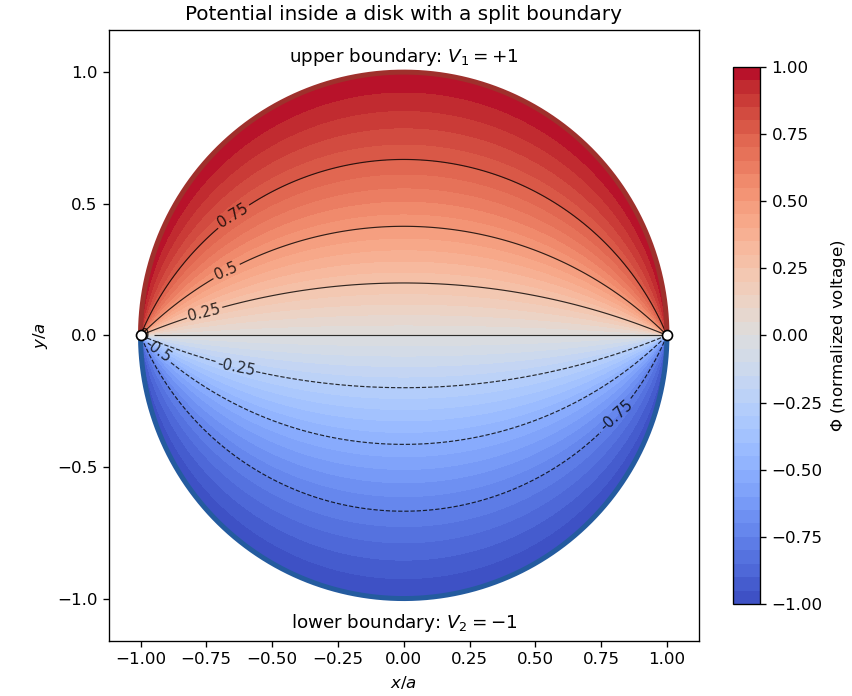
For Laplace's equation in polar coordinates, put . Separation of variables gives and . Periodicity selects integers . For , the radial solutions are ; for , they are , while a term linear in is excluded by periodicity. Their superposition isInside the disk, boundedness at the origin removes the logarithm and all negative powers. The separately biased semicircular boundary values have mean , no nonconstant cosine coefficients, and sine coefficients for odd , zero for even . The disk potential with two semicircular boundary values is thereforePut . The odd logarithmic series sums to . The quotient has positive real part for , so its argument is the principal arctangent of . Taking imaginary parts givesThe boundary limits away from the two voltage jumps are . Along the diameter through a jump the value is the mean; incompatible adjacent boundary limits prevent a continuous extension at the junctions.

The denominator factors as and neither factor cancels with the numerator. Thus there are simple poles at . At infinity the quotient tends to one and has a regular expansion in , so it has a removable singularity at infinity, with extended value one.
The numerator is nonzero at and , so the finite singularities are a pole of order three at and a pole of order two at . The numerator degree exceeds the denominator degree by three, with leading behaviour . Hence infinity is a pole of order three.
There are logarithmic branch points at and infinity. At zero, every local branch has , so division by gives a pole of order two at zero. Decay at infinity does not remove its branching: with , the function is , which changes branch when encircles zero.
A holomorphic function is complex differentiable throughout an open region; equivalently it is locally represented by a convergent complex power series. For , the Cauchy-Riemann equations are , . With continuous first partial derivatives, these equations imply holomorphicity and .
The Cauchy-Riemann equations give , . Integrating and matching both derivatives gives the harmonic conjugateThe real part of this polynomial is exactly the required .
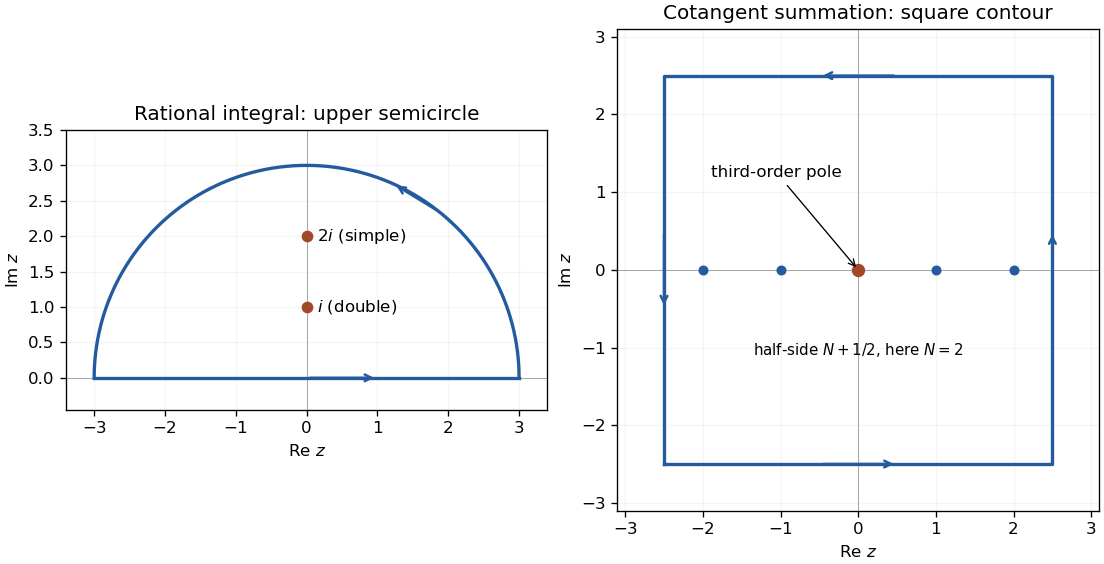
For a pole of order at , the residue is . For the rational integral, close the real-axis contour with an upper semicircle. The poles are double at and simple at , withThe arc integral vanishes as . By the residue theorem the whole real-axis integral is , and evenness givesFor the second calculation, reciprocal expansion of the sine gives . Multiplying by yields . ThereforeAt every nonzero integer , has a simple pole with residue one, giving residue after division by .
The cotangent contour summation uses the positively oriented square of half-side . Its length is and on its boundary. The supplied cotangent bound implies . Its enclosed residues sum to . The residue theorem therefore proves the Basel problem value

The one-sided Laplace transform is . Its Bromwich inversion formula is , with an upward vertical contour to the right of all singularities and within the appropriate convergence half-plane.
To derive the convolution theorem for Laplace transforms, transform . With , the triangular integration region becomes a quadrant. Fubini's theorem gives , under the usual absolute convergence hypotheses. Inversion gives the required convolution formula.
For the differential equation, the transformed initial conditions give , hence . Since for , the convolution yieldsThe integral and its first derivative vanish at zero, so the homogeneous term supplies both initial values. Differentiating twice gives the forcing through the unit derivative of the hyperbolic-sine kernel at zero.
For a Cartesian tensor under a proper orthogonal change , the rank- law is , with repeated indices summed. An isotropic tensor has for every such rotation.
For rank two, . A half-turn about a coordinate axis, obtained by applying a quarter-turn twice, reverses each off-diagonal component with exactly one index on that axis. Invariance forces every off-diagonal entry to vanish. A quarter-turn about the third axis exchanges and ; quarter-turns about the other axes equate them with . Thus the isotropic second-rank tensor isConversely , proving sufficiency.
The unique symmetric and antisymmetric decomposition is , . Both pieces are Cartesian tensors: transposing gives , so and . Hence this is a decomposition into a symmetric tensor and an antisymmetric second-rank tensor, rather than just a decomposition of numerical arrays.
For the axial vector of an antisymmetric second-rank tensor, contract the two Levi-Civita symbols:ThusWith this convention , so the displayed matrix is the negative of the cross-product matrix for .
For proper rotations the Levi-Civita symbol is invariant, so contracting the two rank-one tensors and gives with transformation . Thus the curl is a vector under proper rotations. Under an orientation-reversing orthogonal change it acquires an additional determinant sign: it is an axial vector when is a polar vector.
Commuting smooth partial derivatives and using epsilon contraction gives the curl of the curl identity:Now take the curl of Faraday's law and use the vacuum Ampère-Maxwell equation: . Since , the identity gives . Taking the curl of the Ampère-Maxwell equation gives the same result for , using . Hence both satisfy the electromagnetic wave equation
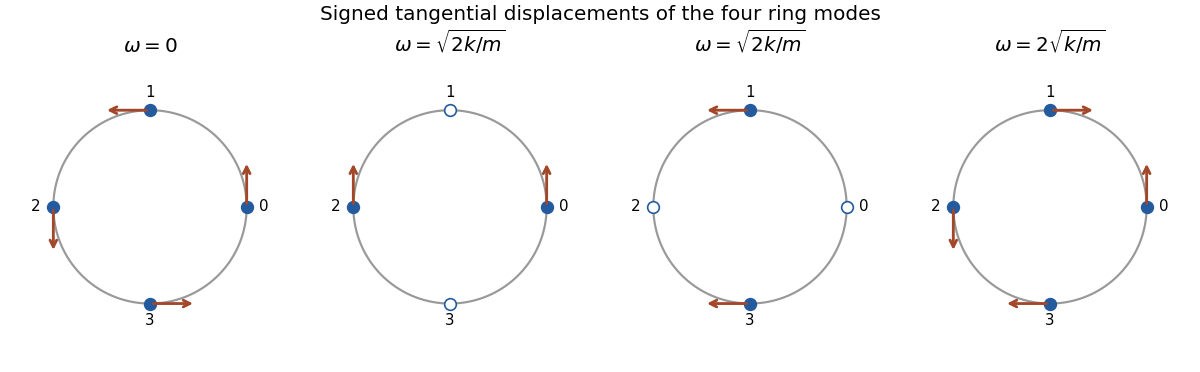
For small oscillations with quadratic kinetic and potential energies, a normal mode has a fixed spatial amplitude pattern and one angular normal frequency. Its amplitude is a normal coordinate; choosing all modes diagonalizes the two quadratic forms and decouples their equations. A zero frequency describes a free symmetry motion.
Let be the small signed arc displacements, with cyclic indices . The springs follow arcs, so their extensions are . The Lagrangian of the normal modes of a four-bead spring ring isThe stiffness matrix divided by is the cycle graph Laplacian, with diagonal entries two, adjacent entries minus one, and zero opposite entries. An orthonormal basis of mode vectors and their frequencies isThe normal mode coordinates are , with equations . The zero mode rotates all beads together without stretching a spring and has . In each of the two degenerate middle modes, opposite beads have opposite signed arc displacements while the other pair remains stationary. Any fixed linear combination is another mode of that frequency. The last mode alternates the signed displacement of adjacent beads. The radius cancels from the frequencies because arc length supplies the same factor to the angular kinetic and spring energies.

A group has a closed binary operation, associativity, an identity, and an inverse for each element. For a finite group, Lagrange's theorem states for each subgroup , so divides .
The order of a group element is the least positive with , or infinity if none exists. In a finite group the powers form the cyclic subgroup of that order; Lagrange's theorem proves . If is prime and , its order must be . Thus generates the whole group, proving .
If every nonidentity element has order two, every element is its own inverse. Then . This proves that a group of exponent two is abelian.
In a group of order six, element orders divide six. If there were no element of order three or six, every nonidentity element would have order two, making the group abelian by the preceding argument. Choose and . Then is a subgroup of order four: its elements are distinct, it is closed because commute and square to , and each element is its own inverse. This contradicts Lagrange's theorem, since four does not divide six. Hence an element of order three or six exists.
Suppose have order three but . Their cyclic subgroups have trivial intersection: any common nonidentity element would generate both subgroups and force or . The nine products , , are distinct. Indeed implies in that intersection, so and modulo three. Nine distinct elements cannot fit in a group of order six, proving the claim without assuming commutativity.
If an element has order six, it generates , so . Otherwise choose an element of order three. The preceding result excludes any further order-three elements outside , and there are no elements of order six by assumption. Each of the other three elements must therefore have order two. ThusThe noncyclic case is the symmetric group on three points, as the classification of a group of order six further identifies.
A normal subgroup satisfies for every . A group homomorphism preserves multiplication, . It follows that and .
The kernel of a group homomorphism contains the identity and satisfies for , so is a subgroup. For , . Thus , and applying the same inclusion to gives equality. Hence the kernel is a normal subgroup.
The product is a Vandermonde determinant up to a fixed overall sign. A transposition exchanging reverses their mutual factor. Every other factor involving one of these variables is paired with the corresponding factor involving the other; those paired products are unchanged. ThereforeIf a permutation has decompositions into and transpositions, they act as and . This polynomial is nonzero, for example at pairwise distinct real inputs, so the signs must agree. Thus all decompositions have the same parity, and an even decomposition forces every decomposition to be even. This defines the sign of a permutation; its kernel is the alternating group, linking the parity argument to the normal-kernel result above.
An invariant subspace satisfies for every ; applying the inverse gives equality. The representation is irreducible when the only invariant subspaces are and the full space.
The inverse and conjugate transpose each reverse multiplication order, so their combination preserves it:Its values are invertible, so this is the conjugate contragredient representation.
If is invariant under , take and . For the standard Hermitian inner product,since . Hence , proving its invariance. If is irreducible, is either zero or the whole space; finite-dimensional orthogonal complementation makes the whole space or zero, respectively. Thus is irreducible whenever is irreducible.
Articles by others on the same topic
There are currently no matching articles.