The residue theorem states that the contour integral of a meromorphic function around a positively oriented simple closed contour equals times the sum of its enclosed residues, provided there are no singularities on the contour. The roots of are , . They are simple poles, with residues .
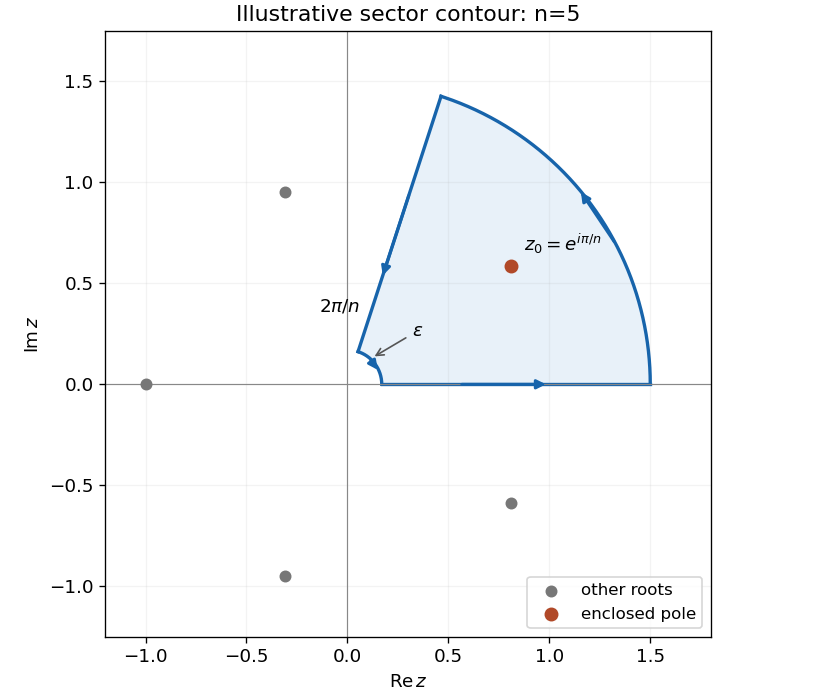
Use the sector contour of angle , running outward along the positive axis and inward along the rotated ray. It encloses only . The large-arc contribution is , hence vanishes. With , the two ray contributions giveSince ,For the second integral, use on a branch continuous across the sector away from zero, with a small inner arc of radius . Its large arc is and its small arc is , both vanishing for . On the rotated ray, changes by , so the two radial contributions add rather than subtract. The enclosed residue is . ConsequentlyBoth answers are instances of the Mellin integral of a reciprocal binomial. The direct contour argument also tracks the branch needed when is odd.

Articles by others on the same topic
There are currently no matching articles.