Write . A radial function harmonic away from the source satisfies , hence . Decay at infinity forces . Integrating over a small sphere, the divergence theorem requires flux one:Therefore the fundamental solution in this sign convention isAdding point sources outside the domain changes only a harmonic function inside it. The method of images selects their positions and strengths to cancel boundary values. The sign reverses for the alternative convention .
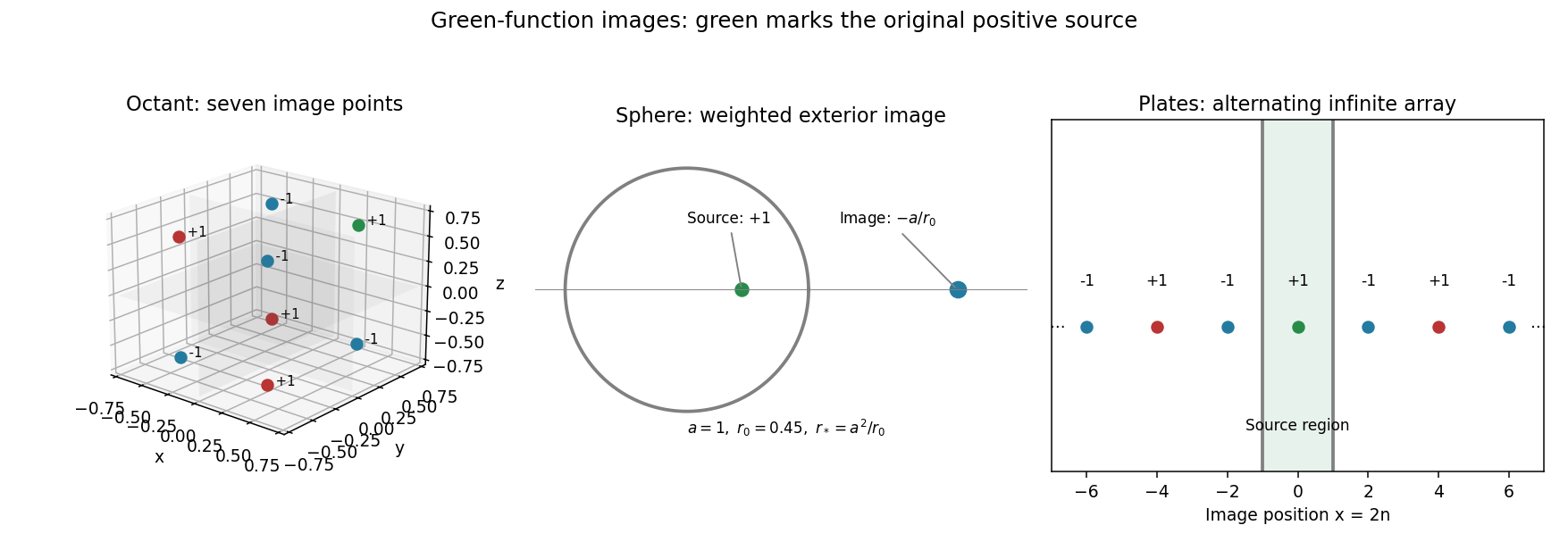
Let the source be with all three coordinates positive. Reflect it independently in the three coordinate planes: the eight points are , with . Assign strength . ThenThe all-positive point is the original source. On any boundary plane, two terms differing only in that plane's sign have equal distances and opposite strengths, so cancel. All seven additional points lie outside the positive octant, leaving exactly the required interior source. This is the octant Dirichlet Green function.
Let with . The Dirichlet Green function inside a sphere uses the exterior inverse point and strength . ThusFor , the distance identity makes the bracket zero. The image is outside the sphere, so it adds no interior singularity. This is the radial weight associated with the Kelvin transform.
The printed unit-strength restriction must be relaxed in this part: the required single image has strength , whose magnitude is generally not one. A reflected unit charge does not give the spherical boundary cancellation. For a centered source, the limiting formula isIts correcting term is constant and corresponds to the weighted image moving to infinity, rather than a finite unit point image.
Take the source at the origin and write . Repeated reflection in places the sources at with strengths , . There are countably infinitely many images; is the original source. A convergent prescription groups adjacent opposite charges:Each bracket is on compact sets away from the source, so the paired series converges absolutely. The individual unsigned point-charge terms would not be absolutely summable. On , reflection pairs the index with ; on , it pairs with . Their distances agree and signs oppose. Symmetric finite cutoffs leave only a vanishing far-tail contribution, proving both zero boundary values. All nonzero-index sources lie outside the slab. This is the centered-source version of the Dirichlet Green function between parallel planes, selected to decay at large transverse distance.

Articles by others on the same topic
There are currently no matching articles.