The rational factors give four simple poles at ; none is canceled by the numerator. The square root has branch points at , with local behaviour proportional to in the integrand.
For this part, choose analytic off and satisfying at infinity. Its values are for , for , andThus the chosen branch cut is , and the function is analytic elsewhere apart from the four poles. Infinity is not an intrinsic branch point: on this branch.
Another legitimate convention applies the positive-axis square root of part (a) to ; it places the cuts on and . Its upper-half-plane values agree with the branch used here, so the contour calculation below and the positive real square root in the required integral are unchanged. The branch choice must be stated because a square root alone does not specify a single-valued complex function.
Use the branch from part (i) and close the real-axis path with a large upper semicircle, indenting clockwise around and . On the segment between them, take the upper-bank value of the branch cut. This is an instance of square-root endpoint integrals by an upper-half-plane contour.
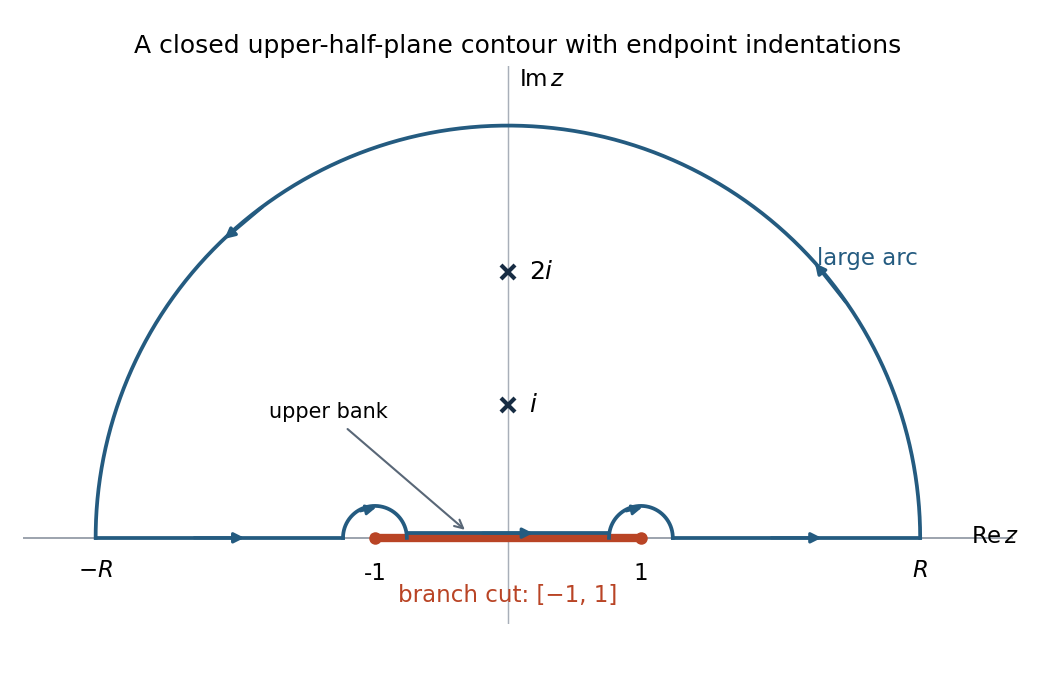
Upper-half-plane contour, clockwise endpoint indentations, and the two enclosed poles; indentation sizes are exaggerated
. Details. 
The contributions can be controlled separately. Since , the large arc contributes . Near either branch point, , so an arc of length contributes . On the upper bank of ,which is odd in , so its integral is zero. On the exterior real intervals , while the rational numerator is odd. Hence and the two exterior contributions sum to .
Articles by others on the same topic
There are currently no matching articles.