Between two barriers, region III becomes a finite intermediate well containing both right- and left-moving oscillatory components, . Repeated reflection produces standing-wave-like enhancement and quasi-bound levels with finite escape lifetimes. At resonant energies, the multiple transmitted amplitudes add constructively: an ideal symmetric lossless pair can have transmission approaching unity even when a single barrier transmits poorly. Away from resonance the pair strongly suppresses transmission.
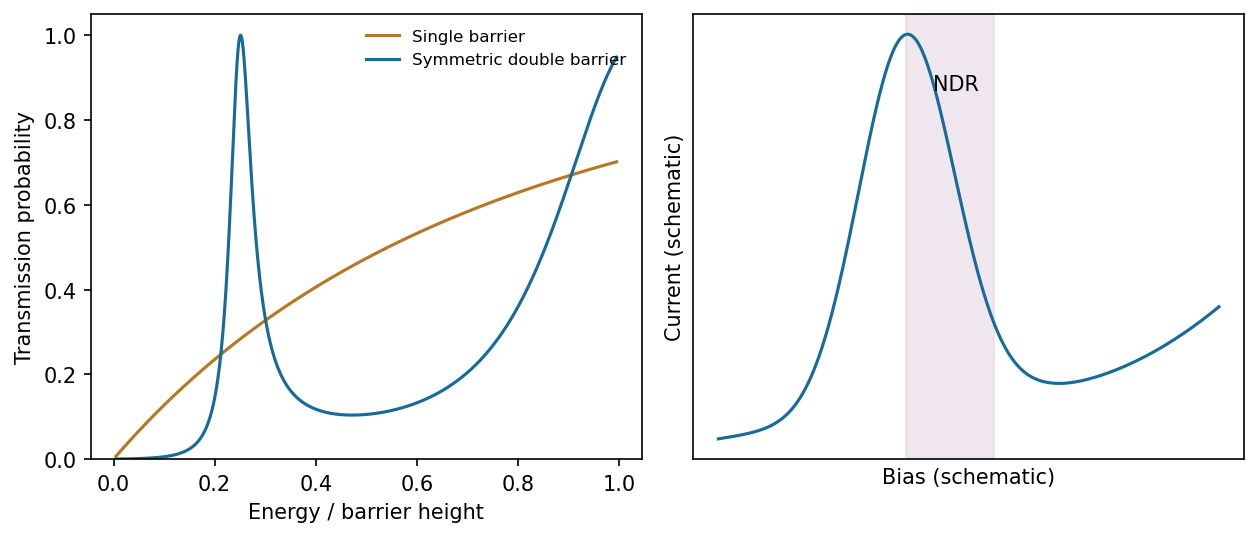
Calculated single- and double-barrier transmission and a separate qualitative resonant-tunnelling current-voltage characteristic
. Source. Details. 
A useful phase condition is , where is the intermediate-well width and the reflection phases account for penetration into the barriers. The printed figure starts the second barrier at , so its well width is ; if the prose's second-barrier position is used instead, the width is . The resonance argument is unchanged once that geometrical convention is fixed.
Articles by others on the same topic
There are currently no matching articles.