Take and equal electron mass in all regions. Define and . ThenThere is no wave incident from the far right. Region I contains oscillatory incident and reflected waves; region II is evanescent, with real exponentials rather than propagating plane waves. Both exponential terms are allowed in a finite barrier; deleting the growing term before boundary matching is generally incorrect. A complex superposition in the barrier can carry a nonzero conserved tunnelling current.
For a finite potential step and constant mass, and are continuous. A finite jump of would require a delta-function contribution in the integrated equation, while a jump of would be still more singular. Matching the preceding amplitudes givesThe transmission probability is because the incident and transmitted regions have equal wave vector and mass; in unequal leads a velocity ratio is also required. These matching conditions do not apply unmodified to infinite walls, delta barriers or mass discontinuities.
Between two barriers, region III becomes a finite intermediate well containing both right- and left-moving oscillatory components, . Repeated reflection produces standing-wave-like enhancement and quasi-bound levels with finite escape lifetimes. At resonant energies, the multiple transmitted amplitudes add constructively: an ideal symmetric lossless pair can have transmission approaching unity even when a single barrier transmits poorly. Away from resonance the pair strongly suppresses transmission.
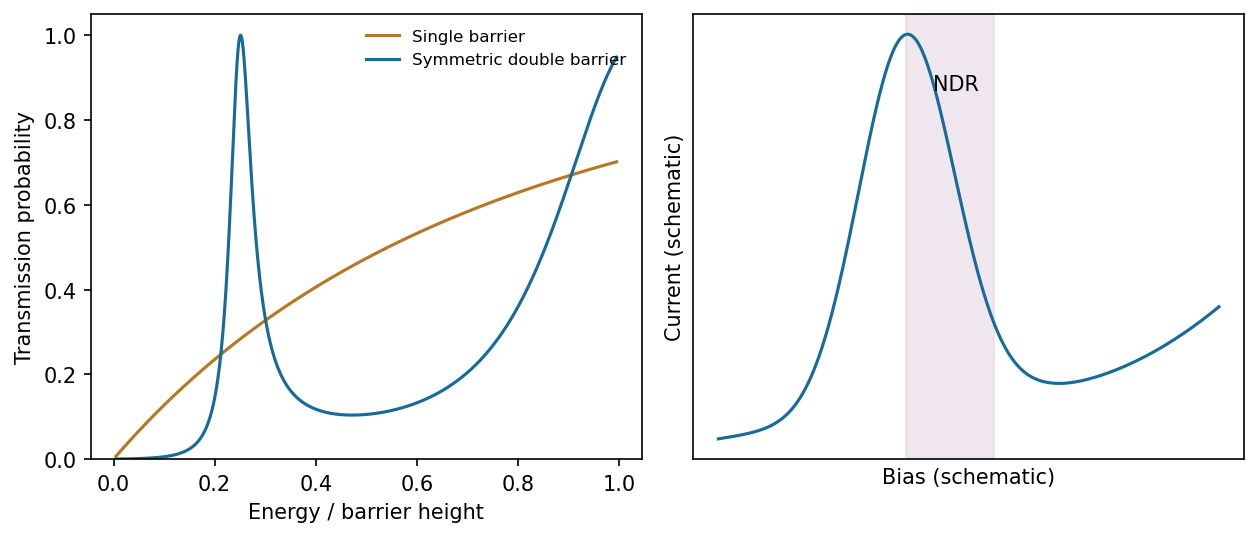
Calculated single- and double-barrier transmission and a separate qualitative resonant-tunnelling current-voltage characteristic
. Source. Details. 
A useful phase condition is , where is the intermediate-well width and the reflection phases account for penetration into the barriers. The printed figure starts the second barrier at , so its well width is ; if the prose's second-barrier position is used instead, the width is . The resonance argument is unchanged once that geometrical convention is fixed.
The intended double-barrier resonant-tunnelling diode has a bias-dependent well level. Initially increasing bias can bring a quasi-bound level into alignment with available occupied emitter states, sharply increasing current. At larger bias the resonant level moves out of the effective injection window, for example below the emitter conduction-band edge, so resonant transmission and current decrease despite increasing voltage. This produces a peak-to-valley interval with . Further bias can increase nonresonant or higher-level current again.
The right panel of the preceding figure is a qualitative example. The device can supply small-signal negative differential conductance to an appropriate oscillator circuit while its current and voltage remain positive. A bias-independent transmission function alone does not guarantee NDR: the voltage-dependent potential profile, contacts and carrier supply must be included. The source's reference to part (ii) appears to point to the earlier barrier matching; the resonant device mechanism uses the added barrier of part (iii).
Articles by others on the same topic
There are currently no matching articles.