An amphiphile has a solvent-compatible polar head and a hydrophobic tail region. The three geometrical parameters are the tail volume , effective head-group area at the interface, and maximum effective tail length . Their dimensionless combination is the amphiphile packing parameter, .
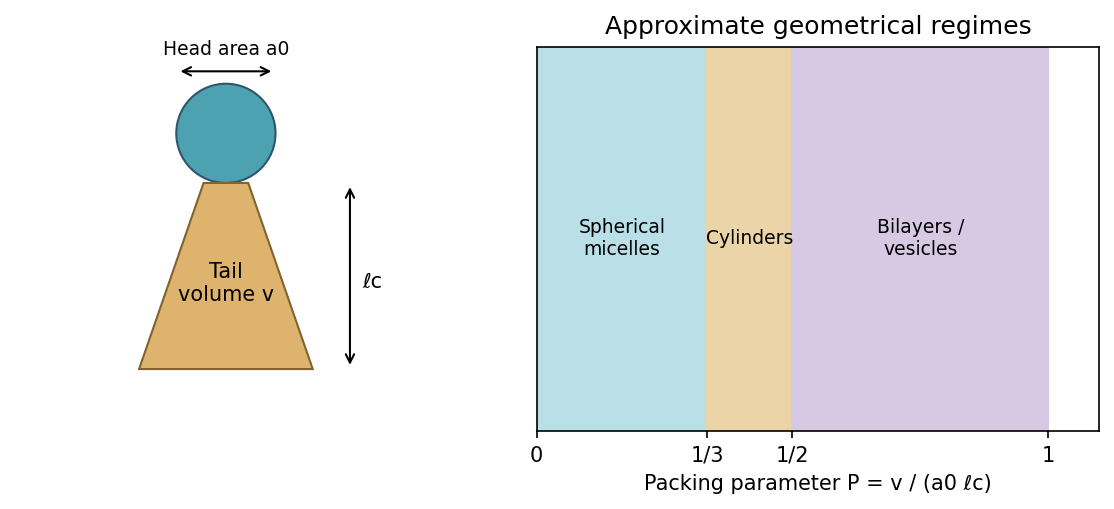

The head area is an effective interfacial area affected by solvent, electrostatic repulsion and composition; it is not simply a fixed atomic cross-section.
For ideal spherical micelles, and , giving . For a long cylindrical micelle, , so cylinders can accommodate larger packing parameters while keeping : roughly favours cylinders. Relatively small head area or greater tail volume reduces positive curvature.
For a planar bilayer leaflet of hydrophobic thickness , , with . Thus favours bilayer/vesicle structures, with nearly planar bilayers toward . The two leaflets put hydrophobic tails together and hydrophilic heads toward water. For , inverse structures become possible. These bounds are approximate packing guides; chain stretching, head interactions and aggregate free energy determine actual phase boundaries.
[ref]
Theory of self-assembly of hydrocarbon amphiphiles by Jacob N. Israelachvili and others. General micelle/bilayer geometrical packing model
Articles by others on the same topic
There are currently no matching articles.