A faceted, approximately equiaxed crystal is indicated. A truncated octahedron bounded by low-energy and facets is a plausible three-dimensional shape for an fcc metal particle; the hexagonal section alone does not uniquely distinguish it from other faceted polyhedra.
The Wulff construction minimizes at fixed particle volume. Place a plane with normal a distance from a common centre and take the inner envelope. Low-surface-energy orientations survive as large facets. Annealing permits diffusion toward this equilibrium morphology, provided the time is sufficient. For a supported or strained alloy, substrate adhesion and elastic energy modify this simple free-particle construction.
For the upper core-shell precursor, first reduce a precursor of metal A to make seeds; then introduce and reduce a precursor of B under conditions favouring heterogeneous deposition on those seeds rather than independent nucleation. Control added quantity, reduction rate and surface ligands to build a shell.
For the lower disordered-alloy precursor, reduce both metal precursors together so both metals enter the growing particles. Match their effective reduction rates by precursor chemistry, temperature, complexation or controlled feeding; otherwise sequential reduction can produce segregation instead of co-incorporation. Quenching or sufficiently mild growth can retain a disordered alloy before the later anneal. These routes need not initially produce equilibrium atomic arrangements.[ref]
Bimetallic Nanocrystals by Kyle D. Gilroy and others. Liquid-phase synthesis of core-shell and alloy architectures
Both starting arrangements converge toward the same chemically ordered alloy, exhibiting chemical ordering in alloys. This supports a lower free energy for the ordered unlike-metal neighbour pattern than for the segregated core-shell or disordered precursor at the final temperature. In a simple nearest-neighbour model, ordering is favoured whenwith consistent bond-energy conventions. Bulk mixing and ordering then compensate the loss of configurational entropy on cooling. Annealing alone does not supply numerical bond or surface energies, and elastic mismatch or adsorbed ligands can also matter.
The final morphology does not show a thick single-metal skin: the surface-energy difference is not large enough to overwhelm the bulk preference for ordering throughout the particle. Some atomic-scale surface enrichment is compatible with the drawing, so exact equality of the two surface free energies is not established.
If B has a much lower surface free energy, Surface segregation of B and an A-rich interior become favourable. A nearly continuous B shell is likely if enough B is present and the surface-energy gain exceeds the cost of disrupting favourable A-B bonds; otherwise only partial enrichment occurs.
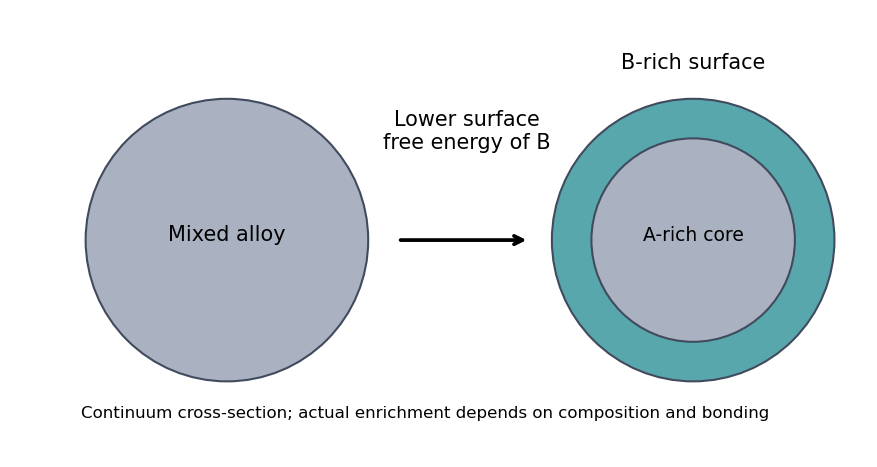
An illustrative surface-energy preference enriches the outermost layers without fixing a universal shell thickness
. Source. Details. In selective-area epitaxy, precursors supplied by metal-organic vapour-phase epitaxy incorporate on exposed crystalline InP through patterned openings in a silicon-nitride mask. Epitaxial facet-dependent incorporation and surface diffusion select axial and radial growth rates. Advantages include lithographic position and pitch control, an epitaxial orientation relationship and the absence of a foreign metal catalyst. Limitations include mask patterning, selective nucleation requirements, facet-dependent composition, loading and pitch effects, and unwanted radial growth.
In vapour-liquid-solid growth, precursors decompose and supply material to a liquid catalyst droplet; supersaturation drives precipitation at the liquid-solid interface. Droplet size can control wire diameter and enable high aspect ratios. Limitations include possible catalyst contamination, droplet stability and coarsening, composition memory at heterointerfaces, and restrictions from the catalyst phase diagram. Patterned catalyst placement can also control position, so positional ordering is not exclusive to selective-area growth. Conversely, selective-area wires are not automatically free of taper or compositional interfaces.[ref]
Efficient Green Emission from Wurtzite AlInP Nanowires by L. Gagliano and others. Selective-area growth and composition-dependent nanowire structure
The emission energies are approximatelyDraw the Al-rich interface as a wider-gap barrier between these two emitting regions: a raised conduction-band edge impedes electron transfer, and a lowered valence-band edge impedes hole transfer. The following is a consistent straddling-barrier schematic, with the shell having the smaller optical gap.
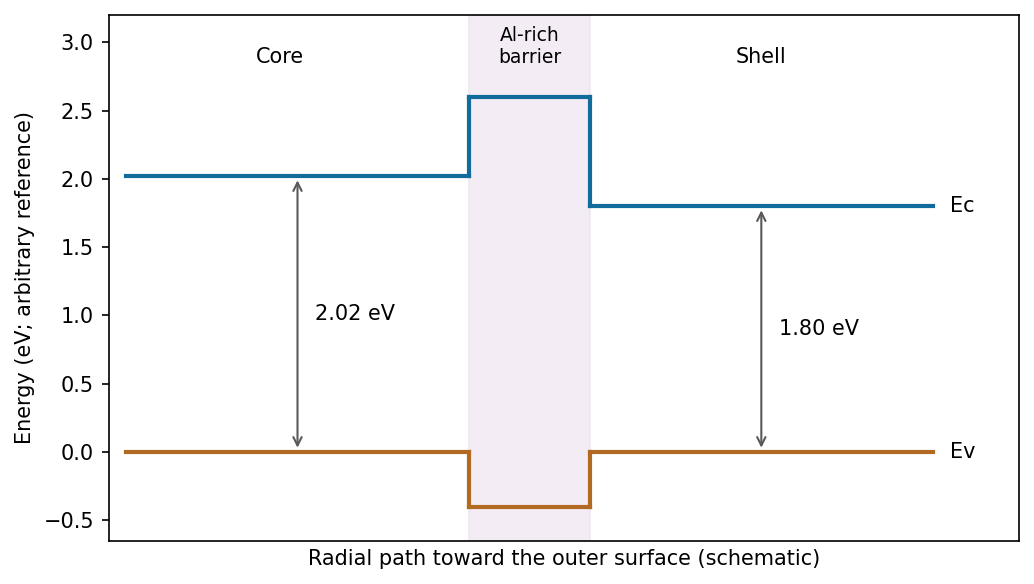
One consistent core–Al-rich-interface–shell alignment; absolute offsets are not fixed by the emission wavelengths
. Source. Details. The two emission wavelengths determine optical transition energies, not unique conduction- and valence-band offsets. Exciton binding, confinement and strain can shift emission relative to the bulk band gap. The stated barrier supports inhibited charge exchange; its separate electron and hole barrier heights need additional band-alignment data.
Place the Ag particles near the emitting shell, along the outer sidewalls or accessible shell at the base. Its emission is close to the localized surface plasmon resonance; the core emission is more detuned and farther from an externally placed particle. The plasmon near field decays with distance, so the local emitter-field overlap matters as well as spectral overlap. A thin spacer can reduce direct-contact nonradiative quenching.
These facts identify a favourable placement for enhanced interaction; they do not by themselves prove the spectroscopic strong-coupling regime, which additionally requires coherent coupling to exceed the relevant losses and normally produces resolvable mode splitting.
A physical bound-state wave function must be single-valued, finite, square-integrable and normalizable. Across a finite step in a regular potential, both and its first derivative are continuous when the particle mass is the same on either side; integrate the Schrödinger equation across an infinitesimal interval to obtain the derivative condition. The second derivative need not be continuous.
An infinite hard wall is an exception to derivative matching: the interior wave function vanishes at the boundary, but its derivative need not equal the exterior zero derivative. A delta-function potential also permits a prescribed derivative jump, and an effective-mass interface requires the appropriate mass-weighted matching condition. Thus ordinary finite-step conditions should not be asserted without qualification for every singular potential.
The wave function vanishes in regions I and III. In region II it is sinusoidal and satisfies . The time-independent equation there isA nonzero stationary state therefore has standing-wave nodes at the two walls; it cannot have a nonzero constant ground-state wave function.
For , write with . The condition at zero gives ; the condition at gives , where . The solution is identically zero and is not a state. Normalization gives . HenceChoosing positive fixes an irrelevant overall phase.
Only have . The printed squared coefficients sum to , rather than exactly one. Normalizing those numbers givesTreating the coefficients as rounded values of an already normalized state gives the intended approximately answer. Probabilities are sums of squared amplitudes because the energy eigenstates are orthonormal.
Let and . For the time-independent well,It remains zero outside the well. Each expansion coefficient acquires a phase of unit magnitude, so every energy probability, including the preceding , is time-independent. The position probability density generally changes because cross terms between different energies oscillate.
The measured energy selects . Immediately after an ideal projective measurement, the normalized state is up to an overall phase, with no surviving components. At later times before any further disturbance it is , where is the measurement time. A repeated energy measurement returns with probability one.
A spin valve contains a magnetically soft free ferromagnet, a thin nonmagnetic metallic spacer and a reference ferromagnet pinned by exchange bias from an antiferromagnet. The recording track's stray field rotates or reverses the free-layer moment while the reference remains approximately fixed. Spin-dependent scattering makes the resistance lower for parallel moments and higher for antiparallel moments. A sense current converts this into a voltage signal, or a fixed voltage into a current signal.
A useful angular approximation is . Biasing the equilibrium moments near gives an approximately linear response to small track fields. Pinning stability, magnetic shielding and the sensor's spatial extent matter for reading adjacent narrow bits.[ref]
For collinear saturated layers, , where . Thus parallel states have and , whereas antiparallel states have and . The free layer switches in the smaller-field interval; the reference layer switches only at larger fields and its loop is shifted by exchange bias.
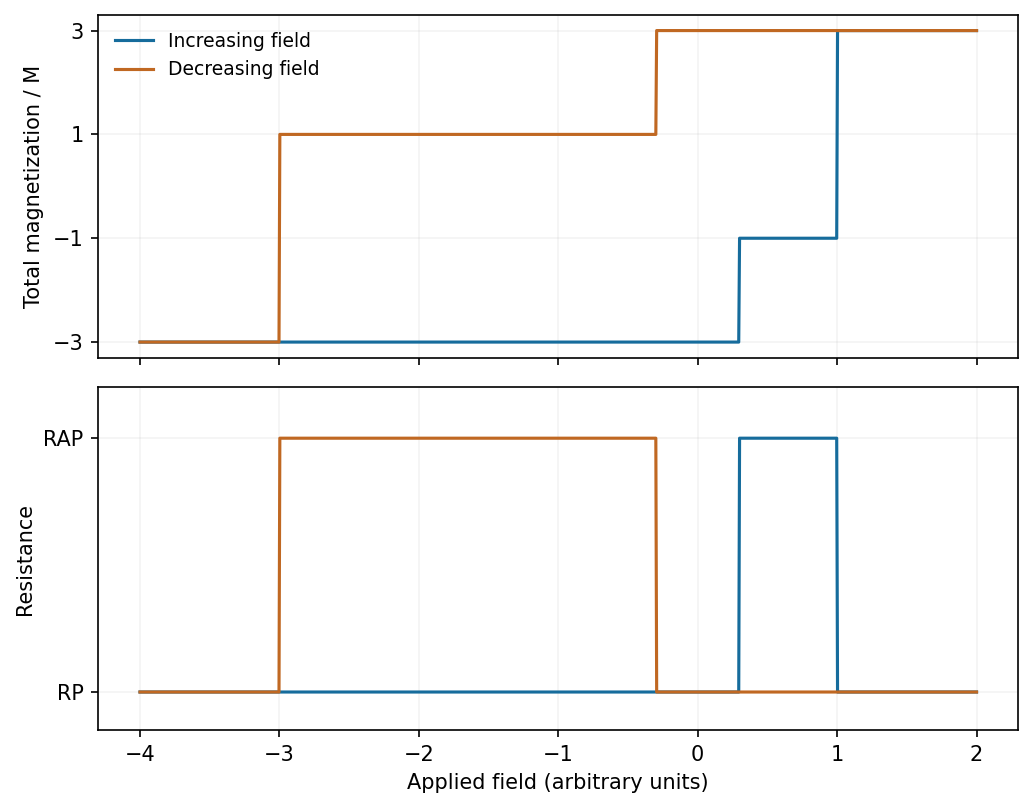
Illustrative major magnetization and resistance loops, with an exchange-shifted reference-layer reversal
. Source. Details. The plotted switching fields are illustrative rather than supplied measurements. In the normal read-head minor-loop range, the reference stays positive and only the pair is sampled. Rotational reversal and domain formation can round these ideal abrupt steps.
Spin-valve read-head noise limits the field-to-electrical response: sensitivity is a response relative to noise, not merely a large total resistance. A small free-layer volume gives larger thermally driven angular fluctuations and can lose magnetic stability when its anisotropy barrier is insufficient compared with . Edge damage, stray coupling to the reference layer, nonuniform domains and Barkhausen jumps cause hysteresis and noise. Johnson noise and low-frequency resistance noise compete with a limited GMR signal; raising sense current is restricted by heating and current-induced disturbance.
One useful design combines a single-domain, gently biased free layer with a flux-compensated synthetic-antiferromagnetic reference. This reduces reference stray fields, suppresses unstable domain switching and holds the free layer near a linear operating point. The active sensing width can remain small while magnetic and electrical design preserve adequate stability and signal. An alternative is a magnetic tunnel junction with an optimized barrier, giving a larger magnetoresistance signal; its resistance-area product, shot noise and barrier reliability still require optimization. Shrinking every magnetic dimension indefinitely is not a sensitivity improvement.
[ref]
Giant room-temperature magnetoresistance in Fe-MgO-Fe junctions by Shinji Yuasa and others. Demonstration of large tunnel magnetoresistance with a crystalline MgO barrier
Negligible rail resistance makes all left-hand groove ends equipotential and all right-hand ends equipotential. The equal hydraulic resistances therefore connect in parallel:Here uses the total inlet flow. The two blind rail ends carry no flow beyond their final grooves.
For a triangular resistance network with edge resistances , replacing it by a star gives the arm at each terminal as the product of its two adjacent triangle resistances divided by . This Delta-star transformation preserves the pressure-flow relation at all three terminals, just as in a linear electrical network.
Apply it recursively to the two-rail ladder. Represent the first grooves by a three-terminal star with arms leading respectively to the fixed inlet, frontier of the left rail and frontier of the right rail. Grooves are added from inlet toward outlet. Adding the next pair of rail segments gives and ; the new groove closes a triangle between the old star centre and the two new rail endpoints. Convert that triangle to a star and combine its centre arm in series with .
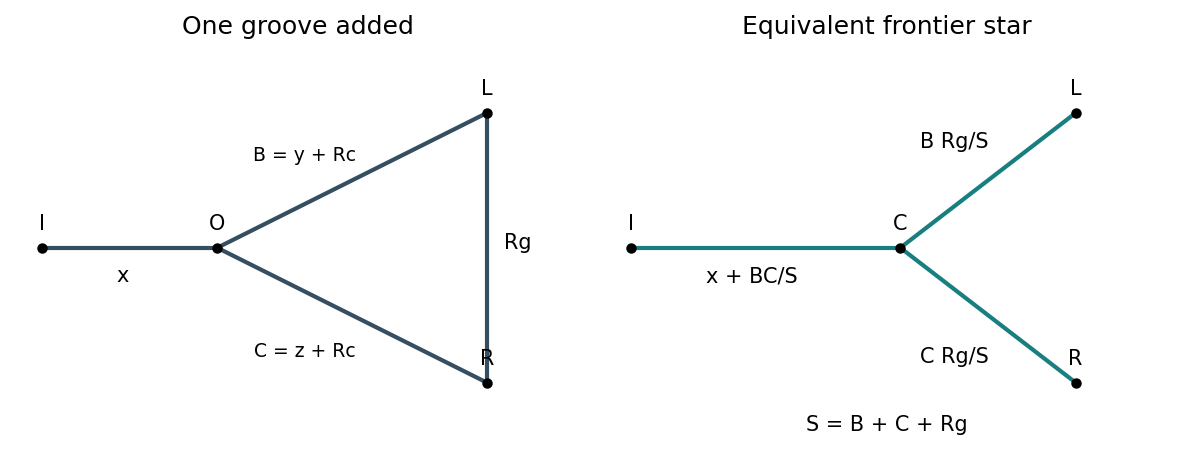
This method retains unequal pressure drops and unequal flow division along the rails; their finite resistances cannot be ignored when assigning the groove flows.
For the hydraulic ladder network, using the frontier star just defined, start at a single groove with . Put , and . The exact update isAfter all grooves have been included, the left frontier is a blind end, so no external flow passes through . The inlet-to-outlet resistance is . Iterate 49 times to obtain .
An equivalent closed form, for , isThus substitute ; no single number follows without . Checks are , , and as . The formula counts only the inter-groove segments in each rail; extra inlet/outlet lead resistances, if present, must be added separately. All elements obey linear laminar-flow pressure-drop laws.
This is a multi-walled carbon nanotube with a hollow interior and approximately concentric graphitic shells running along its axis. The walls show many resolved (002) fringes: a relatively straight section supports an approximate count of 16 shells, with some uncertainty from contrast and overlapping/terminated fringes. The tube is not a uniform straight cylinder: the inner channel narrows and changes direction, walls kink and curve, and some inner fringes terminate or join a partly closed internal region. The rough outer boundary contains disordered carbon or incomplete outer layers. The high-contrast material below the tube should not simply be counted as additional concentric shells.
Bending, incomplete walls and changes of atomic bonding scatter charge carriers and can mix shells, reducing the mean free path and causing extra resistance or localization. Covalent intershell links can also increase transfer between shells. Nonhexagonal rings or vacancies are plausible atomic causes, but this image does not resolve a unique ring inventory or prove a specific Stone-Wales defect. Different shell chiralities can intrinsically give different metallic or semiconducting behaviour; a (002) image alone does not assign those chiralities.
For a graphene honeycomb with C-C bond length , a primitive cell has two atoms and area . Its areal atomic density isFor the nanotube atom-count estimate, treat each shell as a graphene cylinder. The atoms per axial length areUsing the fringe spacing as an internal ruler gives representative estimates , and , consistent with radial spacings of . ThenThe meaningful estimate is of order atoms per nm, not an exact count. It assumes nearly complete cylindrical shells, uses projected dimensions in a reasonably straight segment, and neglects defects, corrugation and extra external carbon. Image uncertainty in wall count and diameter changes the estimate by tens of percent; no external scale bar is available in this figure.
A carbon-containing feed adsorbs and decomposes on a catalytic metal particle, releasing mobile carbon. Carbon can migrate over the surface and/or through the particle, depending on catalyst, temperature and feedstock. Supersaturation and graphitic nucleation generate a curved cap; nonhexagonal rings provide the curvature needed to close its end. Continued carbon incorporation at the cap rim lifts or extends the cap into a tube while leaving a growth interface at the catalyst.
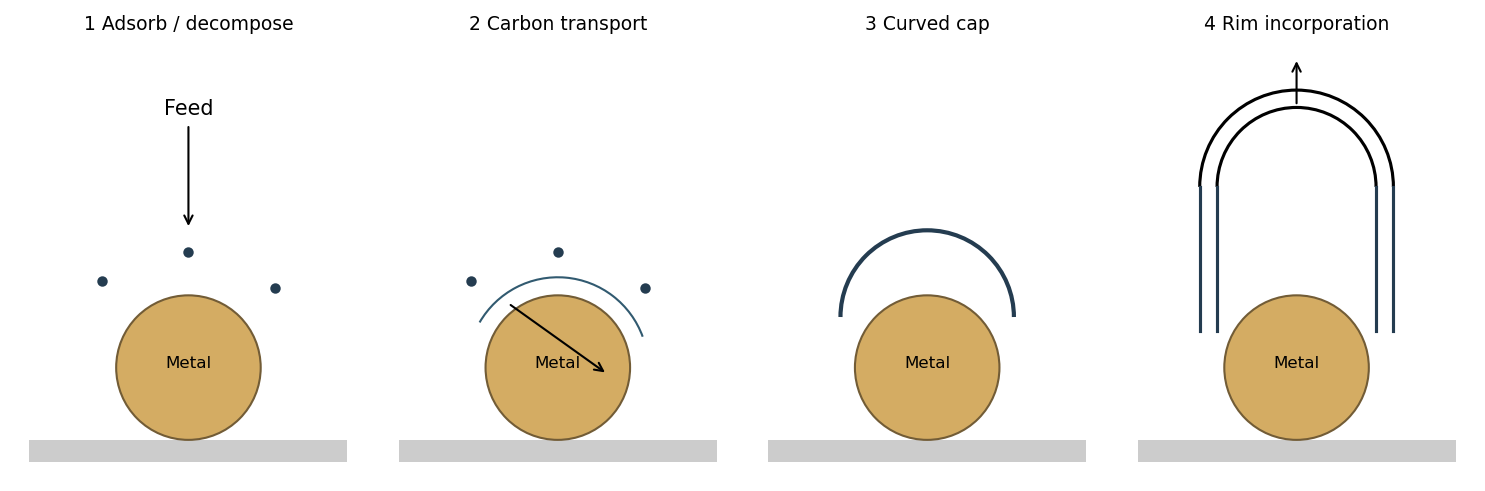


With strong catalyst-support adhesion the particle remains at the base; with weaker adhesion it can lift with the growing tube. Several shells can nucleate and extend to form a multiwall tube. Continued growth requires access to active catalyst sites: encapsulation by an impermeable carbon coating can terminate it. The catalyst need not be liquid in every chemical vapour deposition growth mechanism, and bulk dissolution is not the only possible carbon-transport route.
Let the graphene lattice constant be , and choose direct primitive vectors and . Reciprocal primitive vectors satisfying areThe first Brillouin zone is a hexagon. Its corners K and K' are inequivalent valleys; M denotes an edge midpoint. In the nearest-neighbour model, , where and are the three bond vectors. The band separation is : it vanishes at K/K' and is at M, varying continuously along each edge.
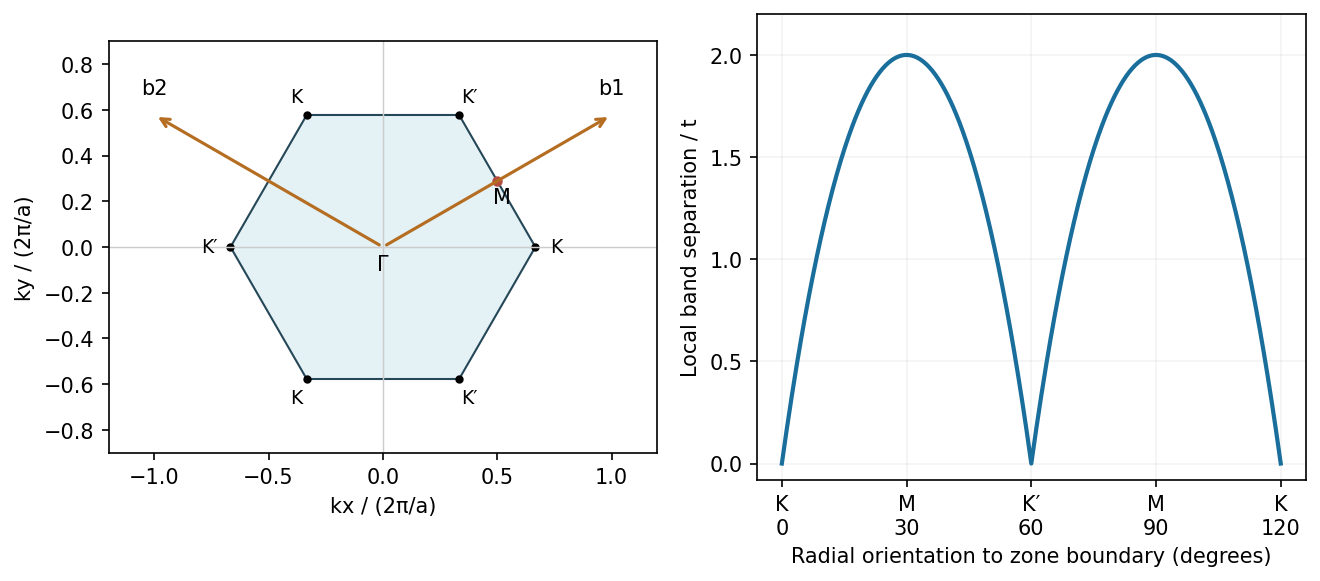
Graphene reciprocal primitive vectors and the orientation-dependent band separation on its zone boundary
. Source. Details. 
This graphene zone-boundary band separation is a local conduction-to-valence separation. Ideal graphene itself remains globally gapless because the bands touch at the corners. Circumferential quantization in a nanotube selects lines through this two-dimensional band structure; whether they pass through a valley determines the ideal metallic versus semiconducting distinction.
For parabolic bands, the density of states near a subband edge scales as , , and . Thus a quasi-1D wire has inverse-square-root singularities at successive transverse subband thresholds, a quasi-2D well has a staircase, and a bulk 3D band rises smoothly from zero. Each expression vanishes below its threshold.
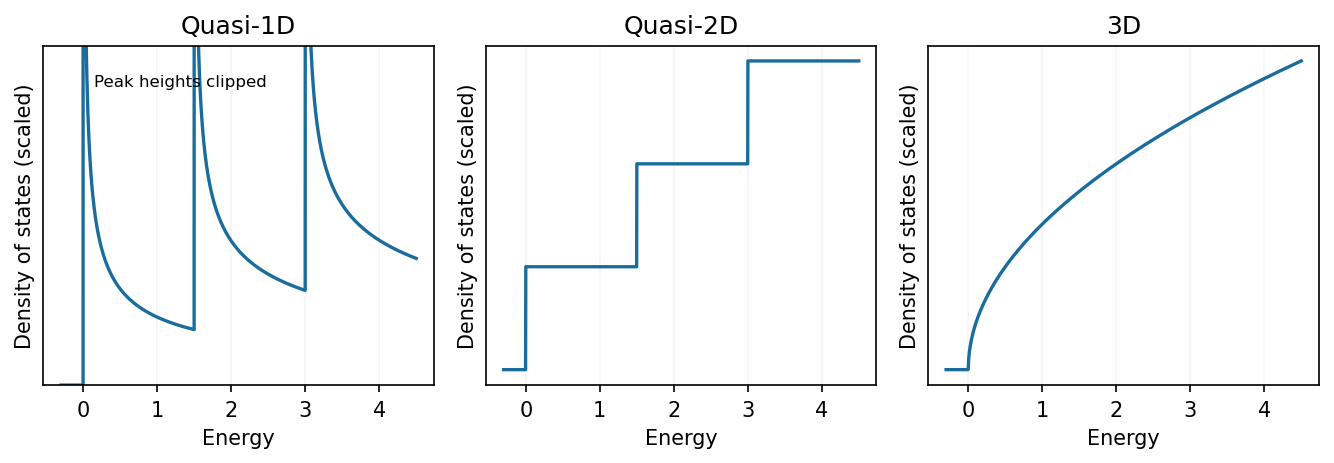
Parabolic-band density of states in one, two and three unconfined dimensions
. Source. Details. 
These sketches assume extended noninteracting states with simple quadratic dispersion. Finite temperature, disorder and finite lifetime broaden measured threshold features; the ideal singularity is integrable and does not represent infinitely many states in a finite energy interval.
n-type doping adds donor impurities with weakly bound electrons near the conduction-band edge; ionization supplies conduction electrons and leaves positive donor ions. p-type doping introduces acceptors near the valence-band edge, producing holes and negatively charged ionized acceptors. Silicon and germanium commonly use group-V donors and group-III acceptors; dopant behaviour in a compound semiconductor depends on its lattice site.
Doping sets carrier concentration, Fermi level and resistivity. Spatially patterned donor and acceptor regions form p-n junctions, transistor source/drain regions and electrical contacts; remote doping can supply carriers to a cleaner conducting layer. Compensation and incomplete ionization mean carrier density need not equal the total impurity concentration.
A larger-gap AlGaAs barrier has a higher conduction-band edge than GaAs. Donors in AlGaAs supply electrons that transfer into lower-energy GaAs states, leaving a positively charged donor region. The resulting electrostatic field bends the GaAs conduction band into a triangular interface well. Motion normal to the interface is quantized, while motion parallel to it remains approximately free, producing a two-dimensional electron gas.
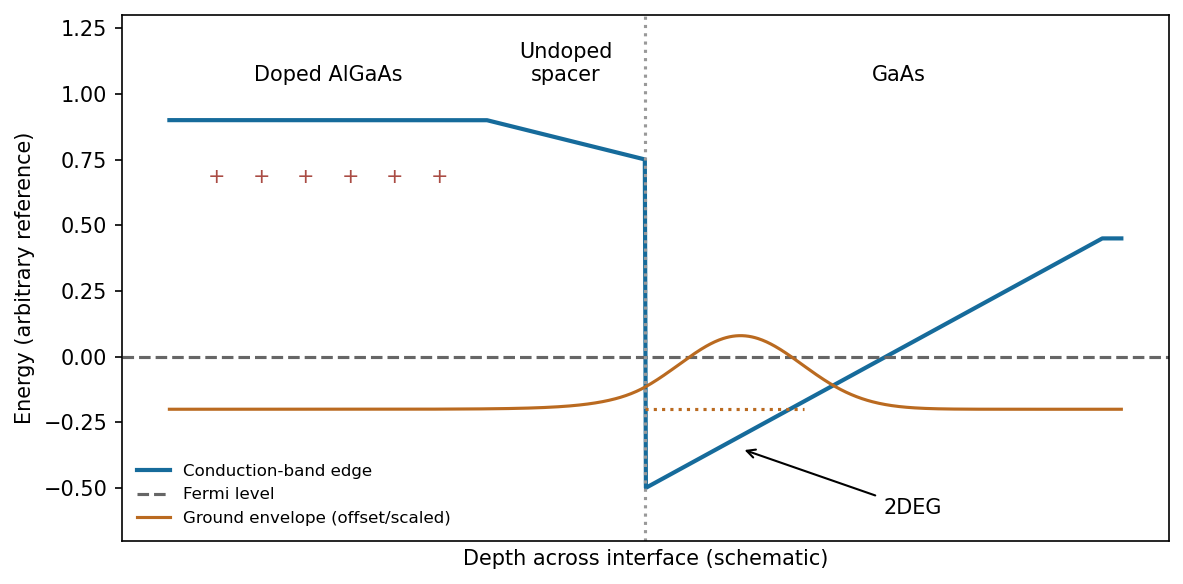
An illustrative remotely doped heterojunction separates the electron envelope from ionized donors
. Source. Details. 
The confined envelope peaks just inside GaAs and decays into the AlGaAs barrier; a triangular-well treatment gives an Airy-function-like envelope with boundary matching. An undoped spacer separates the electrons from the donors, strongly reducing ionized-impurity scattering compared with uniformly doped 3D material and enabling high mobility. Band offsets, donor supply, interface roughness and electrostatics jointly determine whether a single occupied subband is obtained.
For longitudinal motion in transverse subband ,For a completely free particle take and use the full wave vector. In a semiconductor the parabolic-band mass is the appropriate effective mass rather than necessarily the bare electron mass.
For a wire of length , one spin state has states in one propagation direction. Including two degenerate spin states and using givesDivide by for density per unit length. The factor-of-two distinction is essential: the current from one reservoir uses only its incoming propagation branch. If spin degeneracy is lifted, count each resolved spin channel separately.
Use the one-way density per unit length . The electron-flux magnitude in an interval is charge times velocity times line density:If is instead defined for a finite length , the traversal frequency is ; the same cancellation follows. The printed therefore requires to be a line density, not an unscaled total particle number.
Subtract the opposite reservoir's incoming flux. With the stated electron electrochemical potentials, conventional positive current is opposite to electron-number flux, soAt low temperature and small bias, each fully transmitted occupied spin-degenerate subband contributes . Hence . More generally, the Landauer formula weights each mode by its transmission probability; imperfect transmission removes exact integer plateaux.
With ballistic conductance quantization, as a gate opens the channel, conductance plateaux at appear; successive transverse modes add one quantum, approximately per spin-degenerate subband. Their appearance is the key low-temperature electrical signature.
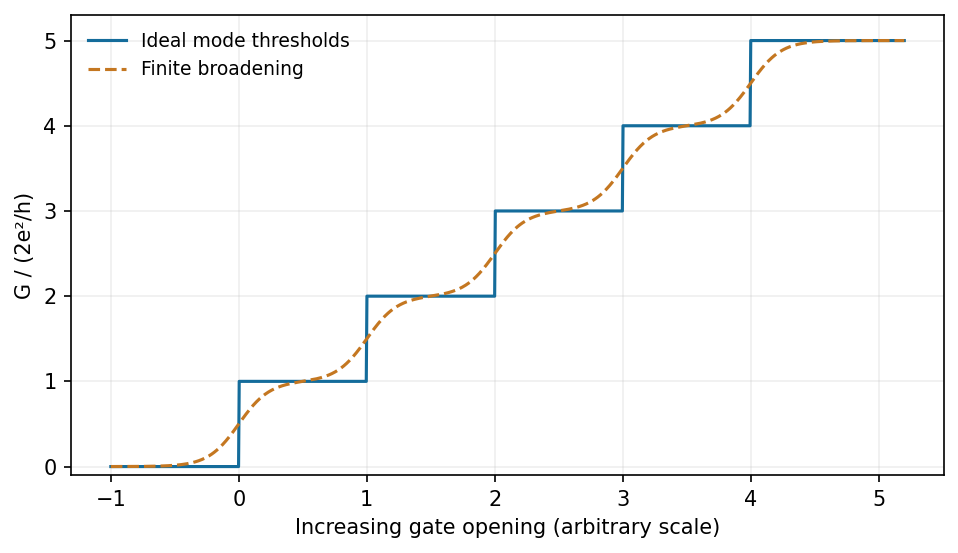
Ideal conductance plateaux sharpen as thermal and disorder broadening become small compared with subband spacing
. Source. Details. 
Require transverse confinement with separated subbands, and measurement-bias energy well below the subband spacing, a mean free path exceeding the channel length, and smooth low-reflection coupling to reservoirs. Correct for appreciable external series resistance. Phase coherence is needed for additional interference oscillations, but perfect phase coherence across an entire macroscopic circuit is not a separate requirement for the basic mode-counting result. A field that resolves spin splitting can produce increments.[ref]
Quantized conductance of point contacts by B. J. van Wees and others. Gate-controlled ballistic GaAs-AlGaAs point contacts and conductance steps
Articles were limited to the first 100 out of 108 total.
Articles by others on the same topic
There are currently no matching articles.