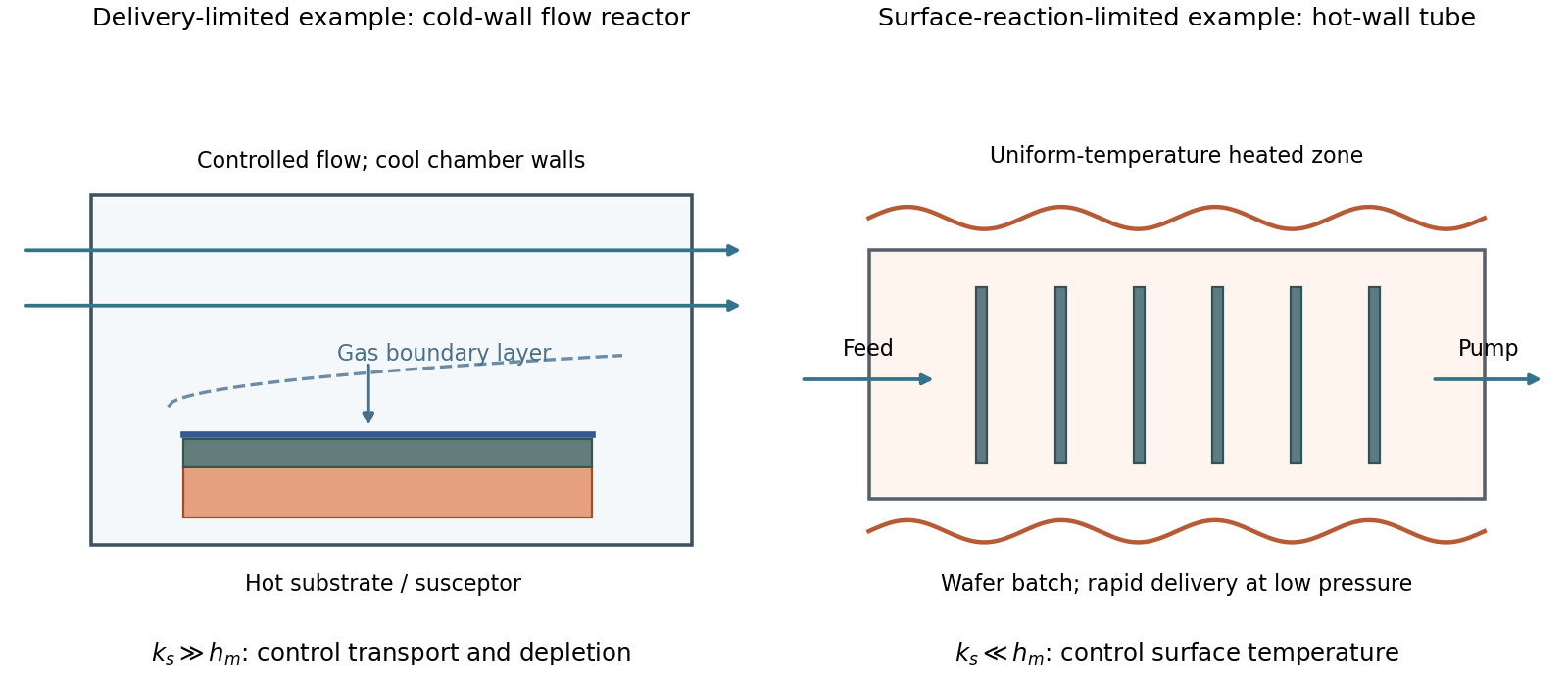
A simple chemical vapor deposition model separates transport through a gas boundary layer, with coefficient , from surface reaction, with coefficient :For , growth is mass-transfer-limited deposition. A typical cold-wall, flowing reactor heats the substrate strongly while keeping most chamber walls cooler. A shaped inlet, controlled flow and tilted or rotating susceptor help control boundary-layer thickness and precursor depletion. The essential design problem is delivering a similar flux everywhere; heating a surface still further gives little benefit once delivery limits growth.
For , growth is reaction-limited deposition. A hot-wall, low-pressure batch tube can hold many wafers in a nearly uniform-temperature zone. Faster gas transport makes surface concentrations more uniform, while slow chemistry reduces consumption before precursors reach downstream surfaces. Temperature uniformity is particularly important because surface rates can depend strongly on temperature.
These are illustrative architectures, not a rule that wall type alone determines the regime. Temperature, pressure, flow and precursor chemistry jointly set .

At fixed reactant partial pressures and temperature, their ideal-gas bulk concentrations remain approximately fixed. Lowering total pressure means removing diluent rather than automatically lowering the reactant concentration.
In the continuum molecular-diffusion regime, gas diffusivities scale approximately as . Delivery through a comparable boundary layer is therefore faster, increasing relative to . The system tends toward reaction-limited operation, where concentration differences between substrate locations are smaller. This commonly improves thickness uniformity and access to recessed surfaces.
The qualification is important: changing pressure can also change flow velocity and the boundary layer, gas-phase chemistry and precursor depletion. In narrow structures at low pressure, Knudsen transport limits the simple improvement. Improved transport does not correct a large substrate-temperature gradient in a strongly temperature-sensitive reaction-limited process.
In evaporative deposition, atoms travel mainly along straight trajectories from a compact source. For an ideal cosine-emitting source below a parallel wafer, a point at lateral radius and source separation receives approximatelyConsequently . Increasing makes arrival angles and distances more similar across a fixed wafer, improving uniformity. But the central flux falls as for a fixed source output, so the deposition rate decreases and less evaporated material is collected.
Rotation averages azimuthal variations, and source shaping or multiple sources can help, but simple rotation does not remove a radial flux gradient. Raising source output can partly compensate at the cost of source heating, consumption and possible material limitations. The trade-off follows from geometry rather than an intrinsic prohibition on simultaneously optimizing a more elaborate system.
Zero step coverage means that a sidewall or hidden surface receives essentially no film even though a horizontal reference surface is coated. Deposition shadowing occurs when an upper edge intercepts trajectories that would otherwise reach a lower region. A directional high-vacuum evaporant flux can therefore coat a feature top while leaving vertical or reentrant walls uncoated.
Sputtering generally releases material from an extended target with a broad angular distribution; gas collisions can further redistribute arrival directions. More oblique trajectories can reach sidewalls, so the extreme zero-coverage behavior of an ideal collimated evaporant beam is reduced.
The absolute claim that these effects never occur in sputtering is too strong. Low-pressure directional sputtering and high-aspect-ratio or reentrant features can still exhibit shadowing and poor coverage. Broader incidence improves access; it does not make a physical deposition process universally conformal.
Articles by others on the same topic
There are currently no matching articles.