The oxygen atom has . Each oxygen contributes six valence electrons, so the molecular diagram contains twelve. Taking the internuclear direction as , the relevant ordering for oxygen isThe valence occupation isThe final two electrons occupy the degenerate antibonding orbitals singly with parallel spin, following Hund's rules. Thus oxygen has two unpaired electrons and is paramagnetic. The core orbitals are deliberately omitted from the valence-only molecular orbital diagram.
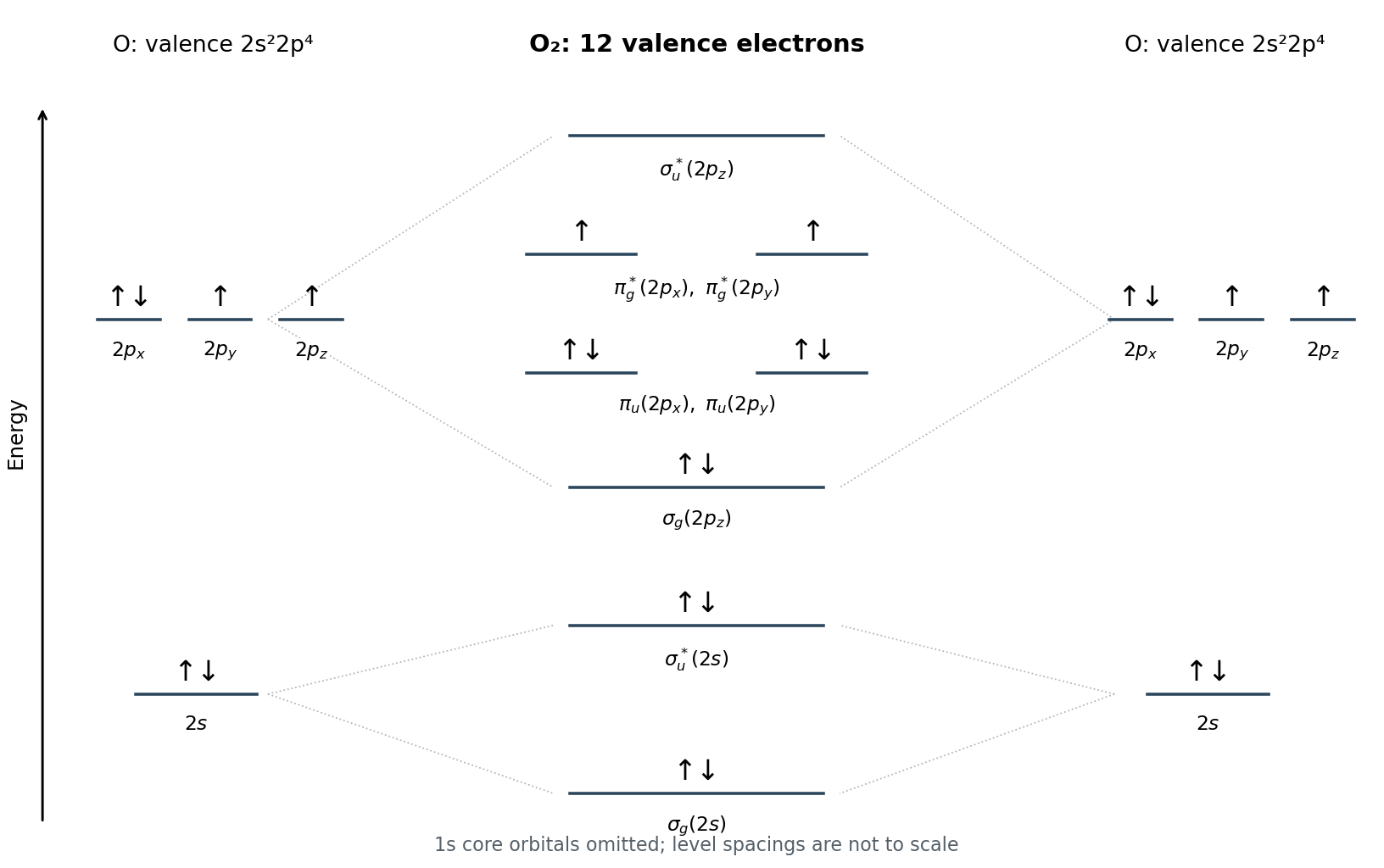

For oxygen, eight valence electrons occupy bonding orbitals and four occupy antibonding orbitals. Its bond order isThe additional electron in superoxide enters a antibonding orbital, givingReduced bond order weakens and lengthens the bond, consistent with the longer bond in superoxide. The diagram explains the direction of the change; it does not predict the two numerical bond lengths without a quantitative electronic-structure calculation.
The stabilizing outer groups should be compatible with the solvent, while the thiol-derived sulfur anchors the ligand shell to the gold nanoparticle.
| Solvent | Thiol number | Reason |
|---|---|---|
| Acidic water | 1 | The terminal amine is protonated, favoring hydration and electrostatic repulsion between similarly charged particles. |
| Basic water | 2 | The carboxylic acid becomes carboxylate, giving a hydrated negatively charged outer group. |
| Hexane | 4 | The long hydrocarbon tail is well solvated by a hydrocarbon solvent and can provide steric protection. |
| Perfluorohexane | 5 | The fluorinated tail is compatible with the fluorous solvent, unlike a conventional hydrocarbon shell. |
| Toluene | 3 | The aromatic-containing ligand is compatible with the aromatic organic solvent. |
These choices concern colloidal stability, not merely whether a free ligand dissolves. Coverage, chain packing and particle separation also matter. In the aqueous cases, high electrolyte concentrations can screen electrostatic repulsion, so ionization alone does not guarantee stability at every acid or base concentration.
The expected order from most to least acidic isHI is stronger than HCl because the H–I bond is weaker and the larger iodide ion accommodates negative charge well. In water both strong acids are substantially leveled to hydronium; their intrinsic ordering should not be mistaken for a large difference in the acidity of equal-concentration fully dissociated aqueous solutions.
Removing the marked proton alpha to the nitro group in (3) gives a resonance-stabilized nitronate, with charge distributed onto oxygen. It is far more favorable than forming the unactivated carbon anions in (1) or (2).
The marked aromatic C–H in (1) is more acidic than the alkane C–H in (2). The resulting aryl carbon lone pair has greater s character than an alkyl carbanion's, and chlorine also exerts an inductive effect. The aryl anion's lone pair is not simply delocalized through the aromatic pi system in the same way as a phenoxide ion. The specified proton positions are essential: this is not an ordering of arbitrary hydrogens on the molecules.
The left-hand open quinoid dianion is pink/purple; the right-hand closed lactone is colorless. In the colored form, a longer conjugated electronic system extends through the quinoid framework. The resulting lower-energy electronic transitions can absorb visible light, producing the observed complementary color.
The closed lactone contains a tetrahedral central carbon that interrupts conjugation between the aromatic fragments. Its remaining electronic transitions are mainly at higher energy, so the molecule does not strongly absorb visible wavelengths. It still absorbs ultraviolet light: colorless does not mean absence of electronic transitions.
The explanation concerns the two drawn forms of phenolphthalein. It does not assert that a single colored form remains dominant at arbitrarily high pH; additional equilibria can alter the spectrum outside the usual indicator range.
Articles by others on the same topic
There are currently no matching articles.