The oxygen atom has . Each oxygen contributes six valence electrons, so the molecular diagram contains twelve. Taking the internuclear direction as , the relevant ordering for oxygen isThe valence occupation isThe final two electrons occupy the degenerate antibonding orbitals singly with parallel spin, following Hund's rules. Thus oxygen has two unpaired electrons and is paramagnetic. The core orbitals are deliberately omitted from the valence-only molecular orbital diagram.
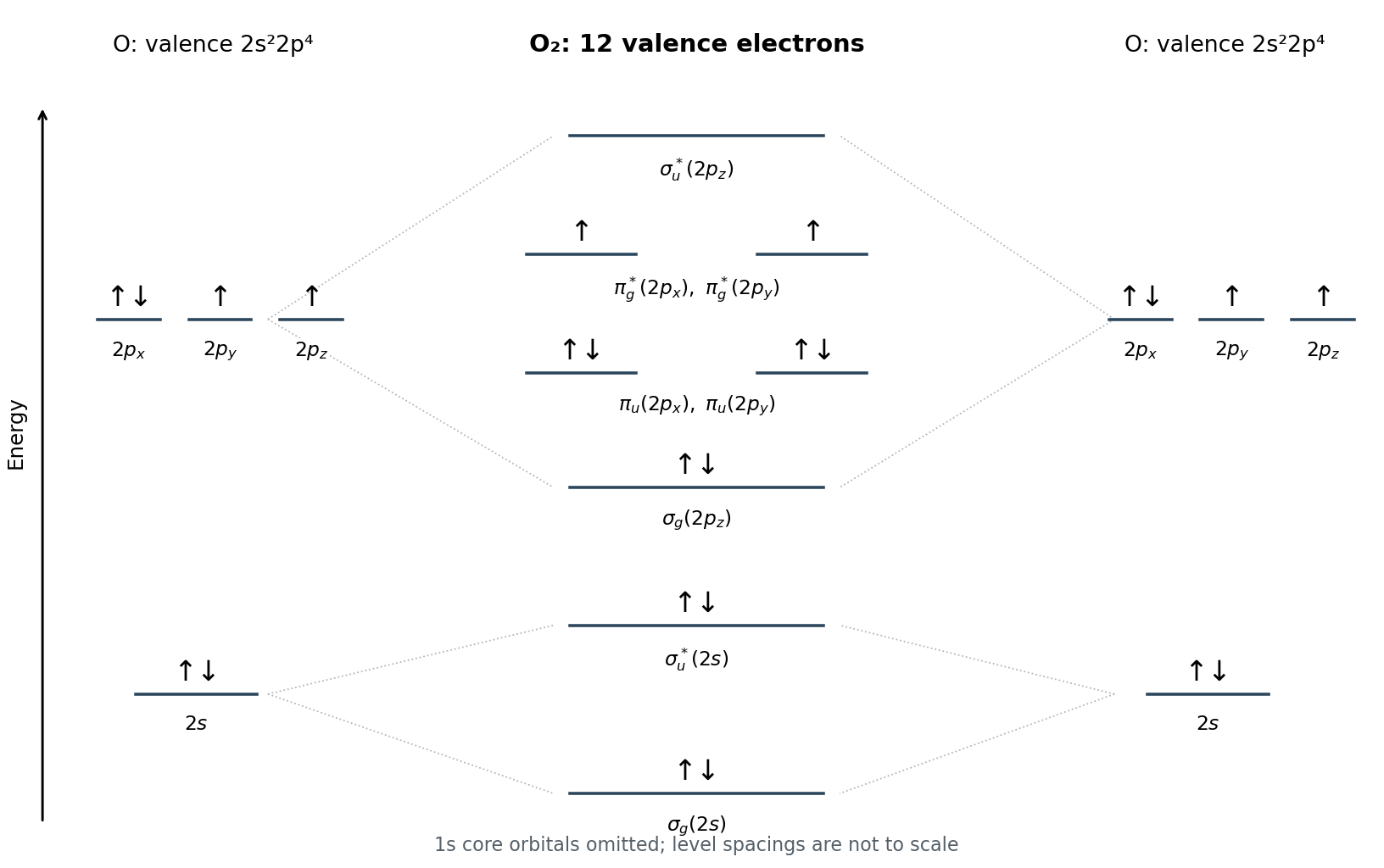

For oxygen, eight valence electrons occupy bonding orbitals and four occupy antibonding orbitals. Its bond order isThe additional electron in superoxide enters a antibonding orbital, givingReduced bond order weakens and lengthens the bond, consistent with the longer bond in superoxide. The diagram explains the direction of the change; it does not predict the two numerical bond lengths without a quantitative electronic-structure calculation.
Articles by others on the same topic
There are currently no matching articles.