The oxygen atom has . Each oxygen contributes six valence electrons, so the molecular diagram contains twelve. Taking the internuclear direction as , the relevant ordering for oxygen isThe valence occupation isThe final two electrons occupy the degenerate antibonding orbitals singly with parallel spin, following Hund's rules. Thus oxygen has two unpaired electrons and is paramagnetic. The core orbitals are deliberately omitted from the valence-only molecular orbital diagram.
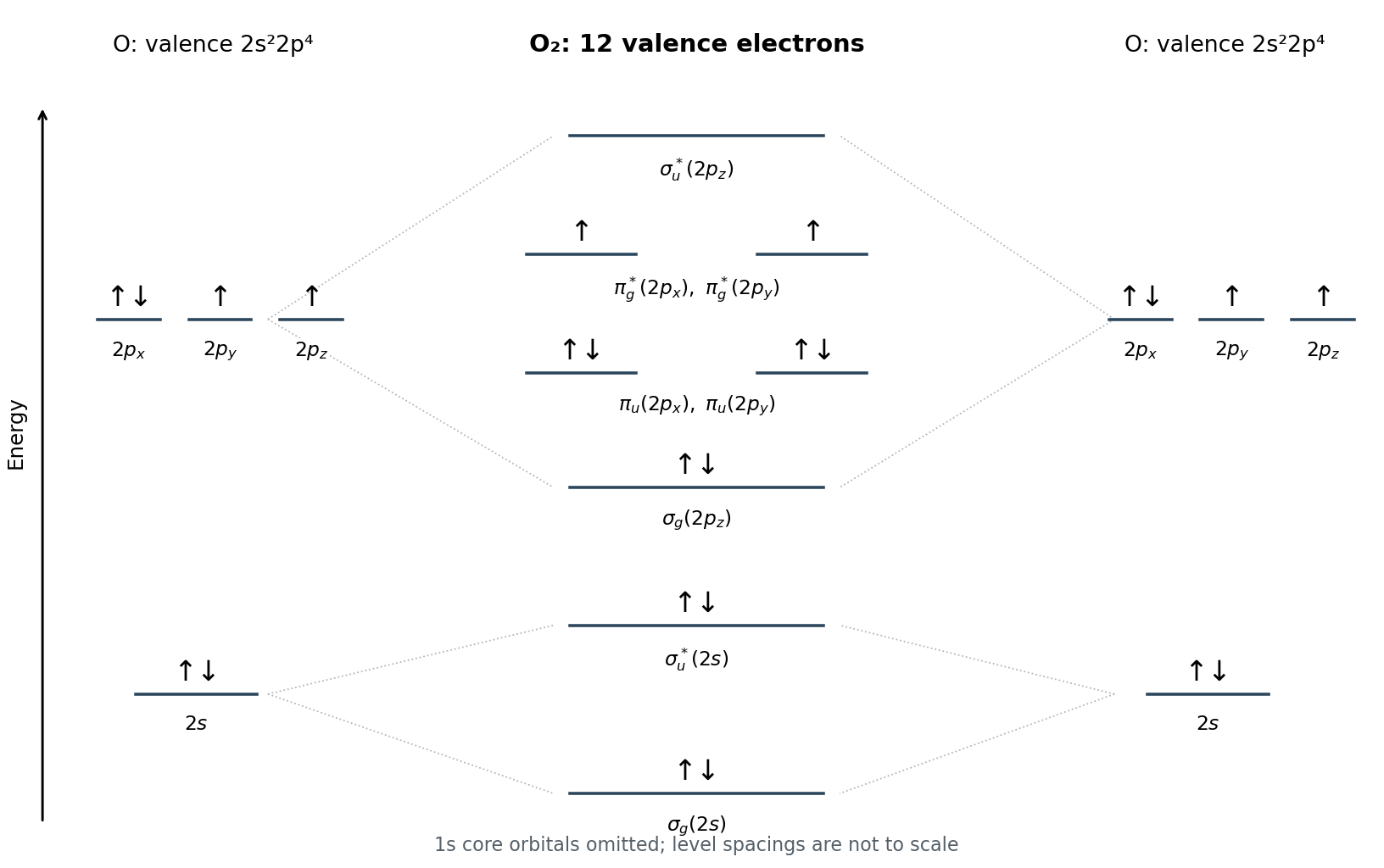

For oxygen, eight valence electrons occupy bonding orbitals and four occupy antibonding orbitals. Its bond order isThe additional electron in superoxide enters a antibonding orbital, givingReduced bond order weakens and lengthens the bond, consistent with the longer bond in superoxide. The diagram explains the direction of the change; it does not predict the two numerical bond lengths without a quantitative electronic-structure calculation.
The stabilizing outer groups should be compatible with the solvent, while the thiol-derived sulfur anchors the ligand shell to the gold nanoparticle.
| Solvent | Thiol number | Reason |
|---|---|---|
| Acidic water | 1 | The terminal amine is protonated, favoring hydration and electrostatic repulsion between similarly charged particles. |
| Basic water | 2 | The carboxylic acid becomes carboxylate, giving a hydrated negatively charged outer group. |
| Hexane | 4 | The long hydrocarbon tail is well solvated by a hydrocarbon solvent and can provide steric protection. |
| Perfluorohexane | 5 | The fluorinated tail is compatible with the fluorous solvent, unlike a conventional hydrocarbon shell. |
| Toluene | 3 | The aromatic-containing ligand is compatible with the aromatic organic solvent. |
These choices concern colloidal stability, not merely whether a free ligand dissolves. Coverage, chain packing and particle separation also matter. In the aqueous cases, high electrolyte concentrations can screen electrostatic repulsion, so ionization alone does not guarantee stability at every acid or base concentration.
The expected order from most to least acidic isHI is stronger than HCl because the H–I bond is weaker and the larger iodide ion accommodates negative charge well. In water both strong acids are substantially leveled to hydronium; their intrinsic ordering should not be mistaken for a large difference in the acidity of equal-concentration fully dissociated aqueous solutions.
Removing the marked proton alpha to the nitro group in (3) gives a resonance-stabilized nitronate, with charge distributed onto oxygen. It is far more favorable than forming the unactivated carbon anions in (1) or (2).
The marked aromatic C–H in (1) is more acidic than the alkane C–H in (2). The resulting aryl carbon lone pair has greater s character than an alkyl carbanion's, and chlorine also exerts an inductive effect. The aryl anion's lone pair is not simply delocalized through the aromatic pi system in the same way as a phenoxide ion. The specified proton positions are essential: this is not an ordering of arbitrary hydrogens on the molecules.
The left-hand open quinoid dianion is pink/purple; the right-hand closed lactone is colorless. In the colored form, a longer conjugated electronic system extends through the quinoid framework. The resulting lower-energy electronic transitions can absorb visible light, producing the observed complementary color.
The closed lactone contains a tetrahedral central carbon that interrupts conjugation between the aromatic fragments. Its remaining electronic transitions are mainly at higher energy, so the molecule does not strongly absorb visible wavelengths. It still absorbs ultraviolet light: colorless does not mean absence of electronic transitions.
The explanation concerns the two drawn forms of phenolphthalein. It does not assert that a single colored form remains dominant at arbitrarily high pH; additional equilibria can alter the spectrum outside the usual indicator range.
A reference electrode should provide a stable, reproducible potential from a well-defined reversible equilibrium, with fixed relevant activities. It should pass negligible measuring current, resist contamination and drift, and avoid changing the sulfate sample through incompatible ions or reactions.
Silver is suitable when coupled to a sparingly soluble silver salt and a controlled filling electrolyte; a silver sulfate reference electrode avoids introducing chloride into a sulfate system. Mercury is also electrochemically suitable in a mercury/mercurous-sulfate reference system, although its toxicity and handling requirements make silver attractive where practical.
Sodium is unsuitable because it reacts with water rather than maintaining a quiet metal/ion reference equilibrium. Calcium and strontium are likewise too reactive in water. Magnesium is not a dependable reference simply because it sometimes reacts slowly: corrosion, oxide/hydroxide films and mixed potentials make its open-circuit potential dependent on surface history and solution conditions. A relatively inert-looking surface is not equivalent to a reproducible reversible electrode.
Even a suitable reference is not just an arbitrary piece of metal immersed in the sample. The metal, equilibrium salt, controlled electrolyte and liquid junction together define the reference system.
Use a silver wire or strip in contact with excess solid silver sulfate, immersed in a sulfate filling solution of known, stable activity. A porous frit connects the filling solution ionically to the sample while limiting bulk mixing. The reference housing should maintain the salt/electrolyte composition rather than letting the sample directly determine it.
Connect the unknown working electrode to the positive input and the silver reference to the negative input of a high-input-impedance voltmeter. The frit or sulfate-compatible salt bridge completes the ionic circuit. At negligible measuring current,A stable, small junction contribution is desirable. The reference electrode should not carry the counterelectrode current in a driven experiment: a separate counterelectrode is used when current is passed.
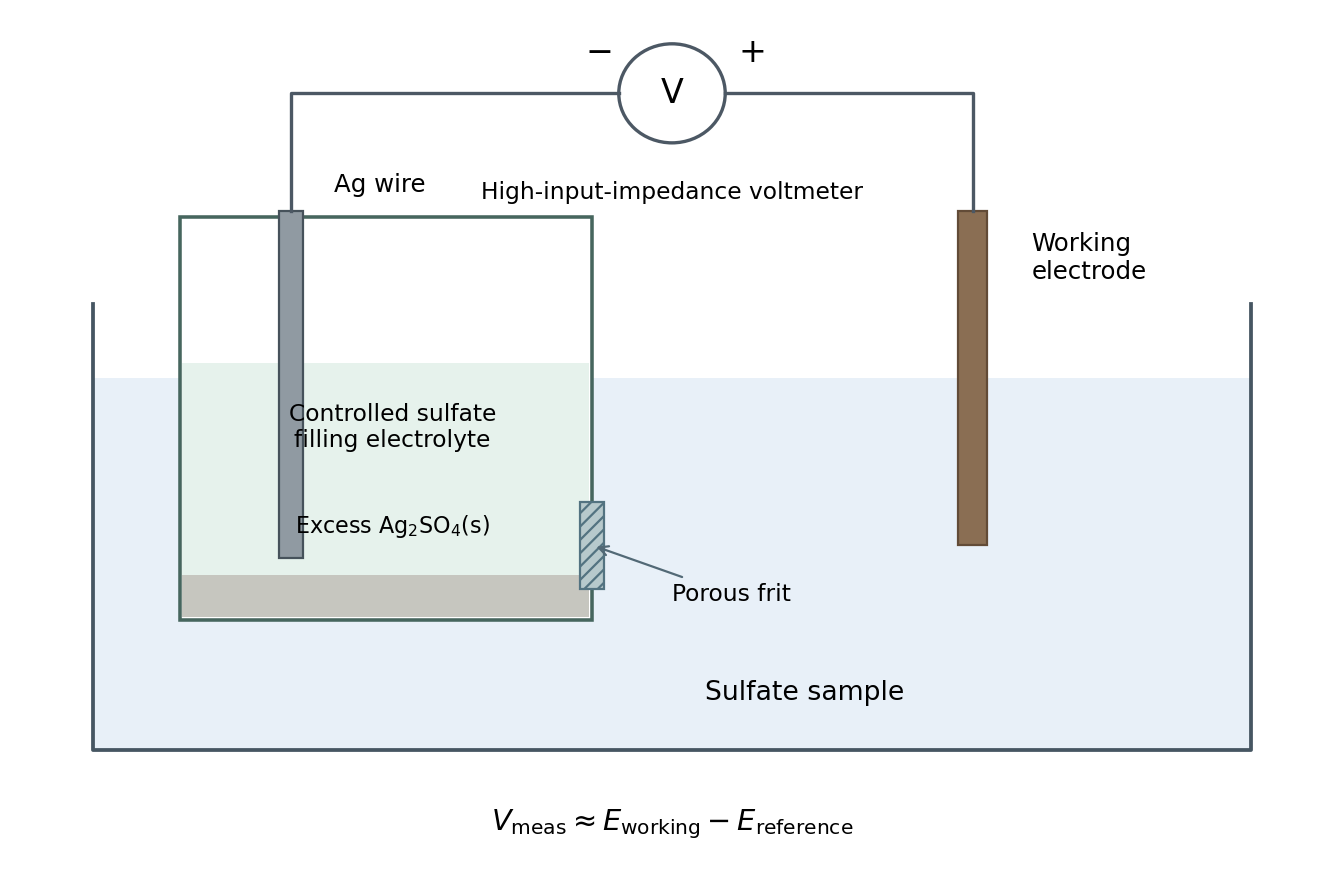

The equilibrium written in the reduction direction isWith pure-solid activities set to one, the Nernst equation givesMaintaining sulfate activity fixes the reference potential; protonation to bisulfate in strongly acidic filling solutions must be included in specifying that activity.
Calibrate against, or use a reliable tabulated potential relative to, the standard hydrogen electrode for the same filling solution and temperature. With the voltmeter sign specified above and a corrected or negligible junction potential,There is no universal numerical offset for every silver reference: silver/silver-chloride, silver/silver-sulfate and different sulfate filling solutions define different potentials.
At fixed discharge current, delivered voltage can be represented aswhere is discharged charge and the terms denote distinct physical losses. A typical trace has an initial drop from open circuit, an approximately flat useful region and a final decline toward cutoff. Its exact shape depends on the cell chemistry and current; not every battery has an equally flat plateau.
Four distinguishable contributions are:
- Ohmic polarization: electronic, ionic and contact resistance cause a rapid drop on applying current. This need not wait for a concentration gradient to develop.
- Activation overpotential: finite electrode-reaction kinetics require a departure from equilibrium to sustain charge transfer. It is important when the exchange current is small.
- Concentration overpotential: electrolyte transport and diffusion within active particles can deplete reactants or accumulate products near reaction sites. These losses often grow near the end of discharge or at high current.
- Phase-transformation polarization: nucleation and growth of a new phase can require extra driving force, produce an initial voltage dip or cause hysteresis. It is especially relevant to conversion and two-phase electrodes, rather than a universal independent loss in every chemistry.
Terminology sometimes groups solid-state transport or phase-change effects differently. The important distinction is the mechanism, not counting the same diffusion loss under two names. A falling equilibrium voltage as composition changes is also not, by itself, polarization.
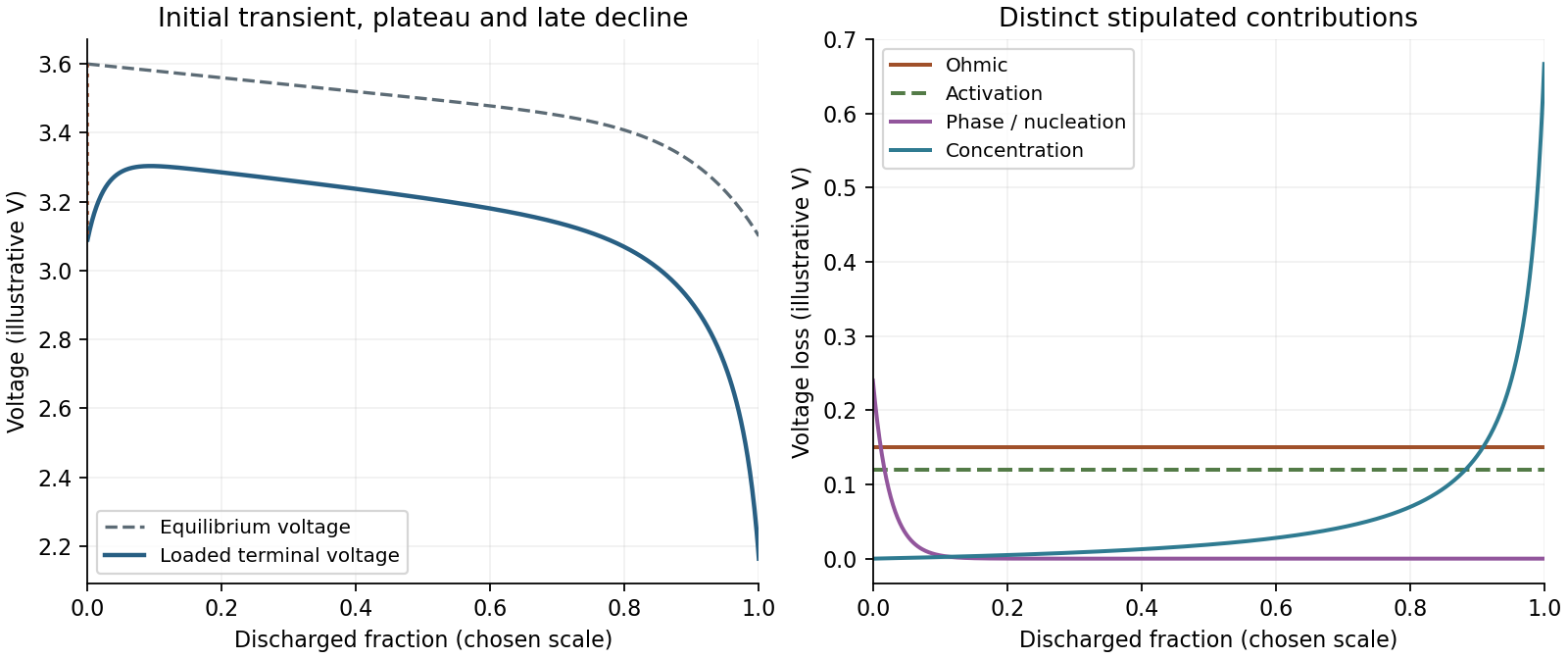
An illustrative discharge voltage combines equilibrium changes and distinct losses
. Original stipulated model, not battery measurements. The loss components show an instantaneous resistive contribution, activation loss, a transient nucleation-related contribution and increasing late-discharge transport loss. The equilibrium curve is plotted separately. Details.
The hydrogen fuel cell is the more likely high-power choice at low temperature, for otherwise comparable electrodes, oxidant supply and device design. Similar equilibrium oxidation potentials imply similar thermodynamic voltage opportunities; they do not imply similar current densities.
Hydrogen oxidation on an appropriate catalyst is relatively facile. Ammonia oxidation requires multiple bond-breaking and nitrogen-coupling steps; adsorbed intermediates can occupy catalytic sites and inhibit continued reaction. A larger anodic activation overpotential and slower turnover reduce the useful current and operating voltage of a low-temperature ammonia cell.
Since areal power is , a cell retaining substantial voltage at a larger current density can deliver more power even when its equilibrium voltage is similar. Ammonia's favorable storage characteristics are a separate system-level consideration; a comparison of power cannot be made by counting the electrons per fuel molecule alone. This is a kinetic expectation, not a universal numerical ranking independent of catalysts, temperature and transport.
Articles by others on the same topic
There are currently no matching articles.