For electron-positron annihilation into a muon pair the gauge diagrams are s-channel photon and Z exchange. For electron-positron annihilation into electron neutrinos there is s-channel Z exchange and t-channel W exchange, with interference. For electron-positron annihilation into W-boson pairs there are s-channel photon and Z diagrams and a t-channel electron-neutrino diagram. All three gauge amplitudes are required for the proper high-energy cancellation. Electron-Yukawa-suppressed s-channel Higgs diagrams can also produce the massive muon or W pair; they vanish in the usual zero-electron-mass approximation used for the leading gauge comparison.
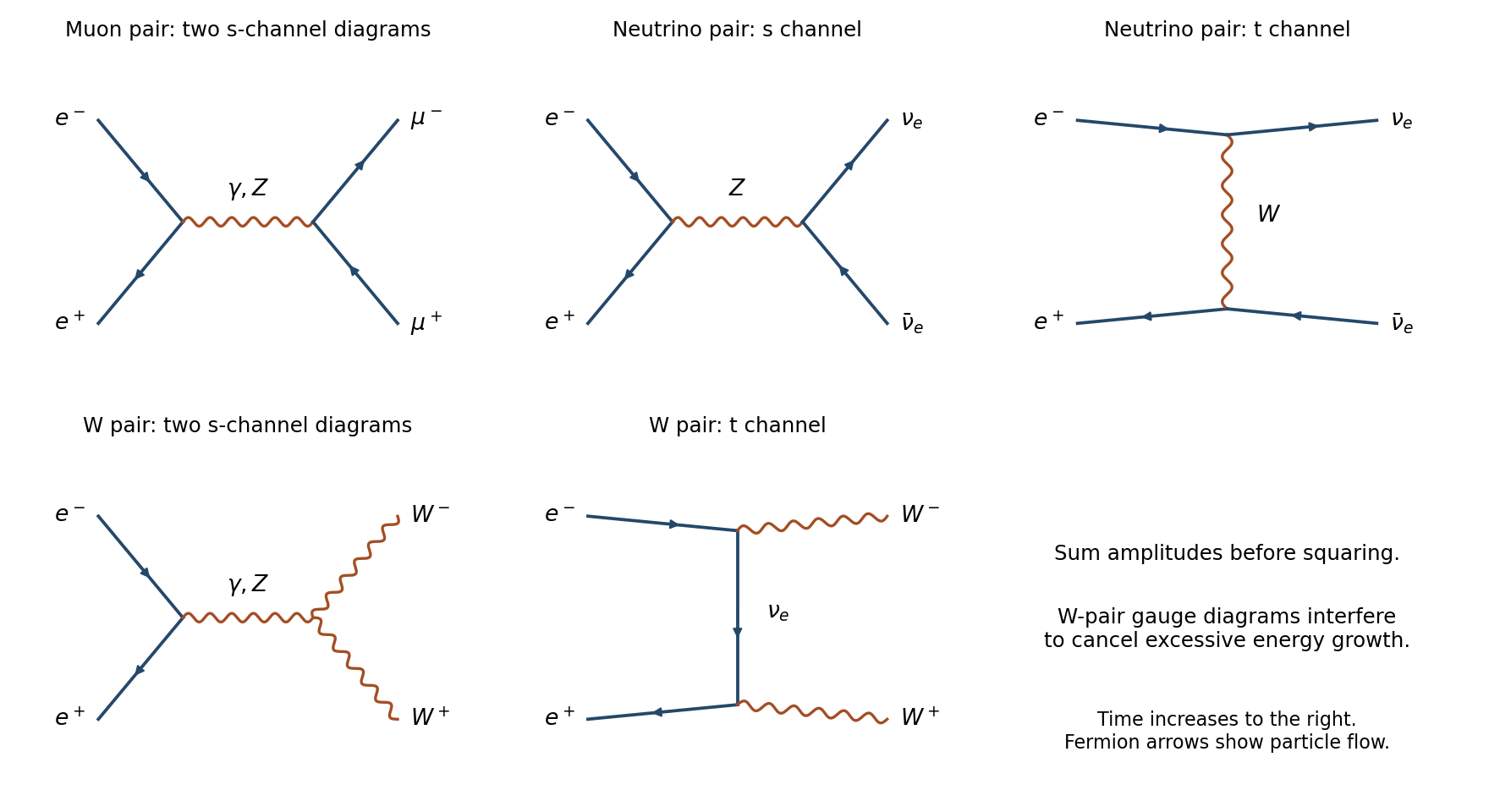

There is no energy-independent ordering. For unpolarized beams and inclusive Born cross sections the useful regimes are:
- Below the muon threshold only the neutrino channel is open, ignoring its tiny mass threshold. Immediately above , muon phase space initially vanishes.
- Well above but well below the weak-boson masses, photon exchange gives , whereas . Hence the muon channel dominates and real W-pair production is closed.
- Near the Z pole, W pairs are still closed and the Z resonance dominates both open channels. The ratio is approximately , from their neutral-current couplings: neutrinos rank above muons. This is for one neutrino flavour.
- At the on-shell W-pair channel opens from zero phase space. Its position in the ordering changes across threshold and must be obtained from the summed amplitudes, rather than inferred solely from a weak/electromagnetic label.
- Far above the weak masses, forward t-channel W exchange makes the inclusive electron-neutrino cross section approach a nonzero scale of order . The W-pair cross section behaves as and the muon cross section as . Thus asymptotically the decreasing order is , then , then . Fixed angular cuts, beam spin polarization and radiative corrections modify these comparisons.
Articles by others on the same topic
There are currently no matching articles.