A Feynman diagram specifies a term in the perturbative scattering amplitude, not a measured microscopic trajectory. Assign external spinors or polarization vectors, an interaction factor to each Feynman vertex and a propagator to each internal line; impose four-momentum conservation and integrate over independent loop momenta. Sum amplitudes for indistinguishable alternatives, then square, sum final spins and average unpolarized initial spins. A decay rate uses in natural units; a cross section also divides by incident flux. interference means probabilities of individual diagrams must not simply be added.
The electromagnetic fermion vertex is , with coupling proportional to ; it preserves fermion flavour. There is no elementary three-photon or four-photon vertex in quantum electrodynamics. The weak charged current has and vertices, with a left-chiral projector and a Cabibbo-Kobayashi-Maskawa matrix element at the quark vertex. The weak neutral current has vertices with vector and axial couplings; it includes neutrinos and is flavour diagonal at tree level. Electroweak gauge interactions also include , and quartic , , and vertices. Higgs-fermion and Higgs-vector interactions complete the mass-related scalar sector.[ref]
Quantum chromodynamics has vertices proportional to , plus three-gluon and four-gluon Feynman vertices because gluons carry color charge. A quark-gluon vertex preserves quark flavour. Internal particles need not be on their mass shells, but electric charge and four-momentum are conserved at each vertex. The figures below show representative leading flavour topologies; binding and hadronization are implicit, and additional strong-interaction contributions can modify hadronic amplitudes.
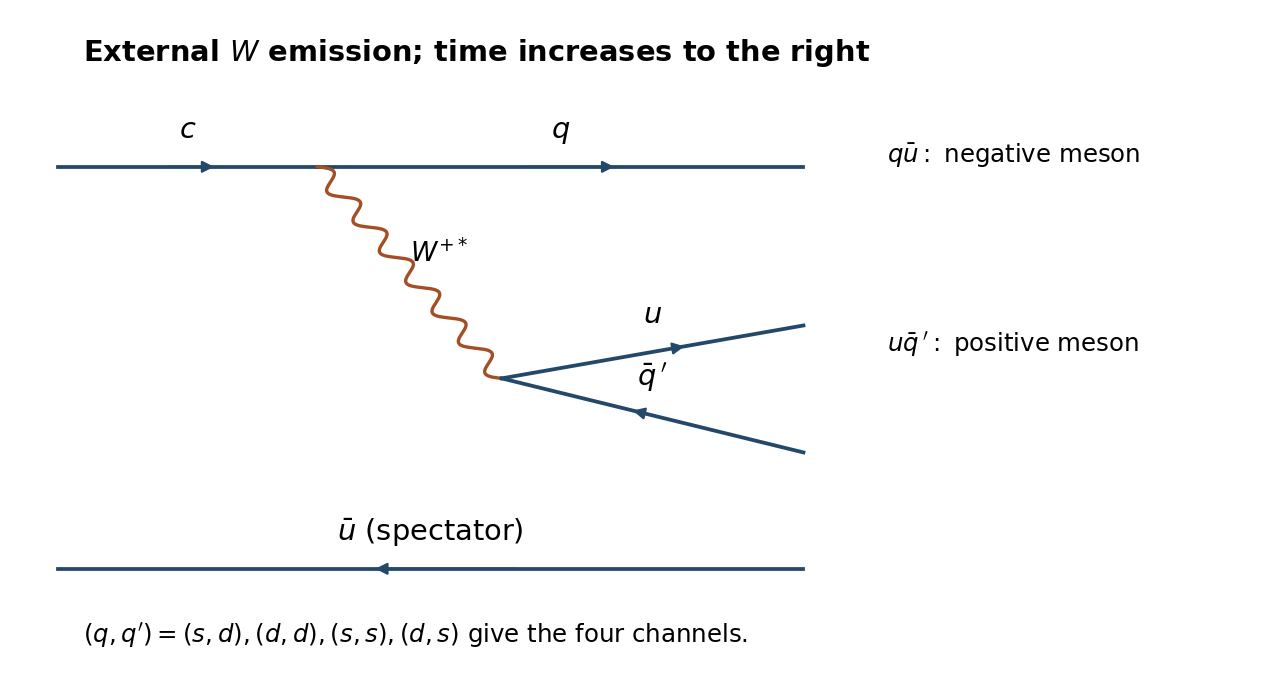
The weak charged current spectator topology is , , with the initial a spectator. The pair forms the negative meson and the positive meson. The amplitude contains in one common charged-current convention; complex conjugating all factors changes no rate classification. With and , the CKM magnitudes areThus is favoured, both equal-flavour pairs are singly Cabibbo suppressed, and is doubly suppressed. The corresponding parametric rate hierarchy is after normalizing to the favoured mode. Cabibbo suppression counting alone does not rank the middle two: phase space, different matrix elements and hadronic final-state interactions matter. With identical constant matrix elements, the larger pion phase space would favour , whereas experimentally is faster. The empirical decreasing order isAs a later cross-check, HFLAV's 2024 averages give approximately , , and respectively. The exact middle ordering is an experimental input, not a consequence of the supplied masses and Cabibbo angle alone.[ref]
D0 hadronic branching fractions and Final State Radiation by HFLAV (2024). final branching-fraction average table and final doubly suppressed-mode estimate
The initial strangeness is . The final state has strangeness , so its allowed nonleptonic amplitude is weak. One representative topology is followed by ; spectator combine with the produced into the , while contributes to the neutral pion. The available rest energy is .
The state would conserve strangeness and could have a strong vertex, but its threshold exceeds the parent mass by . It is kinematically forbidden. Coupling strength cannot rescue a closed decay channel.
The radiative channel also changes strangeness. It is a weak radiative hyperon decay, not an ordinary electromagnetic decay between states of the same flavour. A representative two-quark contribution is W exchange with a photon attached to a charged line; the other allowed attachments, hadronic intermediate states and short-distance loop contributions must be included for a complete amplitude. Its extra electromagnetic coupling and hadronic dynamics suppress it relative to the nonleptonic channel. ConsequentlyNA48 Collaboration measured a radiative branching fraction of about , corroborating the suppression rather than a purely electromagnetic interpretation.[ref]
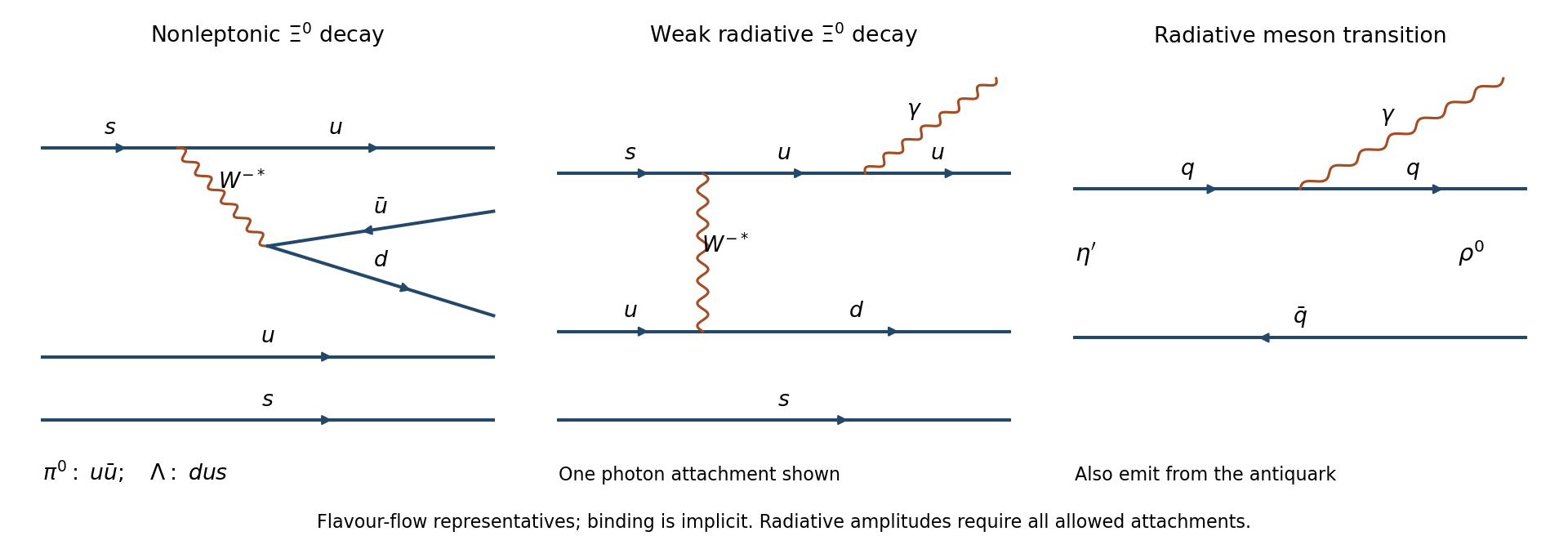
For the neutral quark-antiquark mesons here, . Thus , while . The radiative mode conserves charge conjugation and admits a quark-line photon-emission diagram. Both components of the supplied wavefunction contribute: the charge-weighted flavour overlap is proportional to , so it does not cancel. Its photon energy is .
The mode changes charge conjugation and, more decisively, a spin-zero particle cannot decay into another spin-zero particle and one real photon. In the parent rest frame the photon has helicity , while the opposite-moving pion has helicity zero; the spin-zero two-body helicity selection rule cannot be satisfied. Its on-shell two-body amplitude vanishes even if a weak interaction violates C. A virtual photon subsequently making another pair is a different final state.
For , angular-momentum conservation requires relative orbital angular momentum . Its parity is then negative, matching the parent, but its charge-conjugation eigenvalue is : the two distinct self-conjugate particles are not interchanged by C, so there is no additional factor in this C eigenvalue. The decay is forbidden by strong and electromagnetic charge-conjugation conservation despite being above threshold. A weak contribution would require CP violation as well. At the strong/electromagnetic accuracy of the diagram classification,If extremely small weak CP-violating amplitudes are retained, need not be exactly zero; the one-real-photon spin prohibition remains exact for .
For electron-positron annihilation into a muon pair the gauge diagrams are s-channel photon and Z exchange. For electron-positron annihilation into electron neutrinos there is s-channel Z exchange and t-channel W exchange, with interference. For electron-positron annihilation into W-boson pairs there are s-channel photon and Z diagrams and a t-channel electron-neutrino diagram. All three gauge amplitudes are required for the proper high-energy cancellation. Electron-Yukawa-suppressed s-channel Higgs diagrams can also produce the massive muon or W pair; they vanish in the usual zero-electron-mass approximation used for the leading gauge comparison.
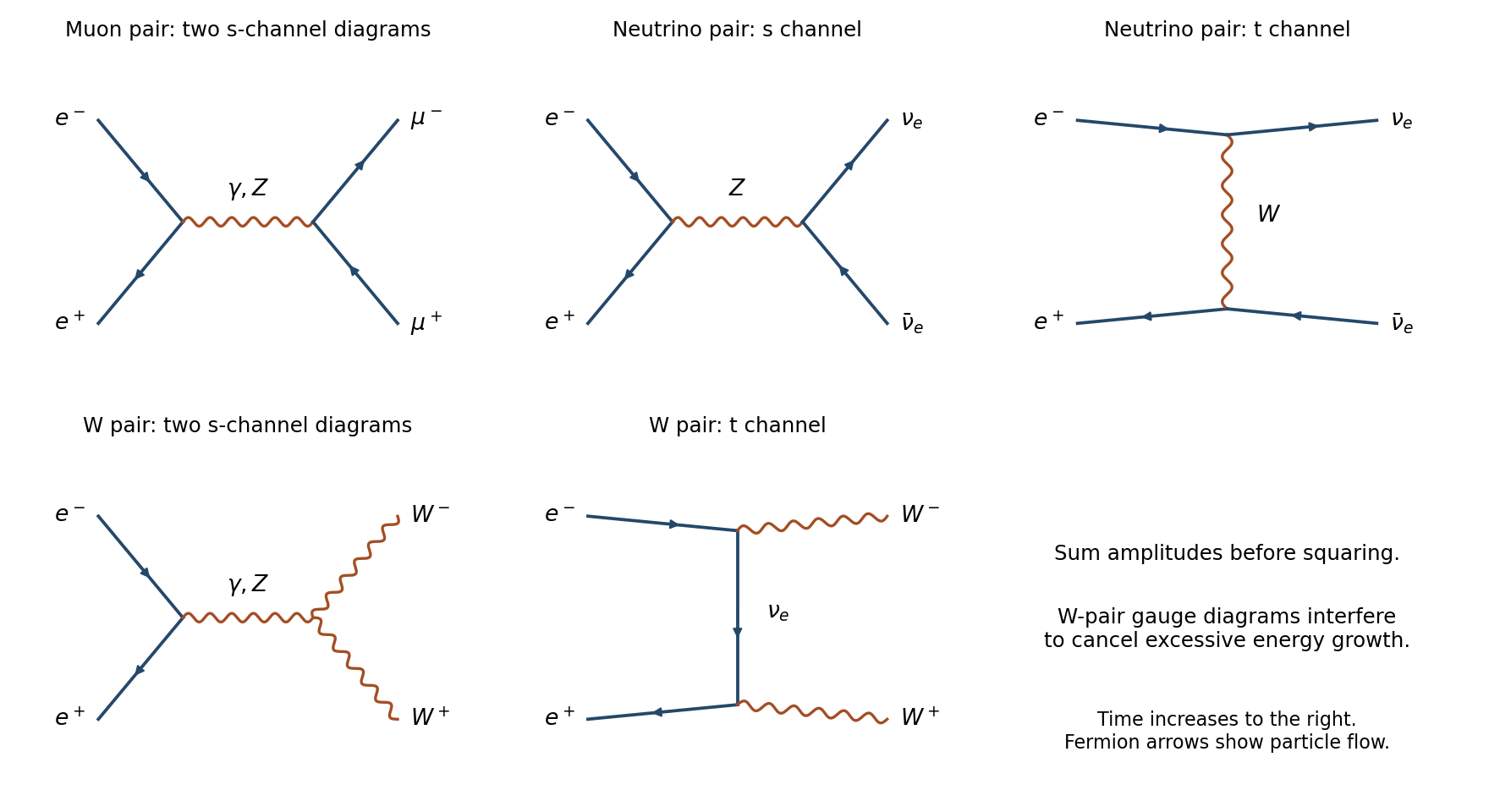


There is no energy-independent ordering. For unpolarized beams and inclusive Born cross sections the useful regimes are:
- Below the muon threshold only the neutrino channel is open, ignoring its tiny mass threshold. Immediately above , muon phase space initially vanishes.
- Well above but well below the weak-boson masses, photon exchange gives , whereas . Hence the muon channel dominates and real W-pair production is closed.
- Near the Z pole, W pairs are still closed and the Z resonance dominates both open channels. The ratio is approximately , from their neutral-current couplings: neutrinos rank above muons. This is for one neutrino flavour.
- At the on-shell W-pair channel opens from zero phase space. Its position in the ordering changes across threshold and must be obtained from the summed amplitudes, rather than inferred solely from a weak/electromagnetic label.
- Far above the weak masses, forward t-channel W exchange makes the inclusive electron-neutrino cross section approach a nonzero scale of order . The W-pair cross section behaves as and the muon cross section as . Thus asymptotically the decreasing order is , then , then . Fixed angular cuts, beam spin polarization and radiative corrections modify these comparisons.
Articles by others on the same topic
There are currently no matching articles.