For , the real and imaginary parts of the exponent divided by areThus constant-phase contours satisfy . Through zero, gives the six rays . The three rays have decreasing real part of the exponent and are steepest descent contours; the alternating three are steepest ascent rays.
Through one, the phase is . Its branch passing through that point can be writtenwith the cube root continuous from . The exponent is , so increasing from zero gives descent and decreasing gives ascent.
Deform the finite interval into the ray , , followed by the reverse of the descent branch from one. The integrand is entire, so Cauchy's integral theorem permits the deformation.
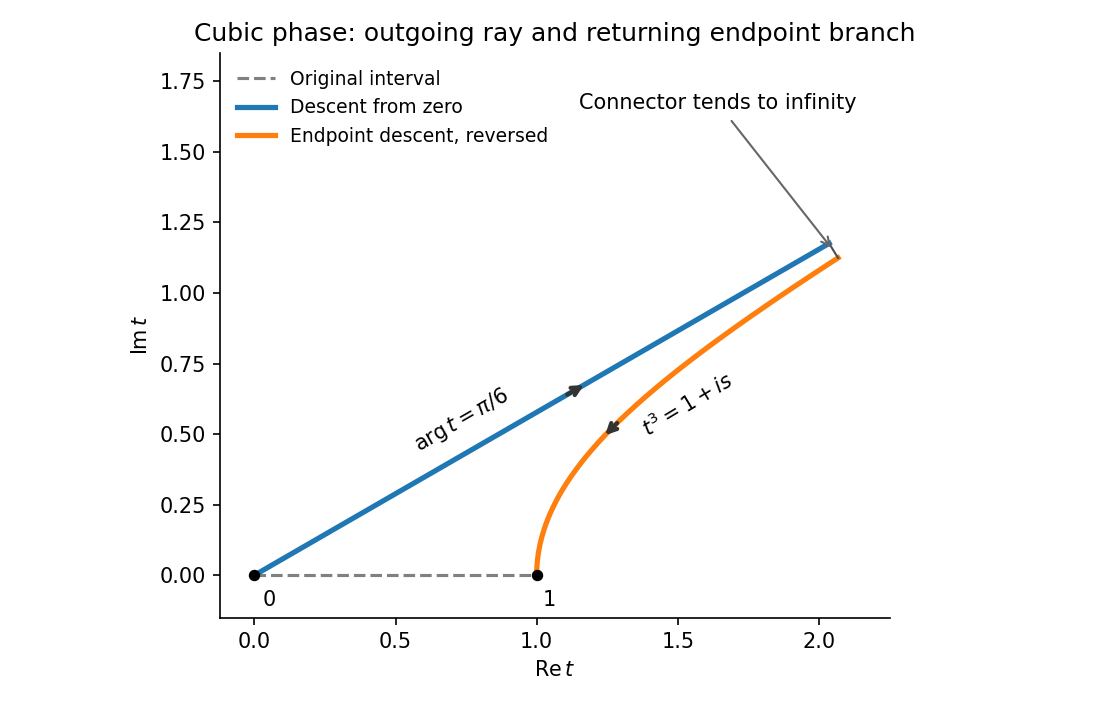

For a precise connector at infinity, use , . Its length is and the exponential has modulus . Its contribution is therefore . This avoids relying on an undifferentiated claim that every large circular arc decays.
A saddle point of the exponential phase occurs where . Hence the only saddle isIt is degenerate: the second phase derivative vanishes there, while the third is . This cubic degeneracy produces the scale. The other endpoint is not a saddle, since the phase derivative there is .
On the selected steepest descent contour put , . Then and . Its exact contribution isUse the Gamma function integral and its recurrence to obtainThere is no remainder here: the complete infinite descent ray was integrated exactly.
The endpoint branch has and . Its reversed orientation in the deformed contour givesAt ,Watson's lemma, or elementary Laplace's method with a Taylor remainder, now yieldsAdding the exact cubic-saddle contribution gives the two leading termsIf the next term is retained, it is . The different powers reflect a degenerate saddle at zero and an ordinary endpoint at one.
Articles by others on the same topic
There are currently no matching articles.