A coarse-grained scalar order parameter describes a short-range Ising-like transition with sign symmetry. Write the dimensionless Landau-Ginzburg functional asHere , with the relevant critical-mass shift understood when fluctuations are included. Higher local powers and gradients are negligible only within a justified long-distance expansion. The partition function is with a microscopic cutoff. The local functional is not already the fluctuation-integrated thermodynamic free energy.
Mean-field theory replaces this integral by its stable uniform saddle, . At ,The branch curvature is : it is above and below. HenceTogether with the finite heat-capacity jump from , this yieldsThe equal- susceptibility amplitude ratio is two. Uniform saddles also miss domain walls and spatial texture. For an -component order parameter, symmetry allows a vector generalization; ordered transverse directions additionally carry Goldstone fluctuations.
To include small fluctuations set . The Gaussian action is , givingThe displayed is a spectral covariance per Fourier delta, avoiding an extra volume factor. As , a growing correlation length lets increasingly large correlated regions fluctuate. The singular Gaussian heat correction contains , which is infrared singular for and logarithmic at four. This signals failure of a simple saddle expansion; the Gaussian heat exponent obtained by extrapolation is not the exact interacting critical exponent.
The Ginzburg criterion compares the fluctuation of a correlation-volume average with , rather than using all ultraviolet fluctuations at a point. Keeping below the transition gives, up to finite convention-dependent constants,Dividing by yieldsFor , writing gives a nonuniversal Ginzburg reduced-temperature windowInside , interacting fluctuations must be treated. For example, in three dimensions in this normalization. Above four dimensions the long-wavelength ratio vanishes at criticality; at four it is marginal and interaction-generated logarithms require further analysis.
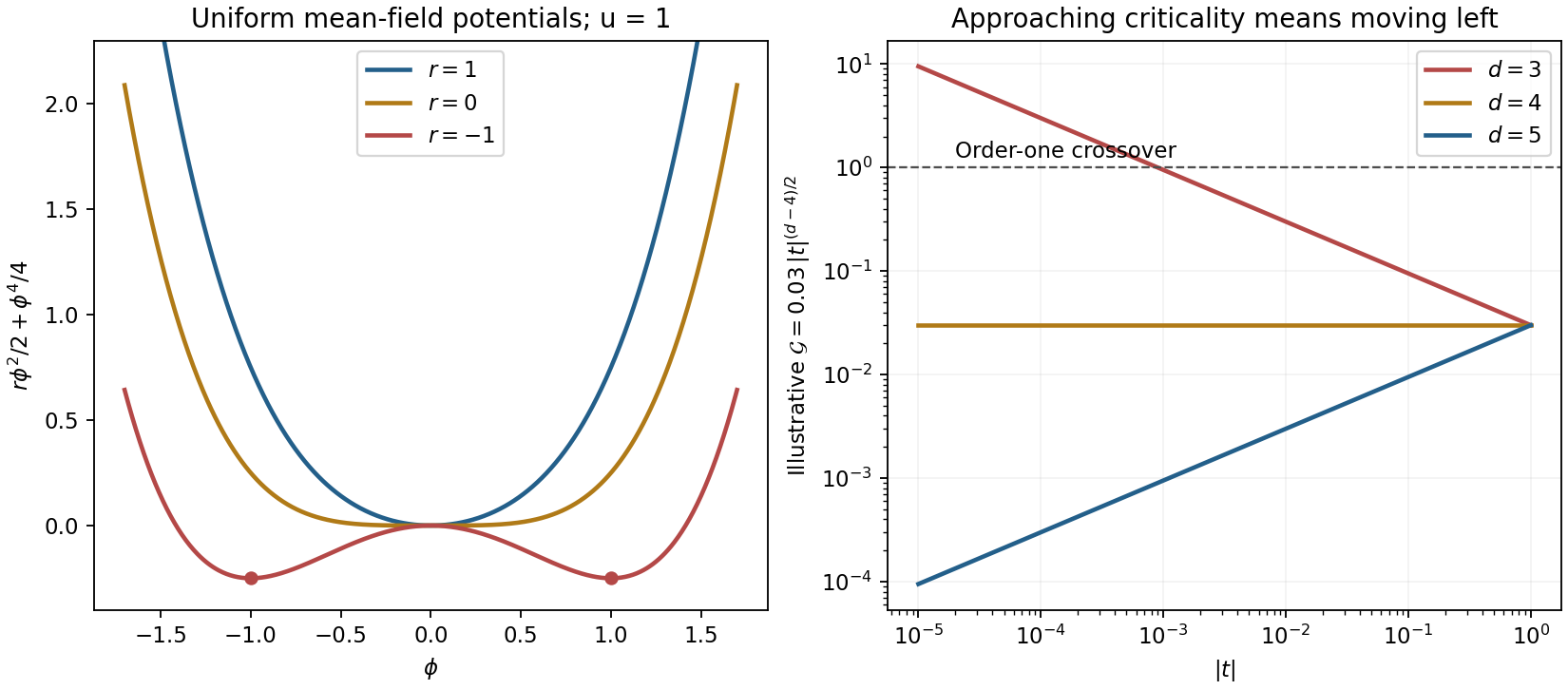

The spatial gradient term supplies correlations absent from uniform Landau theory. The Ginzburg test bounds where its mean-field saddle remains self-consistent; it does not compute nonclassical exponents or a universal material-independent window.[ref]
Statistical Field Theory by David Tong. §2.2.3–§2.2.4: correlation length, upper critical dimension and limits of Gaussian fluctuations
Articles by others on the same topic
There are currently no matching articles.