A coarse-grained scalar order parameter describes a short-range Ising-like transition with sign symmetry. Write the dimensionless Landau-Ginzburg functional asHere , with the relevant critical-mass shift understood when fluctuations are included. Higher local powers and gradients are negligible only within a justified long-distance expansion. The partition function is with a microscopic cutoff. The local functional is not already the fluctuation-integrated thermodynamic free energy.
Mean-field theory replaces this integral by its stable uniform saddle, . At ,The branch curvature is : it is above and below. HenceTogether with the finite heat-capacity jump from , this yieldsThe equal- susceptibility amplitude ratio is two. Uniform saddles also miss domain walls and spatial texture. For an -component order parameter, symmetry allows a vector generalization; ordered transverse directions additionally carry Goldstone fluctuations.
To include small fluctuations set . The Gaussian action is , givingThe displayed is a spectral covariance per Fourier delta, avoiding an extra volume factor. As , a growing correlation length lets increasingly large correlated regions fluctuate. The singular Gaussian heat correction contains , which is infrared singular for and logarithmic at four. This signals failure of a simple saddle expansion; the Gaussian heat exponent obtained by extrapolation is not the exact interacting critical exponent.
The Ginzburg criterion compares the fluctuation of a correlation-volume average with , rather than using all ultraviolet fluctuations at a point. Keeping below the transition gives, up to finite convention-dependent constants,Dividing by yieldsFor , writing gives a nonuniversal Ginzburg reduced-temperature windowInside , interacting fluctuations must be treated. For example, in three dimensions in this normalization. Above four dimensions the long-wavelength ratio vanishes at criticality; at four it is marginal and interaction-generated logarithms require further analysis.
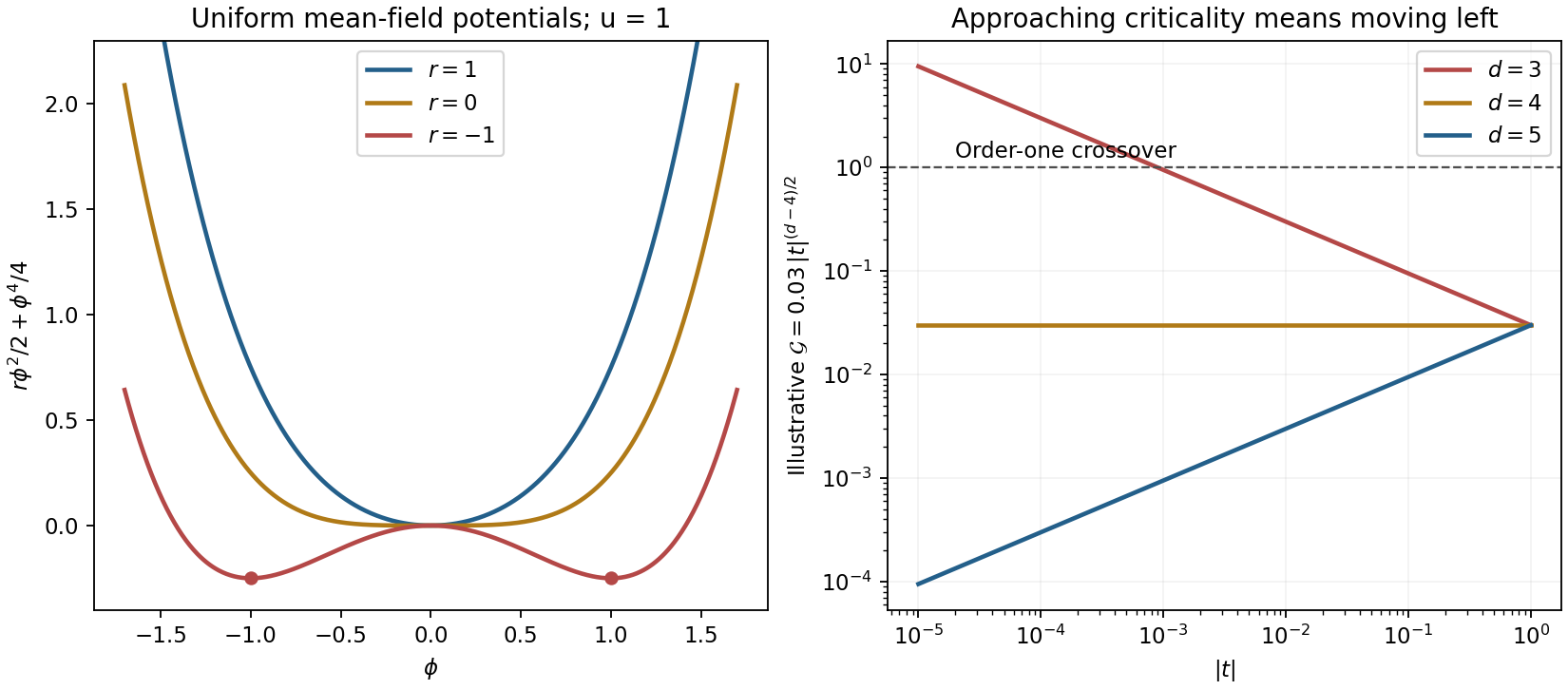

The spatial gradient term supplies correlations absent from uniform Landau theory. The Ginzburg test bounds where its mean-field saddle remains self-consistent; it does not compute nonclassical exponents or a universal material-independent window.[ref]
Statistical Field Theory by David Tong. §2.2.3–§2.2.4: correlation length, upper critical dimension and limits of Gaussian fluctuations
Renormalization compares the same long-distance physics at different observation scales. The starting object is a microscopic or cutoff statistical Hamiltonian with every symmetry-allowed coupling . Because a critical correlation length is much larger than a lattice spacing, repeatedly eliminating short-distance detail can reveal scale-invariant behavior.
In a real-space transformation choose a normalized blocking kernel for retained variables. DefineSumming over proves exact preservation of before truncation. The transformed Hamiltonian generally gains longer-range and many-body interactions and a field-independent constant. Observables must be blocked consistently. In momentum-shell language split , integrate , then use and a field rescaling to restore cutoff and kinetic normalization. Coarse-graining, rescaling and tracking generated interactions are distinct steps.
Repeated transformations generate a flow with composition when the same exact coarse-graining family is used. Losing degrees of freedom generally makes this a semigroup, despite its conventional group name. A renormalization-group fixed point is invariant after rescaling. At a continuous transition the large-distance theory approaches a critical renormalization-group fixed point; finite correlation length instead eventually flows into an ordinary thermodynamic phase regime.
Linearize in scaling coordinates :For increasing observation length, is relevant and must be tuned, is irrelevant, and is marginal and needs nonlinear analysis. Discrete multipliers must be compared with one, not with zero. The stable manifold forms the critical surface after relevant directions have been set to zero.
After subtracting regular additive contributions, ordinary hyperscaling givesChoosing or choosing the field as scale yieldsFor a critical two-point function , the order parameter scaling dimension is , and its conjugate field has . This recovers the Q1 identities while distinguishing the gap exponent from the field's scaling dimension .
As a concrete dimensional check, start from a scalar gradient action. Restoring its coefficient uses , so at the Gaussian fixed pointQuartic interactions are relevant below four dimensions. They can produce an interacting Wilson-Fisher fixed point, whose exponents differ from naive Gaussian counting. Above four, the quartic coupling is irrelevant at the Gaussian fixed point but dangerous for ordered observables: is singular when is dropped. Thus the simple two-variable hyperscaling formula is not universal above the upper critical dimension.
Different microscopic systems can flow to the same long-distance renormalization-group fixed point, explaining universality of exponents and normalized scaling forms. Critical temperatures, metric factors and regular free energies remain nonuniversal. Dimension, order parameter symmetry, interaction range and additional soft variables constrain the universality class. Truncations, perturbative expansions and numerics approximate the flow; they must not be confused with the exact elimination definition.[ref]
Statistical Field Theory by David Tong. §3.1–§3.3: coarse-graining, scaling, relevance and dangerously irrelevant interactions
For a ferromagnetic nearest-neighbour Ising model on a chain let , and . The dimensionless Hamiltonian is . In one dimension, decimating every other spin closes exactly within the nearest-neighbour family, including its additive constant. This is the exact chain building block of the Migdal-Kadanoff approach; bond moving becomes an additional approximation in higher-dimensional lattices.
For exact zero-field Ising-chain decimation, sum over an intermediate spin between two retained spins:Parallel and antiparallel end spins give and . HenceFor an even periodic chain, . Rescaling the lattice spacing back to completes the renormalization step. Decimation of successive links gives , as follows by multiplying the transfer matrix times.
Let . Then on . The infinite-temperature renormalization-group fixed point attracts every ; the zero-temperature renormalization-group fixed point is unstable to heating, with slope two. There is no intermediate ferromagnetic renormalization-group fixed point. Equivalently for small , while for large finite . Thus there is no finite-temperature ordered thermodynamic phase in the short-range chain.
The domain-wall scaling coordinate of an Ising chain near is the domain-wall Boltzmann factor . Its recursion and the zero-field correlation length areSince , the recursion has the correct length scaling. Its exponent is one with respect to ; it is not a finite power of physical temperature about . In the thermodynamic limit, a bond is a domain wall with probability , giving the same exponentially large length scale. Their finite energy allows entropy to proliferate walls at any positive temperature.
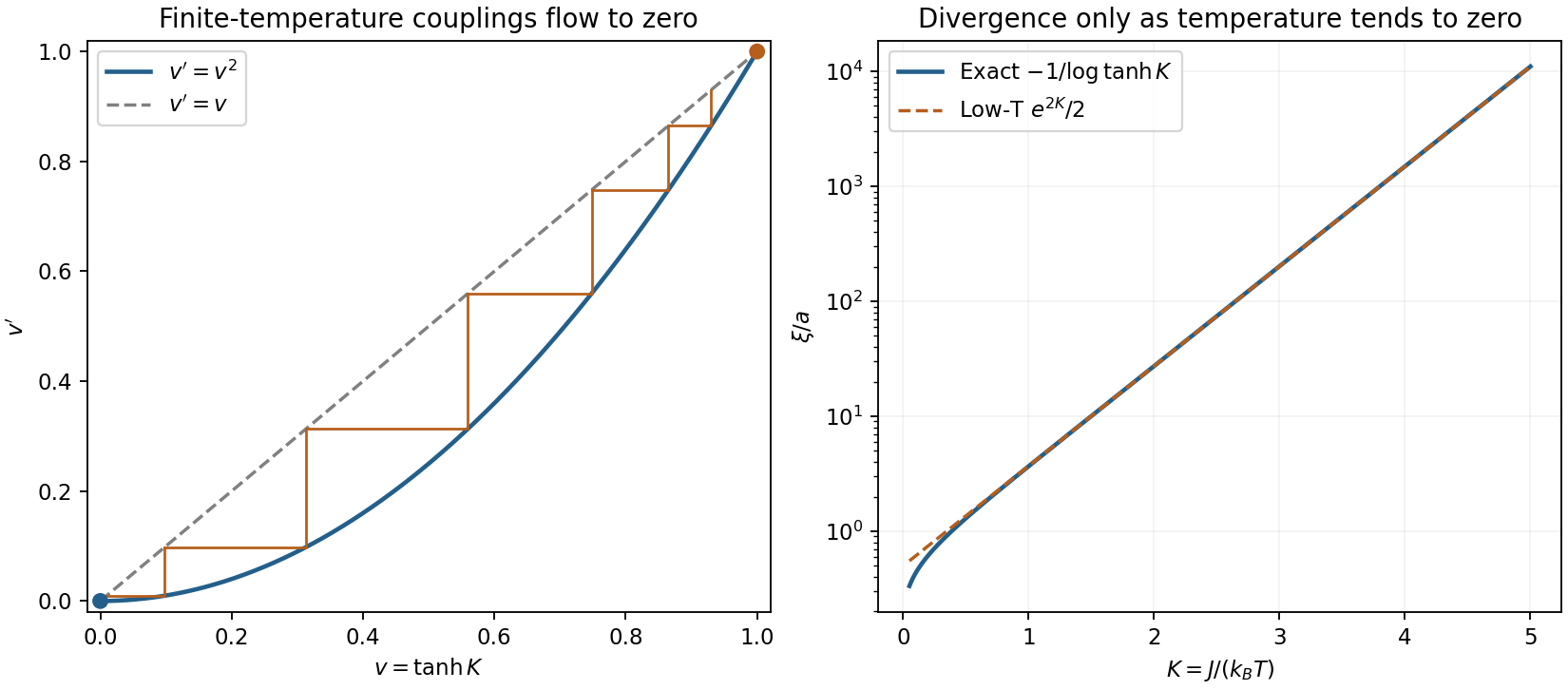
Exact Ising-chain decimation and length
. Original one-dimensional recursion v'=v squared, finite-temperature iterates flowing to zero and the exact correlation length with its low-temperature asymptote. The coordinate v is tanh(J/kBT); no finite-temperature critical point is introduced. Details.
The Ising-chain decimation constant matters for thermodynamics. With dimensionless free energy per spin ,The second expression follows independently from transfer eigenvalues and and satisfies the recursion. Multiplying it by restores the physical free energy. Dropping would preserve normalized retained-spin probabilities but lose the eliminated-spin entropy.
Finite-field Ising-chain decimation is also exact. Use the symmetric transfer matrixand read the new couplings fromHere , and . The latter off-diagonal entry, the field convention split between adjacent bonds and the constant must all be tracked consistently. Near the zero-temperature zero-field renormalization-group fixed point , while at the independent-spin field is unchanged.
In the higher-dimensional Migdal-Kadanoff approximation, moving bonds creates chains that can be decimated. With bond moving first on a -dimensional hypercubic lattice and length factor , the strengthened links have , giving the conventionFor no transverse bonds move, so this reduces to the exact chain result. In higher dimensions it discards geometric correlations and is generally approximate on the original lattice; moving and decimating in another order yields another approximation, not a contradictory exact chain formula.[ref]
Position Space Renormalization Group by Mehran Kardar. lecture 13, printed pp. 79–81, equations V.18–V.27: exact chain; lecture 14, printed pp. 86–87, equations V.51–V.54: bond-moving convention
Articles by others on the same topic
There are currently no matching articles.