In Cartesian coordinates on Euclidean space, the gradient of a scalar-valued differentiable function is the vector of its first partial derivatives. It converts a scalar field, such as temperature or a height, into a vector field describing its local change.
For a unit vector u, the directional derivative is Duf=u⋅∇f. The Cauchy-Schwarz inequality gives ∣Duf∣≤∣∇f∣. At a point where ∇f=0, the greatest increase per unit distance occurs along u=∇f/∣∇f∣, while the opposite direction gives the greatest decrease. These are first-order statements at the current point; they do not predict how the function behaves far along a straight path.
For f(x,y)=x2+2y2 at (1,1), ∇f=(2,4). Moving in the x direction gives rate 2 and moving in the y direction gives rate 4, but the steepest direction is (1,2)/5, withThe direction (−2,1)/5 has rate zero and is tangent to the level curve through that point. More generally, differentiating f(γ(t))=constant along a regular level curve gives ∇f⋅γ′=0, so the gradient is its normal vector.
Duf=25.
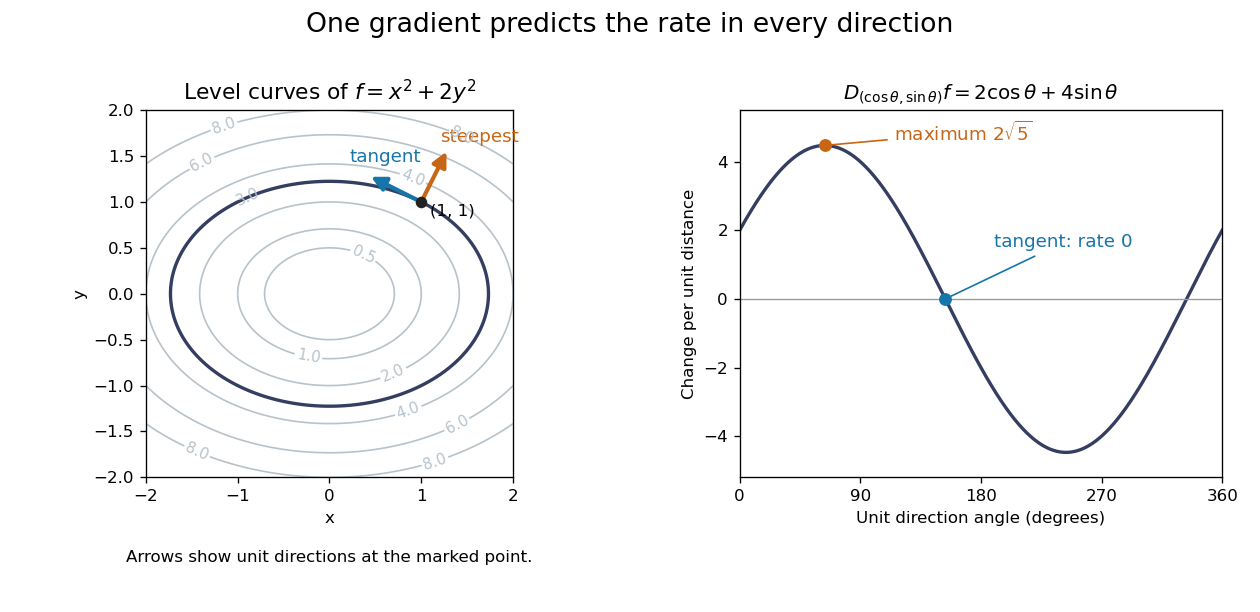
A gradient is normal to level curves and determines the directional derivative for every unit direction
. Details. This is useful when navigating a measured scalar field or applying gradient descent: one collection of partial derivatives predicts every infinitesimal directional change. The derivative assumes a differentiable function, not merely the existence of all directional derivatives. [ref]
4.6 Directional Derivatives and the Gradient. Calculus Volume 3 by Gilbert Strang and others; OpenStax: Directional derivatives and the gradient
.For a differentiable real-valued functional F on a real Hilbert space H, its functional gradient satisfies DF(g)[h]=⟨∇HF(g),h⟩H for every h∈H. A bounded linear derivative has a unique such representative by the Riesz representation theorem. The inner product matters: a formal variational derivative need not equal the functional gradient in another Hilbert space. For F(g)=21∑i(yi−g(xi))2 in a Reproducing kernel Hilbert space, the reproducing property gives ∇HF(g)=∑i(g(xi)−yi)k(xi,⋅). Substitution in the defining inner product proves this formula directly.
For r=x12+⋯+xd2>0, the multivariable chain rule givesIndeed, ∂r/∂xj=xj/r. Thus the gradient points radially outward when g′(r)>0, inward when it is negative, and vanishes when it is zero.
∇g(r)=g′(r)r(x1,…,xd).
At the origin the displayed quotient does not apply. If g has a finite right derivative at zero, the radial function is differentiable there exactly when g′(0+)=0, in which case its gradient is zero. Necessity follows by comparing opposite directional difference quotients: their linear parts cannot both equal a common nonzero radial slope. Sufficiency follows from g(r)−g(0)=o(r), the definition of differentiability with zero linear part.
For differentiable vector fields, expand the cross products using the contraction of two Levi-Civita symbols. The directional-derivative terms cancel the corresponding terms in the two cross products, leaving ∂i(FjGj). This proves the displayed gradient identity by the product rule.
A gradient field is a vector field of the form ∇f for a scalar potential f. Its curl vanishes wherever the required second derivatives commute.
Ancestors (8)
- Partial derivative
- Multivariable calculus
- Calculus
- Real analysis
- Analysis
- Area of mathematics
- Mathematics
- Home
Incoming links (860)
- Acceleration potential
- Acceleration potential of a homogeneous motion
- Angle between intersecting regular surfaces
- Anisotropic Gaussian smectic scaling
- Annular Caccioppoli inequality
- Averaged linearization of a nonlinear divergence-form equation
- Averaged stationarity bound for stochastic gradient descent
- Backpropagation through time
- Barotropic vorticity transport
- Beckmann potential
- Birefringent walk-off
- Block coordinate gradient
- Bose-gas phase-only action
- Boundary flux from a singular harmonic potential
- Boundary layer
- Bounded two-dimensional capacitor field model
- Bounded-variation compactness
- Brenier theorem
- Buoyancy gradient
- Calibration for semicircular hyperbolic geodesics
- Canonical momenta for a squared coordinate
- Cauchy decrease bound
- Cauchy point
- Cell migration
- Centrifugal potential of cylindrical rotation
- Chemoattractant
- Circularly polarized nonlinear Alfvén wave
- Classical Ising chain as a quantum particle
- Closed-form ridge regression estimator
- Coarea formula
- Conformal invariance of the planar Dirichlet inner product
- Conformality
- Conormal derivative
- Constraint qualification
- Convex function
- Convex KKT optimality certificate
- Convex optimization
- Coordinate Lipschitz continuity
- Coordinate subspace
- Corner compatibility for collinear oblique derivative data
- Covector
- Covector evolution of a material scalar gradient
- Critical point
- Critical value
- Cubic degenerate saddle
- Curl of a gradient
- Curl product rule for a scalar field
- Del in cylindrical and spherical coordinates
- Dennis-Moré condition
- Density gradient
- Derivative
- Derivative along a curve
- Descent direction
- Descent lemma
- Dialysis (biochemistry)
- Diffusion
- Diffusive flux
- Direct-adjoint looping
- Directional derivative
- Directional error of a first-order Taylor approximation
- Discrete Hessian-norm denoising
- Disk-median curvature expansion
- Dislocation core
- Divergence and curl of a radial vector field
- Dot-product gradient identity
- Double circular cone
- Edge-free Mumford–Shah limit
- Effective gravity in a rotating frame
- Electric dipole
- Electric potential
- Eligibility trace
- Ellipticity of the minimal surface flux
- EM likelihood monotonicity
- Ertel's theorem
- Euler potentials
- Exact line search
- Exploding gradient problem
- Failure of L2-to-Linfinity Poisson gradient bounds in three dimensions
- Failure of multiplier stationarity at a singular constraint
- Feasible triangle with a squared-distance objective
- Feedback alignment
- Fick's first law
- Fick's laws
- First-order optimality condition
- Fixed-energy initial-condition optimality
- Flat direction of a scalar potential
- Flux-normalized elastic characteristic amplitudes
- Gårding's inequality
- Gauge transformation
- Gaussian curvature
- Gaussian momentum-shell scaling
- Gaussian rotation interpolation inequality
- Gauss's law
- Geopotential
- Ginzburg reduced-temperature window
- Global discrete gradient-norm denoising
- Gradient
- Gradient ascent
- Gradient-B drift
- Gradient descent
- Gradient descent preserves an eigenline for a cubic product
- Gradient Estimation Using Stochastic Computation Graphs by John Schulman and others
- Gradient in cylindrical coordinates
- Gradient maximum principle for harmonic functions
- Gradient of a dipole potential
- Gradient of a dot product
- Gradient of a radial function
- Graph-area Euler-Lagrange equation
- Gravitational field
- Green theorem with holes
- Harmonicity under holomorphic composition
- Helium-3 superfluid discovery experiment
- Helmholtz decomposition
- Hessian matrix
- Hessian of the Euclidean norm
- Higher-order test for separated extrema
- Homogeneous Sobolev space
- Ill-conditioning of a logarithmic barrier
- Image edge
- Interaction potential
- Interior gradient estimate near a zero Dirichlet side
- Interior moment matching in a finite exponential family
- Inverse-square potential
- Karush-Kuhn-Tucker conditions
- Kinematic pressure
- KKT regularity at a local minimum
- Knudsen number
- Ladyzhenskaya's inequality
- Lagrange multiplier
- Lagrange multiplier determinant condition in two variables
- Lagrange multiplier for quadratic cost
- Landau scalar correlation length
- Laplacian
- Level surface
- Liouville lemma for globally Hölder harmonic functions
- Lipschitz gradient
- Local maximum
- Local minimum
- Local strain compatibility versus screw-dislocation circulation
- Local wavelength
- Logarithmic cutoff proof of harmonic uniqueness with finitely many boundary exceptions
- Logarithmic energy of a planar nematic disclination
- Logarithmic gradient of an exponential squared-distance sum
- Log-likelihood
- Lorentz invariance of plane-wave phase
- Magnetic dipole force
- Magnetization
- Mapping a capacitor fringing field
- Maser state selection
- Massive Gaussian field correlation tail
- Minimal graphical cone is a plane
- Monotone operator
- Morphogen gradient
- Nesterov accelerated gradient method
- Neumann compatibility condition for Laplace's equation
- Newton correction compatibility condition
- Newtonian gravitational field
- Newtonian gravitational potential
- Newtonian velocity preservation in a second-order fluid
- Newton map in optimization
- Newton minimization of the square-root norm
- Newton step
- Nonconvexity of Mumford–Shah segmentation
- Nonisolated stationary point
- Non-vertical supporting hyperplane of a value function
- Normal line to a plane curve
- Normal vector
- One-loop shell mass renormalization in scalar quartic theory
- One-step Newton solution of a quadratic stationary equation
- Origin-regular spherical Poisson flux law
- Orthogonality of regular real and imaginary level curves
- Orthogonality of supported and harmonic Dirichlet functions
- Past exam of the advanced fluid dynamics course of the University of Oxford / 2016 / 1 / a / Solution
- Past exam of the advanced fluid dynamics course of the University of Oxford / 2017 / 1 / a / Solution
- Past exam of the advanced fluid dynamics course of the University of Oxford / 2017 / 1 / b / Solution
- Past exam of the advanced fluid dynamics course of the University of Oxford / 2017 / 2 / b / Solution
- Past exam of the advanced topics in statistical machine learning course of the University of Oxford / 2025 / 3 / a / ii / Solution
- Past exam of the algebra, analysis and differential equations 1 course of the University of Oxford / 2004 / Differential equations / 9 / ii / Solution
- Past exam of the approximation theory and finite element methods course of the University of Oxford / 2007 / B / 6 / iii / Solution
- Past exam of the astrophysical fluid dynamics course of the University of Cambridge / 2016 / Paper 1 / 3 / b / Solution
- Past exam of the astrophysical fluid dynamics course of the University of Cambridge / 2019 / Section B / 4 / Solution
- Past exam of the atomic and Optical Physics course of the University of Cambridge / 2012 / Paper 1 / 1 / Solution
- Past exam of the atomic and Optical Physics course of the University of Cambridge / 2012 / Paper 1 / 3 / a / Solution
- Past exam of the biological physics course of the University of Oxford / 2019 / 2 / d / Solution
- Past exam of the biological physics course of the University of Oxford / 2019 / 5 / d / Solution
- Past exam of the biological physics course of the University of Oxford / 2019 / 6 / i / Solution
- Past exam of the calculus of variations course of the University of Oxford / 2011 / 1 / a / Solution
- Past exam of the calculus of variations course of the University of Oxford / 2011 / 1 / b / ii / Solution
- Past exam of the chemistry course of the year 4 of the natural sciences course of the University of Cambridge / 2022 / Paper 3 / Section F / 47 / b / Solution
- Past exam of the classical mechanics course of the University of Oxford / 2023 / 1 / b / i / Solution
- Past exam of the collisionless plasma physics course of the University of Oxford / 2025 / 3 / c / Solution
- Past exam of the computational neuroscience course of the University of Oxford / 2022 / 5 / Solution
- Past exam of the computational neuroscience course of the University of Oxford / 2022 / 6 / Solution
- Past exam of the computer science course of the University of Oxford / 2015 / Geometric modelling / 1 / b / Solution
- Past exam of the continuous martingales and stochastic calculus course of the University of Oxford / 2023 / 3 / b / i / Solution
- Past exam of the continuous optimisation course of the University of Oxford / 2011 / 1 / iii / Solution
- Past exam of the continuous optimisation course of the University of Oxford / 2011 / 1 / ii / Solution
- Past exam of the continuous optimisation course of the University of Oxford / 2011 / 2 / iii / Solution
- Past exam of the continuous optimisation course of the University of Oxford / 2011 / 2 / ii / Solution
- Past exam of the continuous optimisation course of the University of Oxford / 2011 / 3 / ii / Solution
- Past exam of the continuous optimisation course of the University of Oxford / 2025 / 1 / c / iii / Solution
- Past exam of the continuous optimisation course of the University of Oxford / 2025 / 2 / a / iii / Solution
- Past exam of the continuous optimisation course of the University of Oxford / 2025 / 2 / a / ii / Solution
- Past exam of the continuous optimisation course of the University of Oxford / 2025 / 2 / a / i / Solution
- Past exam of the continuous optimisation course of the University of Oxford / 2025 / 2 / b / i / Solution
- Past exam of the cosmology course of the University of Oxford / 2025 / 2 / a / Solution
- Past exam of the differential equations 1 course of the University of Oxford / 2021 / 3 / a / ii / Solution
- Past exam of the elasticity and plasticity course of the University of Oxford / 2007 / 3 / ii / Solution
- Past exam of the elasticity and plasticity course of the University of Oxford / 2007 / 3 / i / Solution
- Past exam of the elasticity and plasticity course of the University of Oxford / 2008 / 1 / a / Solution
- Past exam of the elasticity and plasticity course of the University of Oxford / 2008 / 1 / b / Solution
- Past exam of the elasticity and plasticity course of the University of Oxford / 2010 / 1 / a / Solution
- Past exam of the elasticity and plasticity course of the University of Oxford / 2010 / 1 / b / Solution
- Past exam of the electromagnetism and optics course of the University of Oxford / 2016 / 1 / Solution
- Past exam of the electromagnetism course of the University of Oxford / 2023 / 2 / b / ii / Solution
- Past exam of the electromagnetism course of the University of Oxford / 2023 / 3 / a / Solution
- Past exam of the electromagnetism course of the University of Oxford / 2023 / 3 / d / i / Solution
- Past exam of the finite element methods for partial differential equations course of the University of Oxford / 2011 / 1 / Solution
- Past exam of the finite element methods for partial differential equations course of the University of Oxford / 2023 / 2 / c / Solution
- Past exam of the fixed point methods for nonlinear partial differential equations course of the University of Oxford / 2023 / 3 / d / Solution
- Past exam of the fluids and waves course of the University of Oxford / 2014 / 1 / a / Solution
- Past exam of the fluids and waves course of the University of Oxford / 2015 / 1 / a / Solution
- Past exam of the fluids and waves course of the University of Oxford / 2017 / 2 / a / ii / Solution
- Past exam of the fluids and waves course of the University of Oxford / 2023 / 1 / a / Solution
- Past exam of the functional analytic methods for partial differential equations course of the University of Oxford / 2023 / 1 / b / Solution
- Past exam of the functional analytic methods for partial differential equations course of the University of Oxford / 2023 / 2 / b / iii / Solution
- Past exam of the functional analytic methods for partial differential equations course of the University of Oxford / 2023 / 2 / b / iv / Solution
- Past exam of the functional analytic methods for partial differential equations course of the University of Oxford / 2023 / 3 / a / ii / Solution
- Past exam of the functional analytic methods for partial differential equations course of the University of Oxford / 2023 / 3 / b / iv / Solution
- Past exam of the further mathematical biology course of the University of Oxford / 2023 / 3 / a / Solution
- Past exam of the general relativity II course of the University of Oxford / 2021 / 1 / d / ii / Solution
- Past exam of the how to build a brain from scratch course of the University of Oxford / 2022 / 2 / Solution
- Past exam of the how to build a brain from scratch course of the University of Oxford / 2022 / 6 / Solution
- Past exam of the mathematical and Computational Biology course of the University of Cambridge / 2025 / Paper 2 / 7 / c / Solution
- Past exam of the mathematical and Computational Biology course of the University of Cambridge / 2025 / Paper 2 / 7 / d / Solution
- Past exam of the mathematical and Computational Biology course of the University of Cambridge / 2025 / Paper 2 / 7 / e / Solution
- Past exam of the mathematical methods I course of the University of Oxford / 2015 / 13 / b / ii / Solution
- Past exam of the mathematical methods II course of the University of Oxford / 2013 / 11 / b / Solution
- Past exam of the mathematical methods II course of the University of Oxford / 2013 / 4 / a / Solution
- Past exam of the mathematical methods II course of the University of Oxford / 2013 resit / 6 / Solution
- Past exam of the mathematical methods II course of the University of Oxford / 2014 / 12 / a / Solution
- Past exam of the mathematical methods II course of the University of Oxford / 2014 / 3 / Solution
- Past exam of the mathematical methods II course of the University of Oxford / 2014 resit / 6 / b / Solution
- Past exam of the mathematical methods II course of the University of Oxford / 2015 / 9 / b / Solution
- Past exam of the mathematical methods II course of the University of Oxford / 2015 / 9 / c / Solution
- Past exam of the mathematical methods II course of the University of Oxford / 2015 resit / 10 / a / Solution
- Past exam of the mathematical methods II course of the University of Oxford / 2015 resit / 10 / b / Solution
- Past exam of the mathematical methods II course of the University of Oxford / 2015 resit / 10 / c / Solution
- Past exam of the mathematical methods II course of the University of Oxford / 2016 / 7 / Solution
- Past exam of the mathematical methods II course of the University of Oxford / 2016 resit / 12 / d / Solution
- Past exam of the mathematical methods II course of the University of Oxford / 2016 resit / 3 / i / Solution
- Past exam of the mathematical methods II course of the University of Oxford / 2016 resit / 6 / Solution
- Past exam of the mathematical methods II course of the University of Oxford / 2017 / 11 / d / Solution
- Past exam of the mathematical methods II course of the University of Oxford / 2017 resit / 4 / a / Solution
- Past exam of the mathematical methods II course of the University of Oxford / 2017 resit / 6 / Solution
- Past exam of the mathematical methods II course of the University of Oxford / 2017 resit / 7 / Solution
- Past exam of the mathematical methods II course of the University of Oxford / 2018 / 8 / Solution
- Past exam of the mathematical methods II course of the University of Oxford / 2021 / 4 / Solution
- Past exam of the mathematical methods II course of the University of Oxford / 2021 resit / 2 / Solution
- Past exam of the mathematical methods II course of the University of Oxford / 2021 resit / 5 / Solution
- Past exam of the mathematical methods II course of the University of Oxford / 2021 resit / 8 / c / Solution
- Past exam of the mathematical methods II course of the University of Oxford / 2022 / 10 / a / Solution
- Past exam of the mathematical methods II course of the University of Oxford / 2022 / 4 / Solution
- Past exam of the mathematics course of the University of Cambridge / 2001 / ib / Paper 1 / 15G / Solution
- Past exam of the mathematics course of the University of Cambridge / 2001 / ib / Paper 3 / 8G / Solution
- Past exam of the mathematics course of the University of Cambridge / 2001 / iii / Paper 12 / 4 / Solution
- Past exam of the mathematics course of the University of Cambridge / 2001 / iii / Paper 42 / 2 / Solution
- Past exam of the mathematics course of the University of Cambridge / 2002 / ia / Paper 3 / 12A / c / Solution
- Past exam of the mathematics course of the University of Cambridge / 2002 / ia / Paper 3 / 9A / Solution
- Past exam of the mathematics course of the University of Cambridge / 2002 / iii / Paper 43 / 3 / Solution
- Past exam of the mathematics course of the University of Cambridge / 2002 / iii / Paper 43 / 4 / Solution
- Past exam of the mathematics course of the University of Cambridge / 2002 / iii / Paper 47 / 2 / Solution
- Past exam of the mathematics course of the University of Cambridge / 2002 / iii / Paper 51 / 2 / Solution
- Past exam of the mathematics course of the University of Cambridge / 2002 / iii / Paper 64 / 2 / Solution
- Past exam of the mathematics course of the University of Cambridge / 2002 / iii / Paper 69 / 1 / b / Solution
- Past exam of the mathematics course of the University of Cambridge / 2002 / iii / Paper 69 / 1 / Solution
- Past exam of the mathematics course of the University of Cambridge / 2002 / iii / Paper 69 / 2 / c / Solution
- Past exam of the mathematics course of the University of Cambridge / 2002 / iii / Paper 69 / 2 / Solution
- Past exam of the mathematics course of the University of Cambridge / 2002 / iii / Paper 69 / 3 / c / Solution
- Past exam of the mathematics course of the University of Cambridge / 2002 / iii / Paper 71 / 4 / a / Solution
- Past exam of the mathematics course of the University of Cambridge / 2003 / ia / Paper 3 / 11A / a / Solution
- Past exam of the mathematics course of the University of Cambridge / 2003 / ia / Paper 3 / 12A / Solution
- Past exam of the mathematics course of the University of Cambridge / 2003 / iii / Paper 34 / 3 / Solution
- Past exam of the mathematics course of the University of Cambridge / 2003 / iii / Paper 34 / 4 / Solution
- Past exam of the mathematics course of the University of Cambridge / 2003 / iii / Paper 9 / 1 / b / Solution
- Past exam of the mathematics course of the University of Cambridge / 2004 / iii / Paper 55 / 1 / Solution
- Past exam of the mathematics course of the University of Cambridge / 2004 / iii / Paper 59 / 2 / b / Solution
- Past exam of the mathematics course of the University of Cambridge / 2004 / iii / Paper 59 / 3 / a / Solution
- Past exam of the mathematics course of the University of Cambridge / 2004 / iii / Paper 59 / 3 / b / Solution
- Past exam of the mathematics course of the University of Cambridge / 2005 / ib / Paper 2 / 8E / Solution
- Past exam of the mathematics course of the University of Cambridge / 2005 / iii / Paper 82 / 1 / b / Solution
- Past exam of the mathematics course of the University of Cambridge / 2005 / iii / Paper 82 / 2 / a / Solution
- Past exam of the mathematics course of the University of Cambridge / 2005 / iii / Paper 83 / 1 / i / Solution
- Past exam of the mathematics course of the University of Cambridge / 2005 / iii / Paper 83 / 2 / v / Solution
- Past exam of the mathematics course of the University of Cambridge / 2005 / iii / Paper 83 / 3 / ii / Solution
- Past exam of the mathematics course of the University of Cambridge / 2005 / iii / Paper 83 / 4 / iii / Solution
- Past exam of the mathematics course of the University of Cambridge / 2005 / iii / Paper 83 / 4 / ii / Solution
- Past exam of the mathematics course of the University of Cambridge / 2005 / iii / Paper 83 / 4 / iv / Solution
- Past exam of the mathematics course of the University of Cambridge / 2006 / ia / Paper 1 / 1B / Solution
- Past exam of the mathematics course of the University of Cambridge / 2006 / ib / Paper 1 / 5A / Solution
- Past exam of the mathematics course of the University of Cambridge / 2006 / ib / Paper 1 / 8C / Solution
- Past exam of the mathematics course of the University of Cambridge / 2006 / iii / Paper 42 / 4 / iv / Solution
- Past exam of the mathematics course of the University of Cambridge / 2006 / iii / Paper 51 / 1 / a / Solution
- Past exam of the mathematics course of the University of Cambridge / 2006 / iii / Paper 51 / 1 / f / Solution
- Past exam of the mathematics course of the University of Cambridge / 2006 / iii / Paper 51 / 3 / Solution
- Past exam of the mathematics course of the University of Cambridge / 2006 / iii / Paper 77 / 1 / Solution
- Past exam of the mathematics course of the University of Cambridge / 2006 / iii / Paper 77 / 2 / Solution
- Past exam of the mathematics course of the University of Cambridge / 2006 / iii / Paper 77 / 3 / Solution
- Past exam of the mathematics course of the University of Cambridge / 2006 / iii / Paper 80 / 1 / i / Solution
- Past exam of the mathematics course of the University of Cambridge / 2006 / iii / Paper 80 / 2 / iii / Solution
- Past exam of the mathematics course of the University of Cambridge / 2006 / iii / Paper 80 / 2 / i / Solution
- Past exam of the mathematics course of the University of Cambridge / 2006 / iii / Paper 80 / 3 / ii / Solution
- Past exam of the mathematics course of the University of Cambridge / 2006 / iii / Paper 86 / 3 / c / Solution
- Past exam of the mathematics course of the University of Cambridge / 2007 / ia / Paper 3 / 3A / ii / Solution
- Past exam of the mathematics course of the University of Cambridge / 2007 / ia / Paper 3 / 9A / i / Solution
- Past exam of the mathematics course of the University of Cambridge / 2007 / ib / Paper 3 / 20C / Solution
- Past exam of the mathematics course of the University of Cambridge / 2007 / ib / Paper 3 / 6E / Solution
- Past exam of the mathematics course of the University of Cambridge / 2007 / ib / Paper 4 / 18D / Solution
- Past exam of the mathematics course of the University of Cambridge / 2007 / iii / Paper 35 / 1 / Solution
- Past exam of the mathematics course of the University of Cambridge / 2007 / iii / Paper 65 / 2 / c / i / Solution
- Past exam of the mathematics course of the University of Cambridge / 2007 / iii / Paper 65 / 4 / a / Solution
- Past exam of the mathematics course of the University of Cambridge / 2007 / iii / Paper 68 / 4 / Solution
- Past exam of the mathematics course of the University of Cambridge / 2007 / iii / Paper 84 / 4 / ii / Solution
- Past exam of the mathematics course of the University of Cambridge / 2008 / ia / Paper 3 / 11C / b / iii / Solution
- Past exam of the mathematics course of the University of Cambridge / 2008 / iii / Paper 13 / 3 / b / Solution
- Past exam of the mathematics course of the University of Cambridge / 2008 / iii / Paper 13 / 4 / a / Solution
- Past exam of the mathematics course of the University of Cambridge / 2008 / iii / Paper 13 / 5 / c / Solution
- Past exam of the mathematics course of the University of Cambridge / 2008 / iii / Paper 13 / 6 / a / Solution
- Past exam of the mathematics course of the University of Cambridge / 2008 / iii / Paper 17 / 5 / c / Solution
- Past exam of the mathematics course of the University of Cambridge / 2008 / iii / Paper 45 / 2 / a / Solution
- Past exam of the mathematics course of the University of Cambridge / 2008 / iii / Paper 50 / 1 / b / Solution
- Past exam of the mathematics course of the University of Cambridge / 2008 / iii / Paper 50 / 2 / Solution
- Past exam of the mathematics course of the University of Cambridge / 2008 / iii / Paper 50 / 3 / b / Solution
- Past exam of the mathematics course of the University of Cambridge / 2008 / iii / Paper 61 / 3 / c / Solution
- Past exam of the mathematics course of the University of Cambridge / 2008 / iii / Paper 74 / 1 / Solution
- Past exam of the mathematics course of the University of Cambridge / 2008 / iii / Paper 74 / 2 / Solution
- Past exam of the mathematics course of the University of Cambridge / 2008 / iii / Paper 86 / 3 / Solution
- Past exam of the mathematics course of the University of Cambridge / 2008 / iii / Paper 86 / 4 / Solution
- Past exam of the mathematics course of the University of Cambridge / 2008 / iii / Paper 87 / 3 / iii / Solution
- Past exam of the mathematics course of the University of Cambridge / 2008 / iii / Paper 87 / 3 / i / Solution
- Past exam of the mathematics course of the University of Cambridge / 2008 / iii / Paper 87 / 3 / v / Solution
- Past exam of the mathematics course of the University of Cambridge / 2009 / ia / Paper 3 / 10B / Solution
- Past exam of the mathematics course of the University of Cambridge / 2009 / ia / Paper 3 / 9B / Solution
- Past exam of the mathematics course of the University of Cambridge / 2009 / ib / Paper 3 / 18D / Solution
- Past exam of the mathematics course of the University of Cambridge / 2009 / iii / Paper 12 / 1 / ii / Solution
- Past exam of the mathematics course of the University of Cambridge / 2009 / iii / Paper 12 / 1 / iv / Solution
- Past exam of the mathematics course of the University of Cambridge / 2009 / iii / Paper 12 / 1 / v / Solution
- Past exam of the mathematics course of the University of Cambridge / 2009 / iii / Paper 12 / 3 / ii / Solution
- Past exam of the mathematics course of the University of Cambridge / 2009 / iii / Paper 12 / 3 / i / Solution
- Past exam of the mathematics course of the University of Cambridge / 2009 / iii / Paper 12 / 5 / iv / Solution
- Past exam of the mathematics course of the University of Cambridge / 2009 / iii / Paper 12 / 6 / iii / Solution
- Past exam of the mathematics course of the University of Cambridge / 2009 / iii / Paper 12 / 6 / ii / Solution
- Past exam of the mathematics course of the University of Cambridge / 2009 / iii / Paper 12 / 6 / iv / Solution
- Past exam of the mathematics course of the University of Cambridge / 2009 / iii / Paper 22 / 2 / Solution
- Past exam of the mathematics course of the University of Cambridge / 2009 / iii / Paper 52 / 1 / e / Solution
- Past exam of the mathematics course of the University of Cambridge / 2010 / ia / Paper 2 / 8A / b / Solution
- Past exam of the mathematics course of the University of Cambridge / 2010 / ia / Paper 2 / 8A / c / Solution
- Past exam of the mathematics course of the University of Cambridge / 2010 / iii / Paper 32 / 3 / Solution
- Past exam of the mathematics course of the University of Cambridge / 2010 / iii / Paper 5 / 3 / b / Solution
- Past exam of the mathematics course of the University of Cambridge / 2011 / ia / Paper 2 / 6A / b / ii / Solution
- Past exam of the mathematics course of the University of Cambridge / 2011 / ia / Paper 4 / 9B / b / Solution
- Past exam of the mathematics course of the University of Cambridge / 2012 / ia / Paper 3 / 11C / b / Solution
- Past exam of the mathematics course of the University of Cambridge / 2012 / iii / Paper 13 / 4 / ii / Solution
- Past exam of the mathematics course of the University of Cambridge / 2012 / iii / Paper 32 / 2 / Solution
- Past exam of the mathematics course of the University of Cambridge / 2012 / iii / Paper 32 / 5 / Solution
- Past exam of the mathematics course of the University of Cambridge / 2012 / iii / Paper 49 / 3 / Solution
- Past exam of the mathematics course of the University of Cambridge / 2012 / iii / Paper 61 / 1 / i / Solution
- Past exam of the mathematics course of the University of Cambridge / 2012 / iii / Paper 61 / 3 / i / Solution
- Past exam of the mathematics course of the University of Cambridge / 2012 / iii / Paper 7 / 1 / g / Solution
- Past exam of the mathematics course of the University of Cambridge / 2013 / iii / Paper 57 / 1 / a / ii / Solution
- Past exam of the mathematics course of the University of Cambridge / 2013 / iii / Paper 57 / 1 / b / i / Solution
- Past exam of the mathematics course of the University of Cambridge / 2013 / iii / Paper 64 / 4 / Solution
- Past exam of the mathematics course of the University of Cambridge / 2013 / iii / Paper 75 / 4 / b / Solution
- Past exam of the mathematics course of the University of Cambridge / 2014 / ia / Paper 3 / 11A / iv / Solution
- Past exam of the mathematics course of the University of Cambridge / 2014 / ia / Paper 3 / 3A / a / Solution
- Past exam of the mathematics course of the University of Cambridge / 2014 / ia / Paper 3 / 3A / b / i / Solution
- Past exam of the mathematics course of the University of Cambridge / 2014 / ia / Paper 3 / 4A / a / Solution
- Past exam of the mathematics course of the University of Cambridge / 2014 / ia / Paper 3 / 9A / a / Solution
- Past exam of the mathematics course of the University of Cambridge / 2014 / iii / Paper 54 / 2 / a / Solution
- Past exam of the mathematics course of the University of Cambridge / 2014 / iii / Paper 54 / 4 / c / Solution
- Past exam of the mathematics course of the University of Cambridge / 2014 / iii / Paper 5 / 4 / a / iii / Solution
- Past exam of the mathematics course of the University of Cambridge / 2014 / iii / Paper 68 / 1 / Solution
- Past exam of the mathematics course of the University of Cambridge / 2014 / iii / Paper 68 / 2 / Solution
- Past exam of the mathematics course of the University of Cambridge / 2014 / iii / Paper 68 / 3 / Solution
- Past exam of the mathematics course of the University of Cambridge / 2014 / iii / Paper 68 / 4 / Solution
- Past exam of the mathematics course of the University of Cambridge / 2015 / iii / Paper 10 / 1 / 2 / Solution
- Past exam of the mathematics course of the University of Cambridge / 2015 / iii / Paper 10 / 3 / 2 / Solution
- Past exam of the mathematics course of the University of Cambridge / 2015 / iii / Paper 33 / 1 / Solution
- Past exam of the mathematics course of the University of Cambridge / 2015 / iii / Paper 57 / 2 / c / Solution
- Past exam of the mathematics course of the University of Cambridge / 2015 / iii / Paper 68 / 3 / c / Solution
- Past exam of the mathematics course of the University of Cambridge / 2015 / iii / Paper 9 / 2 / a / Solution
- Past exam of the mathematics course of the University of Cambridge / 2015 / iii / Paper 9 / 3 / a / Solution
- Past exam of the mathematics course of the University of Cambridge / 2016 / ia / Paper 3 / 11C / a / Solution
- Past exam of the mathematics course of the University of Cambridge / 2016 / ia / Paper 3 / 11C / c / Solution
- Past exam of the mathematics course of the University of Cambridge / 2016 / ia / Paper 3 / 12C / c / Solution
- Past exam of the mathematics course of the University of Cambridge / 2016 / ia / Paper 3 / 9C / b / Solution
- Past exam of the mathematics course of the University of Cambridge / 2016 / iii / Paper 107 / 4 / ii / Solution
- Past exam of the mathematics course of the University of Cambridge / 2016 / iii / Paper 107 / 4 / i / Solution
- Past exam of the mathematics course of the University of Cambridge / 2016 / iii / Paper 202 / 5 / c / Solution
- Past exam of the mathematics course of the University of Cambridge / 2016 / iii / Paper 213 / 4 / Solution
- Past exam of the mathematics course of the University of Cambridge / 2016 / iii / Paper 303 / 3 / a / Solution
- Past exam of the mathematics course of the University of Cambridge / 2016 / iii / Paper 303 / 3 / b / Solution
- Past exam of the mathematics course of the University of Cambridge / 2017 / ia / Paper 3 / 12B / b / Solution
- Past exam of the mathematics course of the University of Cambridge / 2017 / ib / Paper 3 / 6D / a / Solution
- Past exam of the mathematics course of the University of Cambridge / 2017 / iii / Paper 105 / 2 / c / Solution
- Past exam of the mathematics course of the University of Cambridge / 2017 / iii / Paper 105 / 2 / e / Solution
- Past exam of the mathematics course of the University of Cambridge / 2017 / iii / Paper 107 / 1 / b / Solution
- Past exam of the mathematics course of the University of Cambridge / 2017 / iii / Paper 203 / 2 / d / Solution
- Past exam of the mathematics course of the University of Cambridge / 2017 / iii / Paper 216 / 4 / c / Solution
- Past exam of the mathematics course of the University of Cambridge / 2017 / iii / Paper 216 / 6 / Solution
- Past exam of the mathematics course of the University of Cambridge / 2017 / iii / Paper 217 / 1 / Solution
- Past exam of the mathematics course of the University of Cambridge / 2017 / iii / Paper 303 / 3 / b / Solution
- Past exam of the mathematics course of the University of Cambridge / 2017 / iii / Paper 308 / 2 / Solution
- Past exam of the mathematics course of the University of Cambridge / 2017 / iii / Paper 311 / 3 / d / Solution
- Past exam of the mathematics course of the University of Cambridge / 2017 / iii / Paper 312 / 1 / b / i / Solution
- Past exam of the mathematics course of the University of Cambridge / 2017 / iii / Paper 320 / 2 / Solution
- Past exam of the mathematics course of the University of Cambridge / 2017 / iii / Paper 321 / 1 / b / i / Solution
- Past exam of the mathematics course of the University of Cambridge / 2017 / iii / Paper 321 / 2 / b / Solution
- Past exam of the mathematics course of the University of Cambridge / 2017 / iii / Paper 321 / 3 / a / ii / Solution
- Past exam of the mathematics course of the University of Cambridge / 2017 / iii / Paper 331 / 1 / a / i / Solution
- Past exam of the mathematics course of the University of Cambridge / 2017 / iii / Paper 331 / 4 / a / Solution
- Past exam of the mathematics course of the University of Cambridge / 2017 / iii / Paper 332 / 2 / ii / Solution
- Past exam of the mathematics course of the University of Cambridge / 2017 / iii / Paper 332 / 2 / Solution
- Past exam of the mathematics course of the University of Cambridge / 2017 / iii / Paper 337 / 1 / i / Solution
- Past exam of the mathematics course of the University of Cambridge / 2017 / iii / Paper 340 / 5 / b / Solution
- Past exam of the mathematics course of the University of Cambridge / 2017 / iii / Paper 343 / 1 / i / Solution
- Past exam of the mathematics course of the University of Cambridge / 2017 / iii / Paper 343 / 1 / iv / Solution
- Past exam of the mathematics course of the University of Cambridge / 2017 / iii / Paper 343 / 2 / ii / Solution
- Past exam of the mathematics course of the University of Cambridge / 2017 / iii / Paper 343 / 3 / iii / Solution
- Past exam of the mathematics course of the University of Cambridge / 2017 / iii / Paper 344 / 2 / a / Solution
- Past exam of the mathematics course of the University of Cambridge / 2017 / iii / Paper 344 / 2 / b / Solution
- Past exam of the mathematics course of the University of Cambridge / 2017 / ii / Paper 1 / 37B / Solution
- Past exam of the mathematics course of the University of Cambridge / 2017 / ii / Paper 1 / 8E / Solution
- Past exam of the mathematics course of the University of Cambridge / 2017 / ii / Paper 2 / 36B / Solution
- Past exam of the mathematics course of the University of Cambridge / 2017 / ii / Paper 3 / 21F / Solution
- Past exam of the mathematics course of the University of Cambridge / 2018 / ib / Paper 2 / 7D / Solution
- Past exam of the mathematics course of the University of Cambridge / 2018 / iii / Paper 107 / 2 / a / Solution
- Past exam of the mathematics course of the University of Cambridge / 2018 / iii / Paper 107 / 2 / c / Solution
- Past exam of the mathematics course of the University of Cambridge / 2018 / iii / Paper 203 / 3 / a / i / Solution
- Past exam of the mathematics course of the University of Cambridge / 2018 / iii / Paper 213 / 1 / ii / Solution
- Past exam of the mathematics course of the University of Cambridge / 2018 / iii / Paper 213 / 2 / Solution
- Past exam of the mathematics course of the University of Cambridge / 2018 / iii / Paper 218 / 3 / d / Solution
- Past exam of the mathematics course of the University of Cambridge / 2018 / iii / Paper 314 / 1 / a / Solution
- Past exam of the mathematics course of the University of Cambridge / 2018 / iii / Paper 326 / 2 / 2 / f / Solution
- Past exam of the mathematics course of the University of Cambridge / 2018 / iii / Paper 340 / 5 / c / Solution
- Past exam of the mathematics course of the University of Cambridge / 2019 / ia / Paper 4 / 10A / b / iii / Solution
- Past exam of the mathematics course of the University of Cambridge / 2019 / iii / Paper 105 / 1 / c / i / Solution
- Past exam of the mathematics course of the University of Cambridge / 2019 / iii / Paper 107 / 2 / ii / Solution
- Past exam of the mathematics course of the University of Cambridge / 2019 / iii / Paper 210 / 1 / Solution
- Past exam of the mathematics course of the University of Cambridge / 2019 / iii / Paper 331 / 4 / a / Solution
- Past exam of the mathematics course of the University of Cambridge / 2019 / iii / Paper 335 / 3 / iii / Solution
- Past exam of the mathematics course of the University of Cambridge / 2019 / iii / Paper 344 / 2 / d / Solution
- Past exam of the mathematics course of the University of Cambridge / 2019 / iii / Paper 348 / 4 / b / Solution
- Past exam of the mathematics course of the University of Cambridge / 2019 / ii / Paper 2 / 14E / c / Solution
- Past exam of the mathematics course of the University of Cambridge / 2019 / ii / Paper 4 / 38A / a / Solution
- Past exam of the mathematics course of the University of Cambridge / 2020 / ib / Paper 1 / 11E / Solution
- Past exam of the mathematics course of the University of Cambridge / 2020 / ii / Paper 4 / 37D / iii / Solution
- Past exam of the mathematics course of the University of Cambridge / 2021 / ib / Paper 1 / 2F / Solution
- Past exam of the mathematics course of the University of Cambridge / 2021 / ii / Paper 1 / 24F / a / Solution
- Past exam of the mathematics course of the University of Cambridge / 2021 / ii / Paper 1 / 26F / c / i / Solution
- Past exam of the mathematics course of the University of Cambridge / 2022 / ia / Paper 3 / 9A / b / Solution
- Past exam of the mathematics course of the University of Cambridge / 2023 / ib / Paper 3 / 4C / Solution
- Past exam of the mathematics course of the University of Cambridge / 2023 / ib / Paper 4 / 13C / b / ii / Solution
- Past exam of the mathematics course of the University of Cambridge / 2023 / iii / Paper 339 / 1 / d / Solution
- Past exam of the mathematics course of the University of Cambridge / 2023 / iii / Paper 339 / 2 / a / Solution
- Past exam of the mathematics course of the University of Cambridge / 2023 / ii / Paper 1 / 31J / f / Solution
- Past exam of the mathematics course of the University of Cambridge / 2024 / ia / Paper 3 / 11B / iii / Solution
- Past exam of the mathematics course of the University of Cambridge / 2024 / ia / Paper 3 / 11B / iv / Solution
- Past exam of the mathematics course of the University of Cambridge / 2024 / ib / Paper 2 / 4C / Solution
- Past exam of the mathematics course of the University of Cambridge / 2024 / ib / Paper 4 / 18H / a / Solution
- Past exam of the mathematics course of the University of Cambridge / 2024 / iii / Paper 335 / 3 / iii / Solution
- Past exam of the mathematics course of the University of Cambridge / 2024 / ii / Paper 1 / 39C / Solution
- Past exam of the mathematics course of the University of Cambridge / 2024 / ii / Paper 3 / 13A / a / ii / Solution
- Past exam of the mathematics course of the University of Cambridge / 2024 / ii / Paper 3 / 38C / a / Solution
- Past exam of the mathematics course of the University of Cambridge / 2024 / ii / Paper 3 / 40A / b / i / Solution
- Past exam of the mathematics course of the University of Cambridge / 2025 / ii / Paper 1 / 30K / a / Solution
- Past exam of the mathematics course of the University of Cambridge / 2025 / ii / Paper 1 / 39D / c / iii / Solution
- Past exam of the mathematics course of the University of Cambridge / 2026 / iii / Paper 310 / 3 / e / Solution
- Past exam of the mathematics course of the University of Cambridge / 2026 / iii / Paper 310 / 3 / f / Solution
- Past exam of the mathematics course of the University of Cambridge / 2026 / ii / Paper 1 / 39C / Solution
- Past exam of the mathematics course of the University of Cambridge / 2026 / ii / Paper 2 / 23H / d / Solution
- Past exam of the mathematics course of the University of Cambridge / 2026 / ii / Paper 4 / 30K / Solution
- Past exam of the mathematics course of the University of Oxford / 2015 / Prelims / Mathematics III / 3 / a / Solution
- Past exam of the mathematics course of the University of Oxford / 2015 / Prelims / Mathematics III / 3 / b / Solution
- Past exam of the mathematics course of the University of Oxford / 2015 / Prelims / Mathematics III / 3 / c / Solution
- Past exam of the mathematics course of the University of Oxford / 2015 / Prelims / Mathematics V / 2 / a / iii / Solution
- Past exam of the mathematics course of the University of Oxford / 2015 / Prelims / Mathematics V / 2 / a / ii / Solution
- Past exam of the mathematics course of the University of Oxford / 2015 / Prelims / Mathematics V resit / Question 1 / a / Solution
- Past exam of the mathematics course of the University of Oxford / 2015 / Prelims / Mathematics V resit / Question 2 / a / ii / Solution
- Past exam of the mathematics course of the University of Oxford / 2017 / Prelims / Mathematics III / 3 / a / Solution
- Past exam of the mathematics course of the University of Oxford / 2017 / Prelims / Mathematics IV / 3 / a / i / Solution
- Past exam of the mathematics course of the University of Oxford / 2017 / Prelims / Mathematics IV resit / 7 / b / ii / Solution
- Past exam of the mathematics course of the University of Oxford / 2017 / Prelims / Mathematics IV resit / 7 / b / i / Solution
- Past exam of the mathematics course of the University of Oxford / 2017 / Prelims / Mathematics V / 3 / b / i / Solution
- Past exam of the mathematics course of the University of Oxford / 2017 / Prelims / Mathematics V resit / Question 3 / b / Solution
- Past exam of the mathematics course of the University of Oxford / 2017 / Prelims / Mathematics V resit / Question 6 / c / iii / Solution
- Past exam of the mathematics course of the University of Oxford / 2021 / Prelims / Mathematics IV / 7 / b / Solution
- Past exam of the mathematics course of the University of Oxford / 2021 / Prelims / Mathematics V / 2 / a / ii / Solution
- Past exam of the mathematics course of the University of Oxford / 2021 / Prelims / Mathematics V resit / Question 2 / a / ii / Solution
- Past exam of the mathematics course of the University of Oxford / 2021 / Prelims / Mathematics V resit / Question 2 / c / Solution
- Past exam of the mathematics course of the University of Oxford / 2023 / Prelims / Mathematics IV / 7 / c / ii / Solution
- Past exam of the mathematics course of the University of Oxford / 2023 / Prelims / Mathematics IV / 7 / c / i / Solution
- Past exam of the mathematics course of the University of Oxford / 2023 / Prelims / Mathematics V / 1 / b / ii / Solution
- Past exam of the mathematics course of the University of Oxford / Undated / Prelims / Mathematics III resit / 3 / a / Solution
- Past exam of the mathematics course of the year 1 of the natural sciences course of the University of Cambridge / 2002 / Paper 1 / 4 / Solution
- Past exam of the mathematics course of the year 1 of the natural sciences course of the University of Cambridge / 2002 / Paper 1 / 9 / Solution
- Past exam of the mathematics course of the year 1 of the natural sciences course of the University of Cambridge / 2003 / Paper 1 / 7 / iii / Solution
- Past exam of the mathematics course of the year 1 of the natural sciences course of the University of Cambridge / 2003 / Paper 2 / 12 / Solution
- Past exam of the mathematics course of the year 1 of the natural sciences course of the University of Cambridge / 2003 / Paper 2 / 7 / Solution
- Past exam of the mathematics course of the year 1 of the natural sciences course of the University of Cambridge / 2004 / Paper 2 / 7 / a / i / Solution
- Past exam of the mathematics course of the year 1 of the natural sciences course of the University of Cambridge / 2005 / Paper 2 / 1 / b / Solution
- Past exam of the mathematics course of the year 1 of the natural sciences course of the University of Cambridge / 2006 / Paper 2 / 12 / a / Solution
- Past exam of the mathematics course of the year 1 of the natural sciences course of the University of Cambridge / 2006 / Paper 2 / 12 / b / Solution
- Past exam of the mathematics course of the year 1 of the natural sciences course of the University of Cambridge / 2007 / Paper 1 / Section B / 6 / Solution
- Past exam of the mathematics course of the year 1 of the natural sciences course of the University of Cambridge / 2007 / Paper 2 / Section A / 3 / a / Solution
- Past exam of the mathematics course of the year 1 of the natural sciences course of the University of Cambridge / 2007 / Paper 2 / Section A / 3 / b / Solution
- Past exam of the mathematics course of the year 1 of the natural sciences course of the University of Cambridge / 2007 / Paper 2 / Section A / 4 / a / Solution
- Past exam of the mathematics course of the year 1 of the natural sciences course of the University of Cambridge / 2007 / Paper 2 / Section B / 9 / Solution
- Past exam of the mathematics course of the year 1 of the natural sciences course of the University of Cambridge / 2008 / Paper 1 / 17 / a / ii / Solution
- Past exam of the mathematics course of the year 1 of the natural sciences course of the University of Cambridge / 2008 / Paper 1 / 17 / b / Solution
- Past exam of the mathematics course of the year 1 of the natural sciences course of the University of Cambridge / 2008 / Paper 2 / 18 / b / Solution
- Past exam of the mathematics course of the year 1 of the natural sciences course of the University of Cambridge / 2009 / Paper 2 / 13 / a / i / Solution
- Past exam of the mathematics course of the year 1 of the natural sciences course of the University of Cambridge / 2009 / Paper 2 / 3 / Solution
- Past exam of the mathematics course of the year 1 of the natural sciences course of the University of Cambridge / 2010 / Paper 2 / 13 / a / Solution
- Past exam of the mathematics course of the year 1 of the natural sciences course of the University of Cambridge / 2010 / Paper 2 / 13 / b / Solution
- Past exam of the mathematics course of the year 1 of the natural sciences course of the University of Cambridge / 2010 / Paper 2 / 16 / Solution
- Past exam of the mathematics course of the year 1 of the natural sciences course of the University of Cambridge / 2011 / Paper 2 / 11 / a / i / Solution
- Past exam of the mathematics course of the year 1 of the natural sciences course of the University of Cambridge / 2011 / Paper 2 / 11 / b / i / Solution
- Past exam of the mathematics course of the year 1 of the natural sciences course of the University of Cambridge / 2011 / Paper 2 / 13 / b / Solution
- Past exam of the mathematics course of the year 1 of the natural sciences course of the University of Cambridge / 2011 / Paper 2 / 13 / c / Solution
- Past exam of the mathematics course of the year 1 of the natural sciences course of the University of Cambridge / 2012 / Paper 1 / 16 / a / Solution
- Past exam of the mathematics course of the year 1 of the natural sciences course of the University of Cambridge / 2012 / Paper 1 / 20 / b / ii / Solution
- Past exam of the mathematics course of the year 1 of the natural sciences course of the University of Cambridge / 2013 / Paper 1 / 16 / a / Solution
- Past exam of the mathematics course of the year 1 of the natural sciences course of the University of Cambridge / 2013 / Paper 2 / 16 / a / iii / Solution
- Past exam of the mathematics course of the year 1 of the natural sciences course of the University of Cambridge / 2013 / Paper 2 / 4 / Solution
- Past exam of the mathematics course of the year 1 of the natural sciences course of the University of Cambridge / 2014 / Paper 1 / 16 / a / Solution
- Past exam of the mathematics course of the year 1 of the natural sciences course of the University of Cambridge / 2014 / Paper 1 / 20 / a / Solution
- Past exam of the mathematics course of the year 1 of the natural sciences course of the University of Cambridge / 2014 / Paper 1 / 20 / Solution
- Past exam of the mathematics course of the year 1 of the natural sciences course of the University of Cambridge / 2014 / Paper 2 / 16 / b / Solution
- Past exam of the mathematics course of the year 1 of the natural sciences course of the University of Cambridge / 2014 / Paper 2 / 17 / b / Solution
- Past exam of the mathematics course of the year 1 of the natural sciences course of the University of Cambridge / 2014 / Paper 2 / 17 / c / ii / Solution
- Past exam of the mathematics course of the year 1 of the natural sciences course of the University of Cambridge / 2014 / Paper 2 / 17 / c / i / Solution
- Past exam of the mathematics course of the year 1 of the natural sciences course of the University of Cambridge / 2015 / Paper 1 / 9 / b / Solution
- Past exam of the mathematics course of the year 1 of the natural sciences course of the University of Cambridge / 2015 / Paper 2 / 13 / a / Solution
- Past exam of the mathematics course of the year 1 of the natural sciences course of the University of Cambridge / 2015 / Paper 2 / 19 / a / Solution
- Past exam of the mathematics course of the year 1 of the natural sciences course of the University of Cambridge / 2015 / Paper 2 / 6 / a / Solution
- Past exam of the mathematics course of the year 1 of the natural sciences course of the University of Cambridge / 2016 / Paper 1 / 20 / a / ii / Solution
- Past exam of the mathematics course of the year 1 of the natural sciences course of the University of Cambridge / 2016 / Paper 1 / 20 / a / i / Solution
- Past exam of the mathematics course of the year 1 of the natural sciences course of the University of Cambridge / 2016 / Paper 2 / 10 / b / Solution
- Past exam of the mathematics course of the year 1 of the natural sciences course of the University of Cambridge / 2016 / Paper 2 / 17 / b / iii / Solution
- Past exam of the mathematics course of the year 1 of the natural sciences course of the University of Cambridge / 2016 / Paper 2 / 17 / b / ii / Solution
- Past exam of the mathematics course of the year 1 of the natural sciences course of the University of Cambridge / 2017 / Paper 1 / 14 / a / i / Solution
- Past exam of the mathematics course of the year 1 of the natural sciences course of the University of Cambridge / 2017 / Paper 2 / 13 / b / Solution
- Past exam of the mathematics course of the year 1 of the natural sciences course of the University of Cambridge / 2017 / Paper 2 / 13 / d / Solution
- Past exam of the mathematics course of the year 1 of the natural sciences course of the University of Cambridge / 2018 / Paper 1 / 14 / c / Solution
- Past exam of the mathematics course of the year 1 of the natural sciences course of the University of Cambridge / 2018 / Paper 2 / 12 / e / iii / Solution
- Past exam of the mathematics course of the year 1 of the natural sciences course of the University of Cambridge / 2018 / Paper 2 / 12 / e / ii / Solution
- Past exam of the mathematics course of the year 1 of the natural sciences course of the University of Cambridge / 2018 / Paper 2 / 19 / a / i / Solution
- Past exam of the mathematics course of the year 1 of the natural sciences course of the University of Cambridge / 2018 / Paper 2 / 6 / a / Solution
- Past exam of the mathematics course of the year 1 of the natural sciences course of the University of Cambridge / 2018 / Paper 2 / 9 / Solution
- Past exam of the mathematics course of the year 1 of the natural sciences course of the University of Cambridge / 2019 / Paper 2 / 12 / a / Solution
- Past exam of the mathematics course of the year 1 of the natural sciences course of the University of Cambridge / 2019 / Paper 2 / 12 / d / Solution
- Past exam of the mathematics course of the year 1 of the natural sciences course of the University of Cambridge / 2019 / Paper 2 / 13 / b / Solution
- Past exam of the mathematics course of the year 1 of the natural sciences course of the University of Cambridge / 2019 / Paper 2 / 5 / a / Solution
- Past exam of the mathematics course of the year 1 of the natural sciences course of the University of Cambridge / 2020 / Paper 1 / 14 / a / Solution
- Past exam of the mathematics course of the year 1 of the natural sciences course of the University of Cambridge / 2020 / Paper 1 / 14 / c / Solution
- Past exam of the mathematics course of the year 1 of the natural sciences course of the University of Cambridge / 2020 / Paper 1 / 14 / d / Solution
- Past exam of the mathematics course of the year 1 of the natural sciences course of the University of Cambridge / 2020 / Paper 1 / 20 / d / Solution
- Past exam of the mathematics course of the year 1 of the natural sciences course of the University of Cambridge / 2021 / Paper 1 / 10 / Solution
- Past exam of the mathematics course of the year 1 of the natural sciences course of the University of Cambridge / 2021 / Paper 1 / 14 / b / Solution
- Past exam of the mathematics course of the year 1 of the natural sciences course of the University of Cambridge / 2021 / Paper 2 / 12 / d / Solution
- Past exam of the mathematics course of the year 1 of the natural sciences course of the University of Cambridge / 2021 / Paper 2 / 12 / e / Solution
- Past exam of the mathematics course of the year 1 of the natural sciences course of the University of Cambridge / 2021 / Paper 2 / 13 / a / Solution
- Past exam of the mathematics course of the year 1 of the natural sciences course of the University of Cambridge / 2021 / Paper 2 / 13 / f / Solution
- Past exam of the mathematics course of the year 1 of the natural sciences course of the University of Cambridge / 2022 / Paper 2 / 12 / a / Solution
- Past exam of the mathematics course of the year 1 of the natural sciences course of the University of Cambridge / 2022 / Paper 2 / 12 / b / Solution
- Past exam of the mathematics course of the year 1 of the natural sciences course of the University of Cambridge / 2022 / Paper 2 / 12 / d / Solution
- Past exam of the mathematics course of the year 1 of the natural sciences course of the University of Cambridge / 2022 / Paper 2 / 12 / e / Solution
- Past exam of the mathematics course of the year 1 of the natural sciences course of the University of Cambridge / 2022 / Paper 2 / 19 / b / Solution
- Past exam of the mathematics course of the year 1 of the natural sciences course of the University of Cambridge / 2022 / Paper 2 / 19 / c / Solution
- Past exam of the mathematics course of the year 1 of the natural sciences course of the University of Cambridge / 2023 / Paper 1 / 20 / a / Solution
- Past exam of the mathematics course of the year 1 of the natural sciences course of the University of Cambridge / 2023 / Paper 2 / 12 / c / i / Solution
- Past exam of the mathematics course of the year 1 of the natural sciences course of the University of Cambridge / 2023 / Paper 2 / 12 / d / Solution
- Past exam of the mathematics course of the year 1 of the natural sciences course of the University of Cambridge / 2023 / Paper 2 / 7 / a / Solution
- Past exam of the mathematics course of the year 1 of the natural sciences course of the University of Cambridge / 2023 / Paper 2 / 7 / b / Solution
- Past exam of the mathematics course of the year 1 of the natural sciences course of the University of Cambridge / 2024 / Paper 2 / 12 / b / Solution
- Past exam of the mathematics course of the year 1 of the natural sciences course of the University of Cambridge / 2024 / Paper 2 / 12 / f / Solution
- Past exam of the mathematics course of the year 1 of the natural sciences course of the University of Cambridge / 2024 / Paper 2 / 13 / a / Solution
- Past exam of the mathematics course of the year 1 of the natural sciences course of the University of Cambridge / 2024 / Paper 2 / 19 / b / i / Solution
- Past exam of the mathematics course of the year 1 of the natural sciences course of the University of Cambridge / 2024 / Paper 2 / 7 / Solution
- Past exam of the mathematics course of the year 1 of the natural sciences course of the University of Cambridge / 2025 / Paper 1 / 16 / d / Solution
- Past exam of the mathematics course of the year 1 of the natural sciences course of the University of Cambridge / 2025 / Paper 1 / 20 / a / Solution
- Past exam of the mathematics course of the year 2 of the natural sciences course of the University of Cambridge / 2001 / Paper 1 / 1 / Solution
- Past exam of the mathematics course of the year 2 of the natural sciences course of the University of Cambridge / 2002 / Paper 1 / 1 / Solution
- Past exam of the mathematics course of the year 2 of the natural sciences course of the University of Cambridge / 2003 / Paper 1 / 1 / Solution
- Past exam of the mathematics course of the year 2 of the natural sciences course of the University of Cambridge / 2003 / Paper 2 / 1 / Solution
- Past exam of the mathematics course of the year 2 of the natural sciences course of the University of Cambridge / 2006 / Paper 2 / 1 / Solution
- Past exam of the mathematics course of the year 2 of the natural sciences course of the University of Cambridge / 2007 / Paper 1 / 1 / ii / a / Solution
- Past exam of the mathematics course of the year 2 of the natural sciences course of the University of Cambridge / 2007 / Paper 1 / 1 / ii / Solution
- Past exam of the mathematics course of the year 2 of the natural sciences course of the University of Cambridge / 2008 / Paper 1 / 7 / a / Solution
- Past exam of the mathematics course of the year 2 of the natural sciences course of the University of Cambridge / 2010 / Paper 1 / 7 / ii / Solution
- Past exam of the mathematics course of the year 2 of the natural sciences course of the University of Cambridge / 2012 / Paper 1 / 7 / i / b / Solution
- Past exam of the mathematics course of the year 2 of the natural sciences course of the University of Cambridge / 2013 / Paper 1 / 7 / i / Solution
- Past exam of the mathematics course of the year 2 of the natural sciences course of the University of Cambridge / 2015 / Paper 1 / 9 / b / Solution
- Past exam of the mathematics course of the year 2 of the natural sciences course of the University of Cambridge / 2017 / Paper 1 / 7 / a / Solution
- Past exam of the mathematics course of the year 2 of the natural sciences course of the University of Cambridge / 2018 / Paper 2 / 6 / b / i / Solution
- Past exam of the mathematics course of the year 2 of the natural sciences course of the University of Cambridge / 2019 / Paper 1 / 7 / b / Solution
- Past exam of the mathematics course of the year 2 of the natural sciences course of the University of Cambridge / 2021 / Paper 1 / 1 / a / Solution
- Past exam of the mathematics course of the year 2 of the natural sciences course of the University of Cambridge / 2022 / Paper 1 / 7 / a / Solution
- Past exam of the mathematics course of the year 2 of the natural sciences course of the University of Cambridge / 2024 / Paper 1 / 1 / b / Solution
- Past exam of the mathematics course of the year 2 of the natural sciences course of the University of Cambridge / 2024 / Paper 1 / 1 / d / Solution
- Past exam of the mathematics course of the year 2 of the natural sciences course of the University of Cambridge / 2025 / Paper 1 / 7 / a / Solution
- Past exam of the mathematics course of the year 2 of the natural sciences course of the University of Cambridge / 2025 / Paper 2 / 3 / b / Solution
- Past exam of the methods of applied functional analysis course of the University of Oxford / 2009 / A / 2 / Solution
- Past exam of the methods of applied functional analysis course of the University of Oxford / 2009 / B / 6 / b / Solution
- Past exam of the methods of applied functional analysis course of the University of Oxford / 2010 / A / 1 / a / i / Solution
- Past exam of the methods of applied functional analysis course of the University of Oxford / 2010 / A / 2 / b / ii / Solution
- Past exam of the MSc in advanced computer science course of the University of Oxford / 2021 / Bayesian statistical probabilistic programming / 2 / a / Solution
- Past exam of the MSc in advanced computer science course of the University of Oxford / 2021 / Bayesian statistical probabilistic programming / 2 / b / Solution
- Past exam of the numerical linear algebra and continuous optimisation course of the University of Oxford / 2007 / B / 8 / iii / Solution
- Past exam of the numerical linear algebra and continuous optimisation course of the University of Oxford / 2007 / B / 8 / iv / Solution
- Past exam of the numerical linear algebra and continuous optimisation course of the University of Oxford / 2009 / B / 4 / b / Solution
- Past exam of the numerical linear algebra and continuous optimisation course of the University of Oxford / 2009 / B / 4 / c / Solution
- Past exam of the numerical linear algebra and continuous optimisation course of the University of Oxford / 2010 / B / 4 / ii / Solution
- Past exam of the numerical linear algebra and continuous optimisation course of the University of Oxford / 2010 / B / 6 / ii / Solution
- Past exam of the optics and electrodynamics course of the University of Cambridge / 2012 / Paper 1 / 4 / Solution
- Past exam of the optics and electrodynamics course of the University of Cambridge / 2014 / Paper 1 / 3 / Solution
- Past exam of the optics and electrodynamics course of the University of Cambridge / 2015 / Paper 1 / 1 / c / Solution
- Past exam of the optics and electrodynamics course of the University of Cambridge / 2017 / 4 / Solution
- Past exam of the optimal transport and partial differential equations course of the University of Oxford / 2025 / 1 / a / Solution
- Past exam of the optimal transport and partial differential equations course of the University of Oxford / 2025 / 1 / d / Solution
- Past exam of the optimal transport and partial differential equations course of the University of Oxford / 2025 / 1 / e / Solution
- Past exam of the optimal transport and partial differential equations course of the University of Oxford / 2025 / 2 / c / Solution
- Past exam of the optimal transport and partial differential equations course of the University of Oxford / 2025 / 3 / c / Solution
- Past exam of the optimisation for data science course of the University of Oxford / 2023 / 1 / b / Solution
- Past exam of the optimisation for data science course of the University of Oxford / 2023 / 2 / b / Solution
- Past exam of the optimisation for data science course of the University of Oxford / 2023 / 2 / d / Solution
- Past exam of the optimisation for data science course of the University of Oxford / 2023 / 2 / e / Solution
- Past exam of the optimisation for data science course of the University of Oxford / 2023 / 3 / d / Solution
- Past exam of the options I course of the University of Oxford / 2006 / F / F1 / ii / Solution
- Past exam of the options I course of the University of Oxford / 2006 / F / F1 / i / Solution
- Past exam of the options I course of the University of Oxford / 2007 / K / K1 / ii / Solution
- Past exam of the options I course of the University of Oxford / 2009 / G / G1 / Solution
- Past exam of the options I course of the University of Oxford / 2011 / F / 1 / b / i / Solution
- Past exam of the options I course of the University of Oxford / 2013 / F / 1 / a / ii / Solution
- Past exam of the options I course of the University of Oxford / 2013 / F / 1 / a / i / Solution
- Past exam of the options I course of the University of Oxford / 2013 / F / 1 / b / ii / Solution
- Past exam of the options I for mathematics and philosophy course of the University of Oxford / 2013 / F / 1 / a / ii / Solution
- Past exam of the options I for mathematics and philosophy course of the University of Oxford / 2013 / F / 1 / a / i / Solution
- Past exam of the options I for mathematics and philosophy course of the University of Oxford / 2013 / F / 1 / b / ii / Solution
- Past exam of the options II course of the University of Oxford / 2008 / F / F2 / b / Solution
- Past exam of the options II course of the University of Oxford / 2008 / F / F2 / c / Solution
- Past exam of the options II course of the University of Oxford / 2008 printed variant / F / F2 / b / Solution
- Past exam of the options II course of the University of Oxford / 2008 printed variant / F / F2 / c / Solution
- Past exam of the options II course of the University of Oxford / 2009 / F / F2 / b / Solution
- Past exam of the options II course of the University of Oxford / 2011 / F / F2 / a / ii / Solution
- Past exam of the options II course of the University of Oxford / 2011 / F / F2 / b / ii / Solution
- Past exam of the options II course of the University of Oxford / 2011 / F / F2 / b / i / Solution
- Past exam of the options II course of the University of Oxford / 2011 / K / K4 / Solution
- Past exam of the options II course of the University of Oxford / 2013 / F2 / a / iv / Solution
- Past exam of the options II course of the University of Oxford / 2013 / F2 / b / i / Solution
- Past exam of the options II for mathematics and philosophy course of the University of Oxford / 2013 / F2 / a / iv / Solution
- Past exam of the options II for mathematics and philosophy course of the University of Oxford / 2013 / F2 / b / i / Solution
- Past exam of the phase transitions and collective phenomena course of the University of Cambridge / 2012 / Paper 1 / 2 / Solution
- Past exam of the phase transitions and collective phenomena course of the University of Cambridge / 2012 / Paper 1 / 3 / a / Solution
- Past exam of the phase transitions and collective phenomena course of the University of Cambridge / 2012 / Paper 1 / 3 / b / Solution
- Past exam of the philosophy of science supplementary subject of the University of Oxford / 2015 / 8 / Solution
- Past exam of the physics 2 paper of the University of Oxford / 2015 / 2 / a / Solution
- Past exam of the physics 2 paper of the University of Oxford / 2015 / 9 / b / Solution
- Past exam of the physics 2 paper of the University of Oxford / 2015 resit / 1 / Solution
- Past exam of the physics 2 paper of the University of Oxford / 2017 resit / 8 / a / Solution
- Past exam of the physics 2 paper of the University of Oxford / 2019 resit / 4 / Solution
- Past exam of the physics 2 paper of the University of Oxford / 2021 resit / 8 / b / Solution
- Past exam of the physics B course of the University of Cambridge / 2010 / Paper 1 / Section B / B6 / c / Solution
- Past exam of the physics B course of the University of Cambridge / 2010 / Paper 1 / Section B / B9 / Solution
- Past exam of the physics B course of the University of Cambridge / 2010 / Paper 2A / Section D / D17 / a / Solution
- Past exam of the physics B course of the University of Cambridge / 2011 / Paper 1 / Section B / B8 / c / Solution
- Past exam of the physics B course of the University of Cambridge / 2011 / Paper 1 / Section B / B9 / Solution
- Past exam of the physics B course of the University of Cambridge / 2017 / Paper 1 / Section A / A3 / Solution
- Past exam of the physics B course of the University of Cambridge / 2022 / Paper 2 / Section B / B7 / c / Solution
- Past exam of the physics course of the year 1 of the natural sciences course of the University of Cambridge / 2013 / Paper 1 / Section E / E15 / a / Solution
- Past exam of the physics course of the year 1 of the natural sciences course of the University of Cambridge / 2018 / Section E / 15 / b / Solution
- Past exam of the physics course of the year 1 of the natural sciences course of the University of Cambridge / 2021 / Section A / 5 / Solution
- Past exam of the physics of atmospheres and oceans course of the University of Oxford / 2017 / 3 / a / Solution
- Past exam of the physics of atmospheres and oceans course of the University of Oxford / 2017 / 5 / a / Solution
- Past exam of the physics of the Earth as a Planet course of the University of Cambridge / 2012 / Paper 1 / 3 / b / i / Solution
- Past exam of the physics of the Earth as a Planet course of the University of Cambridge / 2012 / Paper 1 / 3 / b / Solution
- Past exam of the physics of the Earth as a Planet course of the University of Cambridge / 2013 / Paper 1 / 1 / a / iv / Solution
- Past exam of the physics of the Earth as a Planet course of the University of Cambridge / 2013 / Paper 1 / 2 / a / Solution
- Past exam of the physics of the Earth as a Planet course of the University of Cambridge / 2014 / Paper 1 / 2 / a / Solution
- Past exam of the physics of the Earth as a Planet course of the University of Cambridge / 2014 / Paper 1 / 3 / a / Solution
- Past exam of the probability, statistics and options I course of the University of Oxford / 2007 / K / 1 / ii / Solution
- Past exam of the probability, statistics and options I course of the University of Oxford / 2007 / K / 1 / i / Solution
- Past exam of the probability, statistics and options I course of the University of Oxford / 2009 / F / 1 / a / Solution
- Past exam of the probability, statistics and options I course of the University of Oxford / 2009 / G / 1 / Solution
- Past exam of the probability, statistics and options I course of the University of Oxford / 2011 / F / 1 / b / i / Solution
- Past exam of the Probability, statistics and options II course of the University of Oxford / 2008 / F / 2 / b / Solution
- Past exam of the Probability, statistics and options II course of the University of Oxford / 2008 / F / 2 / c / Solution
- Past exam of the Probability, statistics and options II course of the University of Oxford / 2010 / F / F2 / b / Solution
- Past exam of the Probability, statistics and options II course of the University of Oxford / 2010 / F / F2 / c / 1 / Solution
- Past exam of the Probability, statistics and options II course of the University of Oxford / 2011 / F / F2 / a / ii / Solution
- Past exam of the Probability, statistics and options II course of the University of Oxford / 2011 / F / F2 / b / ii / Solution
- Past exam of the quantum Condensed Matter Field Theory course of the University of Cambridge / 2015 / Paper 1 / 2 / c / Solution
- Past exam of the quantum Condensed Matter Field Theory course of the University of Cambridge / 2015 / Paper 1 / 3 / d / Solution
- Past exam of the quantum mechanics and electromagnetism course of the University of Oxford / 2011 / A / 1 / Solution
- Past exam of the short options course of the University of Oxford / 2015 / 4 / b / Solution
- Past exam of the short options course of the University of Oxford / 2015 / 4 / c / Solution
- Past exam of the short options course of the University of Oxford / 2017 / 4 / b / i / Solution
- Past exam of the short options course of the University of Oxford / 2017 / 4 / c / Solution
- Past exam of the short options course of the University of Oxford / 2023 / 3 / b / Solution
- Past exam of the short options course of the University of Oxford / 2023 / 3 / c / Solution
- Past exam of the short options paper of the physics Prelims of the University of Oxford / 2019 / S1 / 1 / a / Solution
- Past exam of the short options paper shared by Parts A and B of the physics course of the University of Oxford / 2019 / S1 / 1 / a / Solution
- Past exam of the short options paper shared by Prelims and Parts A and B of the physics course of the University of Oxford / 2016 / S19 / 3 / b / Solution
- Past exam of the short options paper shared by Prelims and Parts A and B of the physics course of the University of Oxford / 2016 / S29 / 3 / 4 / Solution
- Past exam of the short options paper shared by Prelims and Parts A and B of the physics course of the University of Oxford / 2017 / S12 / 3 / 3 / Solution
- Past exam of the short options paper shared by Prelims and Parts A and B of the physics course of the University of Oxford / 2017 / S19 / 3 / b / Solution
- Past exam of the soft condensed matter course of the University of Cambridge / 2017 / 3 / b / Solution
- Past exam of the solid mechanics course of the University of Oxford / 2010 / 1 / b / Solution
- Past exam of the solid mechanics course of the University of Oxford / 2010 / 2 / a / Solution
- Past exam of the solid mechanics course of the University of Oxford / 2010 / 2 / b / Solution
- Past exam of the solid mechanics course of the University of Oxford / 2010 / 2 / c / Solution
- Past exam of the solid mechanics course of the University of Oxford / 2010 / 3 / b / Solution
- Past exam of the solid mechanics course of the University of Oxford / 2011 / 3 / a / Solution
- Past exam of the solid mechanics course of the University of Oxford / 2023 / 1 / b / Solution
- Past exam of the solid mechanics course of the University of Oxford / 2023 / 3 / c / ii / Solution
- Past exam of the solid mechanics course of the University of Oxford / 2023 / 3 / c / i / Solution
- Past exam of the stochastic differential equations course of the University of Oxford / 2025 / 1 / a / i / Solution
- Past exam of the symmetry and relativity course of the University of Oxford / 2022 / 1 / d / Solution
- Past exam of the theoretical mechanics course of the University of Oxford / 2010 / A / 3 / a / Solution
- Past exam of the theoretical mechanics course of the University of Oxford / 2011 / A / 3 / b / ii / Solution
- Past exam of the theoretical mechanics course of the University of Oxford / 2011 / B / 4 / a / Solution
- Past exam of the theoretical physics I course of the University of Cambridge / 2015 / Paper 1 / 6 / e / Solution
- Past exam of the theoretical physics I course of the University of Cambridge / 2016 / Paper 1 / 2 / d / Solution
- Past exam of the theoretical physics I course of the University of Cambridge / 2022 / 3 / f / Solution
- Past exam of the theoretical physics major option course of the University of Oxford / 2018 / 6 / a / Solution
- Past exam of the thermal and statistical physics course of the University of Cambridge / 2012 / Paper 1 / 2 / a / Solution
- Past exam of the topics in applied mathematics course of the University of Oxford / 2011 / A / 3 / a / Solution
- Past exam of the topics in applied mathematics course of the University of Oxford / 2011 / A / 3 / d / Solution
- Past exam of the topics in fluid mechanics course of the University of Oxford / 2008 / 1 / Solution
- Past exam of the year 1 of the computer science course of the University of Oxford / 2014 / Discrete mathematics, continuous mathematics and probability / 5 / c / Solution
- Past exam of the year 1 of the computer science course of the University of Oxford / 2014 / Discrete mathematics, continuous mathematics and probability / 6 / b / ii / Solution
- Past exam of the year 1 of the computer science course of the University of Oxford / 2015 / Discrete mathematics, continuous mathematics, and probability (resit) / 5 / c / Solution
- Past exam of the year 1 of the computer science course of the University of Oxford / 2016 / Discrete mathematics, continuous mathematics and probability / 4 / c / Solution
- Past exam of the year 1 of the computer science course of the University of Oxford / 2016 / Discrete mathematics, continuous mathematics and probability / 4 / d / Solution
- Past exam of the year 1 of the computer science course of the University of Oxford / 2017 / Discrete mathematics, continuous mathematics and probability / 4 / a / Solution
- Past exam of the year 1 of the computer science course of the University of Oxford / 2018 / Discrete mathematics, continuous mathematics, and probability / 5 / c / Solution
- Past exam of the year 1 of the computer science course of the University of Oxford / 2018 / Discrete mathematics, continuous mathematics, and probability / 5 / f / Solution
- Past exam of the year 1 of the computer science course of the University of Oxford / 2019 / Discrete mathematics, continuous mathematics, and probability / 6 / a / Solution
- Past exam of the year 1 of the computer science course of the University of Oxford / 2019 / Discrete mathematics, continuous mathematics, and probability / 6 / c / iii / Solution
- Past exam of the year 1 of the computer science course of the University of Oxford / 2019 / Discrete mathematics, continuous mathematics, and probability / 6 / c / ii / Solution
- Past exam of the year 1 of the computer science course of the University of Oxford / 2019 / Discrete mathematics, continuous mathematics, and probability / 6 / c / i / Solution
- Past exam of the year 1 of the computer science course of the University of Oxford / 2019 / Discrete mathematics, continuous mathematics, and probability / 6 / c / iv / Solution
- Past exam of the year 1 of the computer science course of the University of Oxford / 2019 / Discrete mathematics, continuous mathematics, and probability resit / 4 / c / Solution
- Past exam of the year 1 of the computer science course of the University of Oxford / 2019 / Discrete mathematics, continuous mathematics, and probability resit / 6 / a / Solution
- Past exam of the year 1 of the computer science course of the University of Oxford / 2021 / Discrete mathematics, continuous mathematics, and probability / 5 / c / Solution
- Past exam of the year 1 of the computer science course of the University of Oxford / 2021 / Discrete mathematics, continuous mathematics, and probability / 5 / d / Solution
- Past exam of the year 1 of the computer science course of the University of Oxford / 2021 / Discrete mathematics, continuous mathematics, and probability / 6 / a / ii / Solution
- Past exam of the year 1 of the computer science course of the University of Oxford / 2021 / Discrete mathematics, continuous mathematics, and probability / 6 / a / i / Solution
- Past exam of the year 1 of the computer science course of the University of Oxford / 2021 / Discrete mathematics, continuous mathematics, and probability / 6 / b / iii / Solution
- Past exam of the year 1 of the computer science course of the University of Oxford / 2021 / Discrete mathematics, continuous mathematics, and probability / 6 / b / i / Solution
- Past exam of the year 1 of the computer science course of the University of Oxford / 2022 / Discrete mathematics, continuous mathematics, and probability / Continuous mathematics / 4 / b / ii / Solution
- Past exam of the year 1 of the computer science course of the University of Oxford / 2022 / Discrete mathematics, continuous mathematics, and probability / Continuous mathematics / 6 / a / Solution
- Past exam of the year 1 of the computer science course of the University of Oxford / 2022 / Discrete mathematics, continuous mathematics and probability resit / 4 / b / Solution
- Past exam of the year 1 of the computer science course of the University of Oxford / 2022 / Discrete mathematics, continuous mathematics and probability resit / 5 / a / iii / Solution
- Past exam of the year 1 of the computer science course of the University of Oxford / 2022 / Discrete mathematics, continuous mathematics and probability resit / 5 / a / i / Solution
- Past exam of the year 1 of the computer science course of the University of Oxford / 2022 / Discrete mathematics, continuous mathematics and probability resit / 5 / b / ii / Solution
- Past exam of the year 1 of the computer science course of the University of Oxford / 2022 / Discrete mathematics, continuous mathematics and probability resit / 5 / c / ii / Solution
- Past exam of the year 1 of the computer science course of the University of Oxford / 2023 / Discrete mathematics, probability and continuous mathematics / 5 / c / iii / Solution
- Past exam of the year 2 of the earth sciences (geology) course of the University of Oxford / 2025 / Paper 3 / 2 / a / Solution
- Past exam of the zoology course of the University of Cambridge / 2025 / Paper zm6 / 3 / Solution
- Paul trap
- Perfectly conducting thermal boundary condition
- Phase momentum profile coefficient
- Plastic flow rule
- Poincare inequality with a boundary trace
- Poisson convergence on expanding balls in a homogeneous Sobolev space
- Positive and negative phases of Boltzmann learning
- Potential energy
- Potential function
- Potential of a conservative vector field
- Potential-vorticity gradient
- Pressure coordinate
- Projected-gradient dual total variation algorithm
- Propagation of a derivative jump along a characteristic
- Proximal gradient mapping
- Pruning and minimal-degree polynomial argument
- Quadratic density-phase action
- Quantum optimal control
- Quantum potential
- Quartic gradient monotonicity inequality
- Quartic surface with axes and a circle as its zero set
- Quasi-Newton method
- Quasi-Newton secant equation
- Rabi molecular beam magnetic resonance experiment
- Radial dilation tangency to homogeneous zero sets
- Radial Poisson gradient estimate
- Rayleigh optical gradient force
- Rectangular duct flow
- Regularized Perona-Malik diffusion
- Relativistic radio-cavity enthalpy
- Renormalized interaction potential
- Residual connection
- Salt rejection
- SBV compactness theorem
- Scalar variance
- Segmentation overfitting without an edge penalty
- Seidel coma pupil mapping
- Seismic travel-time triplication
- Separable quartic landscape with nine stationary points
- Sextic stabilization of a quartic saddle
- Small-diffusivity constitutional-supercooling threshold
- Sobolev gradient vanishes on a zero set
- Sobolev norm
- Squared-loss empirical risk for linear prediction
- Stable minimal surface
- Stationary directions of the Rayleigh quotient
- Stationary points are fixed points of Newton's method
- Stationary points of a cosine-modulated Gaussian
- Steepest descent direction
- Steepest descent on a graph surface
- Stern-Gerlach apparatus in 1922
- Stern-Gerlach discrete and classical profiles
- Stern-Gerlach force and flight model
- Stochastic gradient noise floor
- Stochastic gradient second-moment identity
- Strong convexity gradient inequality
- Strong duality without dual attainment
- Strong maximum principle for elliptic operators
- Structure tensor
- Submodularity of relative perimeter
- Superfluidity
- Superfluid velocity
- Surface gradient
- Surrogate Hamiltonian Monte Carlo
- Symmetric preconditioning as energy geometry
- Tangent plane
- Tangent plane requires the point to lie on the surface
- Taylor normalization in elliptic blow-up arguments
- Temperature gradient
- Temporal sensing in bacterial chemotaxis
- The Feynman Lectures on Physics, Volume II by Richard Feynman and others
- Time-reversal invariance of a path Jacobian
- Total variation seminorm on a domain
- Unique minimizer of a positive-definite quadratic function
- Uniqueness for a harmonic transmission problem
- Uniqueness of the Neumann problem
- Upward unit normal to an upper circular cone
- Vanishing gradient problem
- Variational costate gradient for Hamiltonian quantum control
- Vector calculus
- Vector calculus in elliptic cylindrical coordinates
- Vector potential
- Velocity potential
- Velocity reconstruction from a mixed-boundary vector Poisson problem
- Viscous scalar conservation law
- Wall shear stress
- Wavefront
- Weak formulation of the Robin Poisson problem
- Weak gradient
Discussion (0) New discussion
There are no discussions about this article yet.
Articles by others on the same topic (1)


Mnemonic: the gradient shows the direction in which the function increases fastest.
Therefore, it has to:
- take a scalar field as input. Otherwise, how do you decide which vector is larger than the other?
- output a vector field that contains the direction in which the scalar increases fastest locally at each point. This has to give out vectors, since we are talking about directions