A thin high-positive-gradient zone bends rays back rapidly, bunches their return distances, and can produce a triplicated travel-time curve. Rays turning above it retain the ordinary branch. Rays entering and turning within it have a stronger curvature and can return at smaller distances than slightly shallower rays; deeper-turning rays below it eventually regain increasing range. The mapping from turning depth to distance can therefore fold twice. In the overlapping distance interval, three rays with different turning depths have distinct travel times.
The travel-time curve has two fold points, with branches joined at caustics. Its first-arrival curve is the lower envelope, changing branch where travel times cross; later branches remain physically distinct arrivals. The apparent surface slowness on each branch is , with the deeper, faster-sampling ray generally supplying a smaller slope. A finite high-gradient zone does not require a velocity jump or a separate reflected ray. Whether the branches actually triplicate, and the ranges of the caustics, depend on gradient contrast and thickness, which are not numerically supplied.
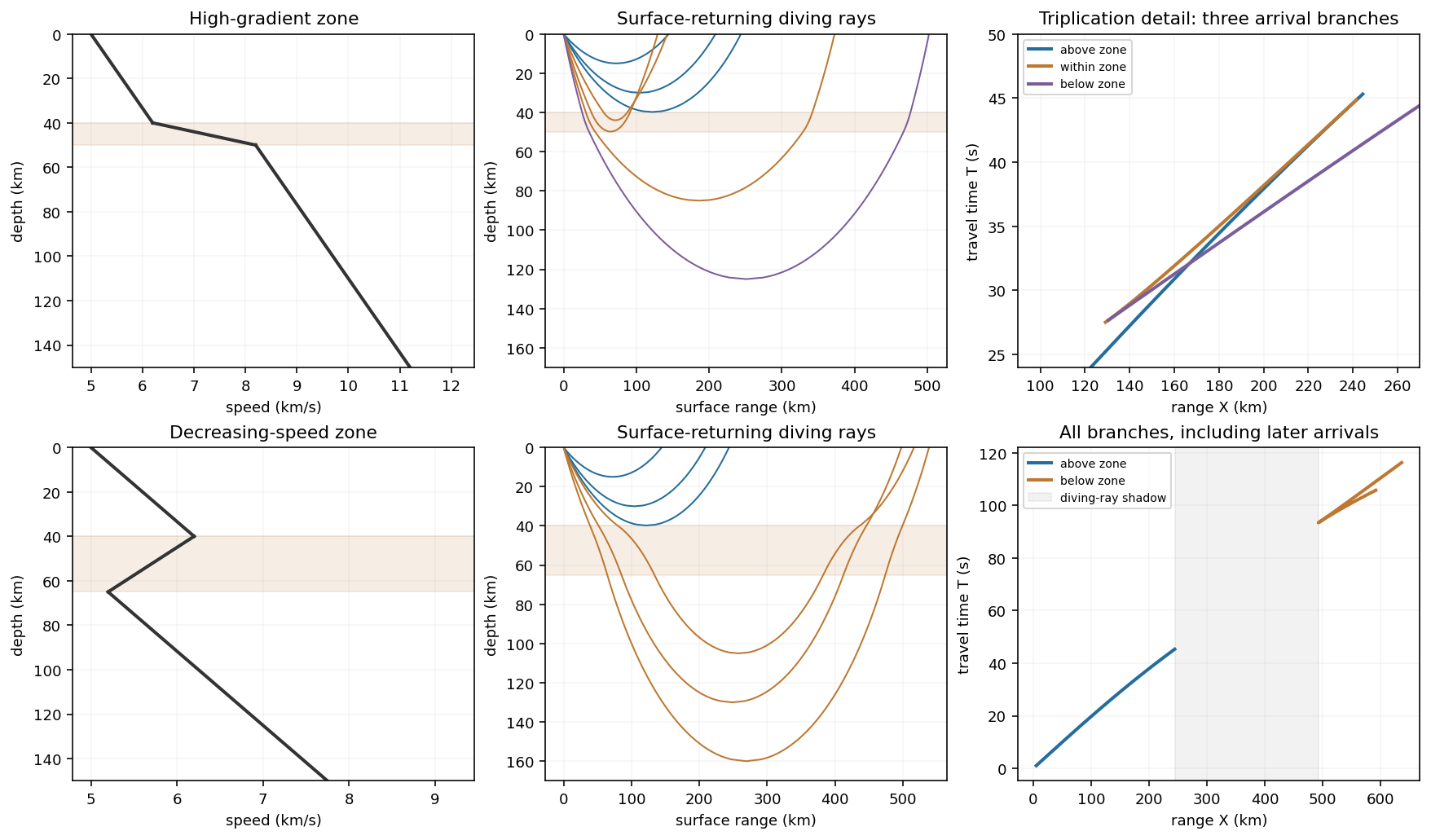
Rays and travel-time branches
. Details. 
Articles by others on the same topic
There are currently no matching articles.