Define and . ThenAt long wavelength, the mass deficit at the lower interface nearly cancels the surface excess, and the gravity field does not resolve their vertical separation. For ,The first mechanical contribution is fourth order in , although the exponential also contributes terms at second and third order. If the ideal interface depth were zero, the leading term would instead be .
At short wavelength, bending resists the interface's deflection, and any remaining buried signal is attenuated. ConsequentlyThis is the uncompensated surface-sheet value. For nonnegative the approach is from below. With ,The scales and respectively mark gravitational depth filtering and flexural resistance; which appears first depends on . Admittance has dimensions of inverse time squared. The formal limit describes this model, not an assertion that thin-plate theory remains accurate at arbitrarily short wavelength.
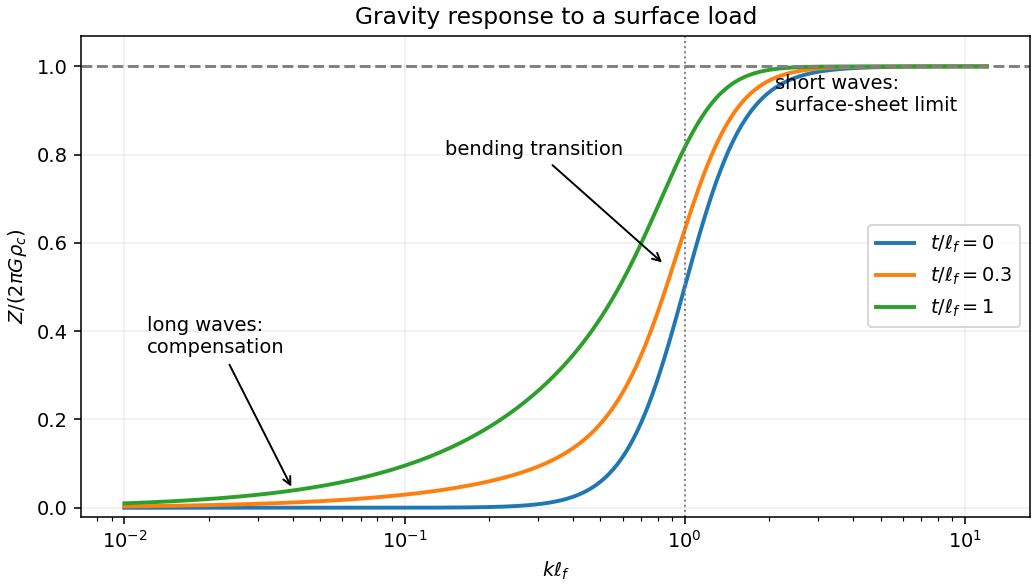
Compensated long wavelengths, flexural transition and the uncompensated gravity limit
. Details. 
Articles by others on the same topic
There are currently no matching articles.