Take upward deflection as positive, use , and write . A positive added load depresses the plate, so is negative beneath it. Because bending moves the original surface while the load adds thickness, the final topography is . For the cosine mode the horizontal biharmonic operator multiplies by , givingEliminate to obtainThe original loading equation contains , whereas the relation after eliminating the added thickness contains . These must not be interchanged prematurely.
At first order in the relief, represent a displaced density interface by a sinusoidal mass sheet. A sheet of surface-density amplitude at depth produces a downward gravity amplitude at the datum. This follows by solving the Fourier-transformed gravitational Poisson equation above and below the sheet: the decaying potential has amplitude , with the normal derivative jump fixed by the sheet mass.
The top interface contributes ; the displaced crust–mantle interface contributes at depth . ThusThe second term is negative beneath a positive load: depression replaces denser mantle material by lighter crust. Substituting the deflection-to-topography ratio yieldsThis flexural gravity admittance combines mechanical compensation and attenuation of the buried interface's gravitational signal. It assumes small relief, a flat uniform thin plate, uniform density layers and the stated surface loading, without additional internal density anomalies. Here is the depth of the crust–mantle interface. It is not automatically the effective elastic thickness ; the latter enters through .
Define and . ThenAt long wavelength, the mass deficit at the lower interface nearly cancels the surface excess, and the gravity field does not resolve their vertical separation. For ,The first mechanical contribution is fourth order in , although the exponential also contributes terms at second and third order. If the ideal interface depth were zero, the leading term would instead be .
At short wavelength, bending resists the interface's deflection, and any remaining buried signal is attenuated. ConsequentlyThis is the uncompensated surface-sheet value. For nonnegative the approach is from below. With ,The scales and respectively mark gravitational depth filtering and flexural resistance; which appears first depends on . Admittance has dimensions of inverse time squared. The formal limit describes this model, not an assertion that thin-plate theory remains accurate at arbitrarily short wavelength.
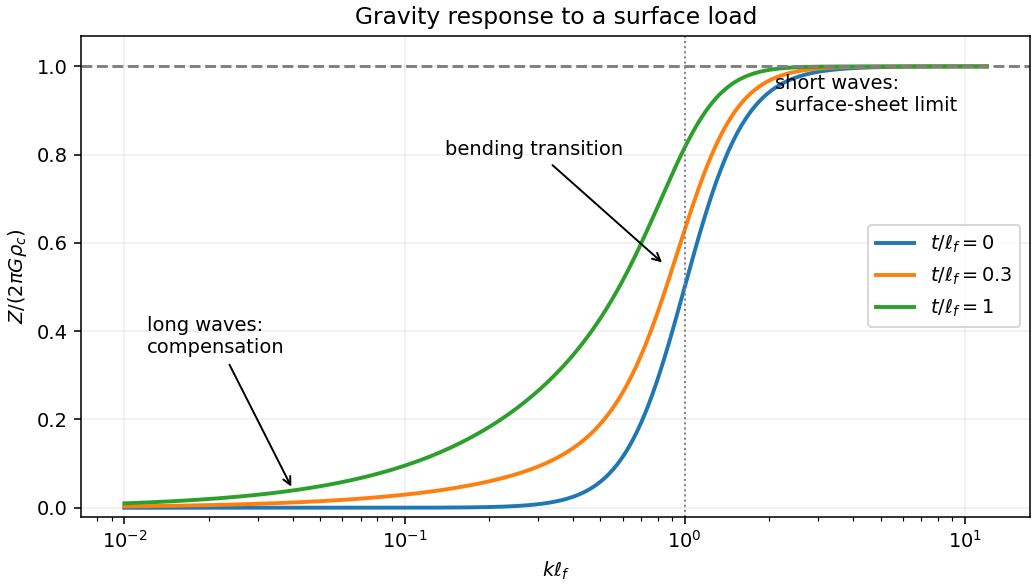
Compensated long wavelengths, flexural transition and the uncompensated gravity limit
. Details. New oceanic lithosphere is hot and mechanically weak. As it cools, the depth over which rock can sustain elastic stress on the loading timescale generally increases, so effective elastic thickness tends to increase with plate age at the time of loading. It is this mechanical state when the load is emplaced, together with subsequent relaxation, that matters; the present age alone is insufficient for an ancient load.
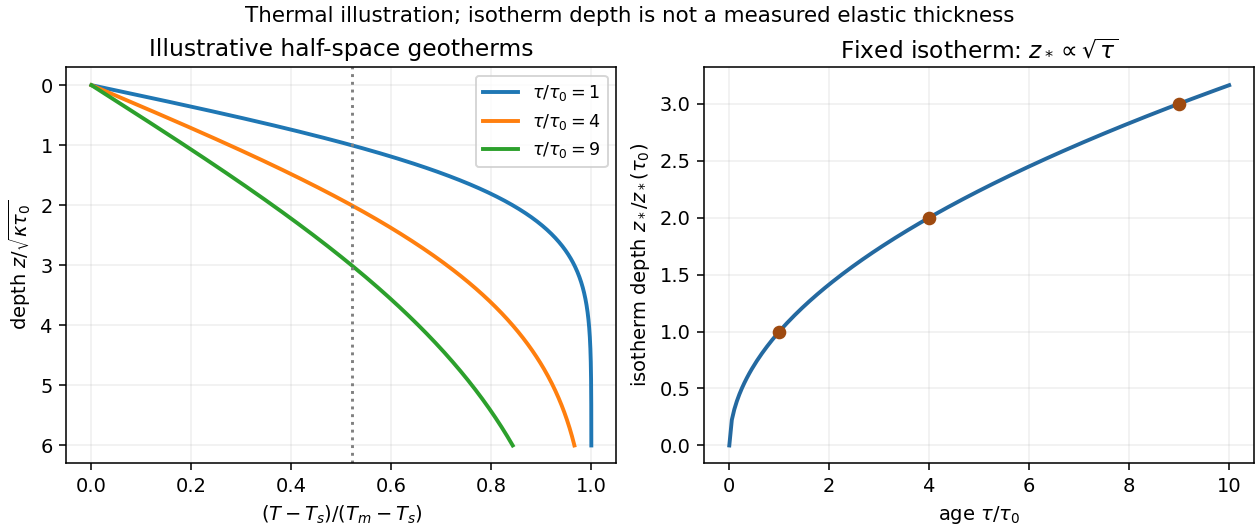
The half-space cooling model illustrates the thermal dependence. With age , surface temperature , initial interior temperature and constant thermal diffusivity ,A chosen temperature lies atIf the base of the mechanically strong layer approximately follows such an isotherm, initially follows a similar age trend. Cooling models constrained by ocean-floor depth and heat flow provide the thermal motivation; their fitted thermal thickness must not be mistaken for measured elastic thickness.[ref]
An analysis of the variation of ocean floor bathymetry and heat flow with age by Barry Parsons and John G. Sclater. 1977, pages 803–806 and discussion of half-space versus finite-plate cooling
In practice is an effective bending thickness rather than the depth of one universal temperature. Stress-dependent yielding, grain size, water content, composition, loading duration and reheating can alter it. Finite-plate cooling and basal heat input also limit indefinite square-root growth at old ages. Nor should be identified with either the thickness of the crust or the full seismically defined lithosphere.


Use the supplied surface temperature, , as the premise. With otherwise comparable material and geothermal gradient, this hotter boundary increases thermally activated material creep at shallow depth and places a chosen mechanical cutoff temperature closer to the surface. That effect alone would favour a thinner elastic layer than in a cool terrestrial oceanic plate.
Water weakening of rocks makes dryness act in the opposite direction. Water can enhance material creep; sufficiently dry material can remain strong at temperatures at which its wet equivalent relaxes. Experiments on dry diabase provide a concrete basis for a strong dry crust and possible mechanical coupling between crust and mantle, rather than requiring a weak crustal layer solely because the surface is hot.[ref]
High-temperature deformation of dry diabase, with application to crustal deformation on Venus by S. J. Mackwell and others. 1996, printed pages 793–794, dry strength and implications for crustal coupling
For an illustrative steady conductive geotherm with thermal conductivity and heat flux , a fixed strength cutoff givesTherefore the comparison would scale aswhere all temperatures are compared consistently and a dry rheology may have a higher effective cutoff . This is a conditional strength-layer estimate, not a universal definition of .
Venus can retain appreciable elastic thickness despite its hot surface; temperature favours thinning, while dryness favours strengthening. The supplied facts alone determine neither a numerical nor a definite ordering relative to Earth's oceanic plates. The comparison requires heat flow, subsurface thermal history, material rheology, interior water content and loading timescale. Little atmospheric water is evidence relevant to the hypothesis of dry rocks, not a direct measurement of deep water activity.
Articles by others on the same topic
There are currently no matching articles.