The complete bipartite graph is not a planar graph. For example, a simple connected triangle-free planar graph with six vertices has at most edges, by Euler formula for a connected planar graph and the fact that every face has boundary length at least four; has nine edges. At least one edge must therefore be deleted.
Delete from the bipartition . The left drawing below is a planar embedding of all eight remaining edges. It proves that the minimum is one edge.
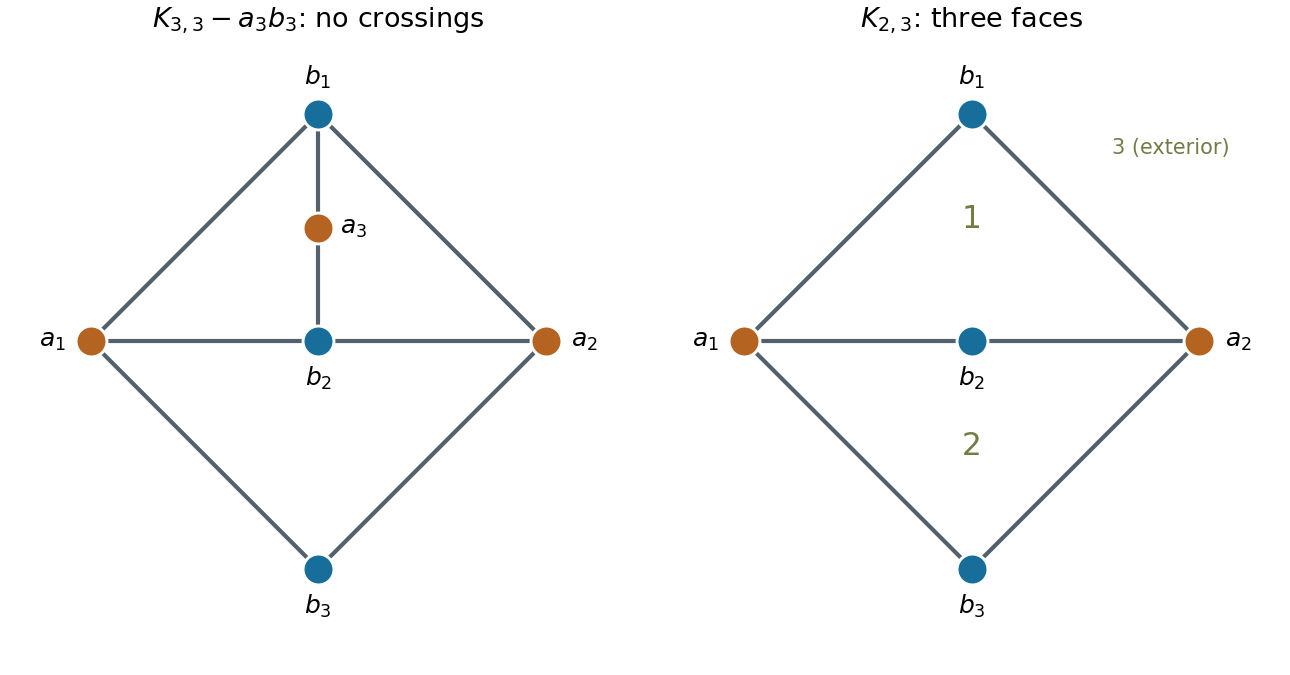
Left: a planar embedding of K3,3 with edge a3b3 removed. Right: K2,3, whose two bounded faces and exterior give three faces in total.
Details. 
The complete bipartite graph is connected and has five vertices and six edges. It is a planar graph, as in the right drawing above. Euler formula for a connected planar graph therefore givesThis includes the unbounded exterior face.
Within each connected component with vertices, grow a tree by starting at one vertex and repeatedly adding an edge to an unreached vertex. Connectedness guarantees such an edge until every vertex has been reached. Exactly edges are added, so the component contains at least that many edges. Summing over the components givesThe selected trees form a spanning forest, and equality holds precisely when the original graph itself is a forest.
Use the convention that is the wheel graph with rim and one additional hub; the assumption gives the rim at least three vertices. The rim needs two colours for even and three for odd . Since the hub is adjacent to every rim vertex, its colour must be a new one. These lower bounds are attained by properly colouring the rim and adding that extra colour. ThusIf a convention indexes a wheel by its total number of vertices instead, replace the rim size by in this formula.
Articles by others on the same topic
There are currently no matching articles.