With the fixed array On success, , , and . On failure there is no occurrence; the output indices are unspecified. Thus
f visible to the procedures, use a Boolean result for success and two output array indices:TYPE Search = PROCEDURE(x: INTEGER; VAR i, j: INTEGER): BOOLEAN;Use a linear search over every pair of array indices.For a worst-case lower bound, consider an input in which every inspected element differs from . If an element remains uninspected, changing just that element to gives an indistinguishable execution requiring the opposite answer. Therefore a correct exact search algorithm must inspect all elements in the worst case.
PROCEDURE SearchAll(x: INTEGER; VAR i, j: INTEGER): BOOLEAN;
VAR r, c: INTEGER;
BEGIN
  FOR r := 0 TO M-1 DO
    FOR c := 0 TO N-1 DO
      IF f[r,c] = x THEN i := r; j := c; RETURN TRUE END
    END
  END;
  RETURN FALSE
END SearchAll;The printed phrase “at least ” uses the upper-bound notation for a lower-bound claim. Its precise interpretation isThis is an adversary argument for access to arbitrary independent array entries.
Write , assuming . By monotonicity, is at least every value in the first row and at most every value in the last column. HenceThe same observation applies to the top-right corner of any remaining rectangular subarray of this monotone matrix.
Implement staircase matrix search from the top-right corner. In the following Oberon-style code, The loop invariant is that every occurrence not yet returned lies inInitially this is the whole array. If , every entry of row in the candidate rectangle is smaller than , so increasing discards no possible answer. If , every entry of column in that rectangle is greater than , so decreasing is safe. These conclusions follow from monotonicity even when repeated values occur.
& denotes short-circuit conjunction; all guarded accesses respect array bounds.PROCEDURE Staircase(x: INTEGER; VAR i, j: INTEGER): BOOLEAN;
VAR r, c: INTEGER;
BEGIN
r := 0; c := N-1;
WHILE (r < M) & (c >= 0) DO
IF f[r,c] = x THEN i := r; j := c; RETURN TRUE
ELSIF f[r,c] < x THEN INC(r)
ELSE DEC(c)
END
END;
RETURN FALSE
END Staircase;The loop variant decreases on every unsuccessful iteration. If a dimension becomes empty, the loop invariant proves absence. For positive dimensions the path inspects at most entries; an initially empty dimension causes no inspection. Thus
Monotonicity gives two excluded rectangles:Indeed the first entries are at most , and the second are at least . In particular, the entire splitting row contains no answer. The only remaining candidates are the upper-right rectangle and the lower-left rectangle . These are the exclusions guaranteed by the given adjacent inequalities; further comparisons may exclude more.
Use half-open rectangles . Split the longer dimension at its middle. If rows are the longer dimension, binary search the middle row for its first entry at least . Equality returns immediately; otherwise part (e) leaves only an upper-right and a lower-left rectangle. A middle-column split uses the transposed argument.The lower-bound binary search invariant says that entries before
PROCEDURE SearchRect(x, r0, r1, c0, c1: INTEGER;
                     VAR i, j: INTEGER): BOOLEAN;
VAR mid, lo, hi, k: INTEGER;
BEGIN
  IF (r0 >= r1) OR (c0 >= c1) THEN RETURN FALSE END;
  IF r1-r0 >= c1-c0 THEN
    mid := r0 + (r1-r0) DIV 2;
    lo := c0; hi := c1;
    WHILE lo < hi DO
      k := lo + (hi-lo) DIV 2;
      IF f[mid,k] < x THEN lo := k+1 ELSE hi := k END
    END;
    IF lo < c1 THEN
      IF f[mid,lo] = x THEN i := mid; j := lo; RETURN TRUE END
    END;
    IF SearchRect(x, r0, mid, lo, c1, i, j) THEN
      RETURN TRUE
    END;
    RETURN SearchRect(x, mid+1, r1, c0, lo, i, j)
  ELSE
    mid := c0 + (c1-c0) DIV 2;
    lo := r0; hi := r1;
    WHILE lo < hi DO
      k := lo + (hi-lo) DIV 2;
      IF f[k,mid] < x THEN lo := k+1 ELSE hi := k END
    END;
    IF lo < r1 THEN
      IF f[lo,mid] = x THEN i := lo; j := mid; RETURN TRUE END
    END;
    IF SearchRect(x, r0, lo, mid+1, c1, i, j) THEN
      RETURN TRUE
    END;
    RETURN SearchRect(x, lo, r1, c0, mid, i, j)
  END
END SearchRect;

PROCEDURE DivideSearch(x: INTEGER; VAR i, j: INTEGER): BOOLEAN;
BEGIN
  RETURN SearchRect(x, 0, M, 0, N, i, j)
END DivideSearch;lo are smaller than and entries from hi onward are at least , within the splitting row or column. At its end, either equality is found or the splitting line is strictly separated around . Endpoint cuts lo=c0, lo=c1, lo=r0, or lo=r1 are valid and merely make one candidate rectangle empty.The recursion invariant is that the current rectangle contains every still-possible answer assigned to that call. The discarded rectangles are excluded by monotonicity; both retained rectangles inherit monotonicity. Each nonempty child has a strictly smaller longest dimension after at most two levels, so the recursion terminates, including one-row and one-column cases. The concise construction is
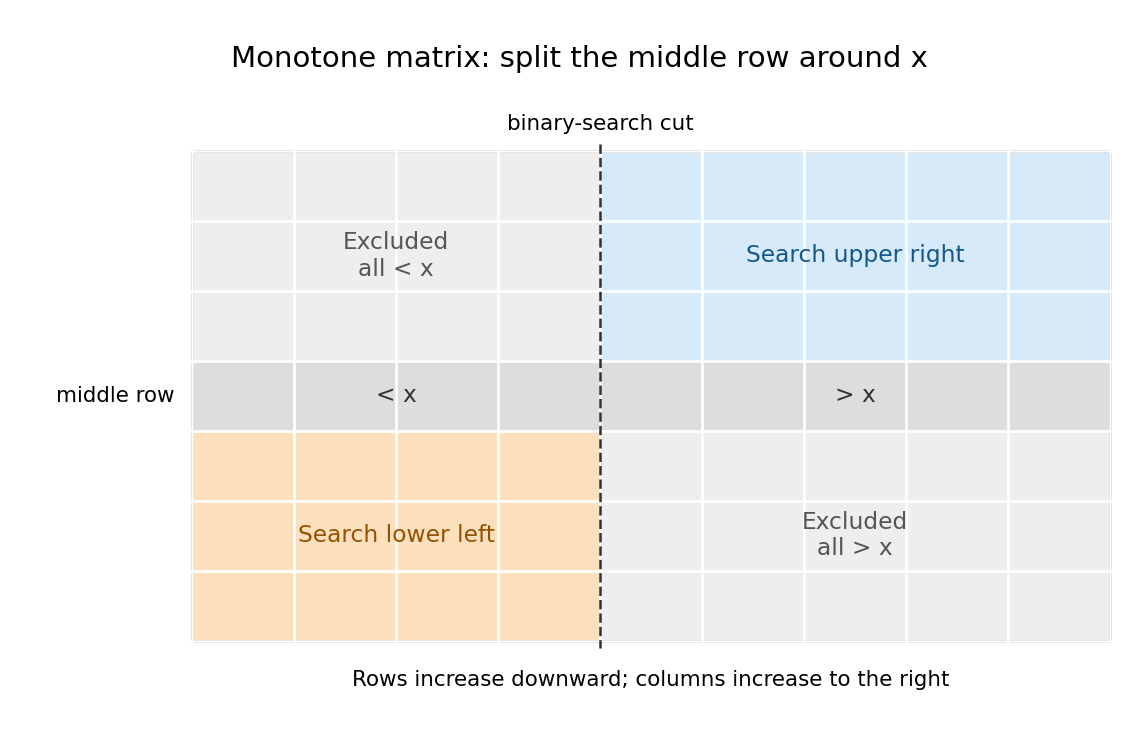
Two complementary rectangles survive a middle-row search
. For a monotone matrix, the middle row's binary search separates entries smaller than from entries greater than when no equality is found. The upper-left and lower-right rectangles are excluded by monotonicity; only the blue and orange rectangles require further search algorithm. Details.
Articles by others on the same topic
There are currently no matching articles.