Maintain white, gray and black colors for undiscovered, active and completed vertices. A single traversal clock records DFS discovery and finishing times:
for v in V: color[v] = white; parent[v] = none
time = 0
visit(u):
    time = time+1; d[u] = time; color[u] = gray
    for v in adjacency[u]:
        if color[v] == white:
            parent[v] = u
            visit(v)
    color[u] = black; time = time+1; f[u] = time
for u in V:
    if color[u] == white: visit(u)
The outer loop makes a depth-first search forest even when the directed graph is disconnected. Each vertex is entered once and each directed adjacency entry is inspected once. Thus an adjacency list representation gives time and auxiliary storage, including the worst-case recursive stack. Sorting neighbors to impose a particular visit order would be additional work.
Relative to the resulting DFS edge classification, a tree edge in depth-first search discovers a white vertex and becomes its parent edge. A forward edge in depth-first search goes to a proper descendant but is not that descendant's discovery edge. A back edge in depth-first search goes to an active ancestor, with a self-loop also counted as a back edge when such edges are allowed. A cross edge in depth-first search joins vertices with no ancestor-descendant relationship in the forest, such as different completed branches or different trees.
The definitions refer to directed edges; an undirected graph is normally classified only with tree and back edges, accounting for the reverse copy of a parent edge separately.
False. Use vertices , edges , , , and start depth-first search at , scanning before . The times areThere is a directed path and , but and are separate children of . Thus is not a descendant of . The path leaves through an already gray ancestor; its later branch need not be explored inside 's recursive call. This is consistent with the DFS parenthesis property.
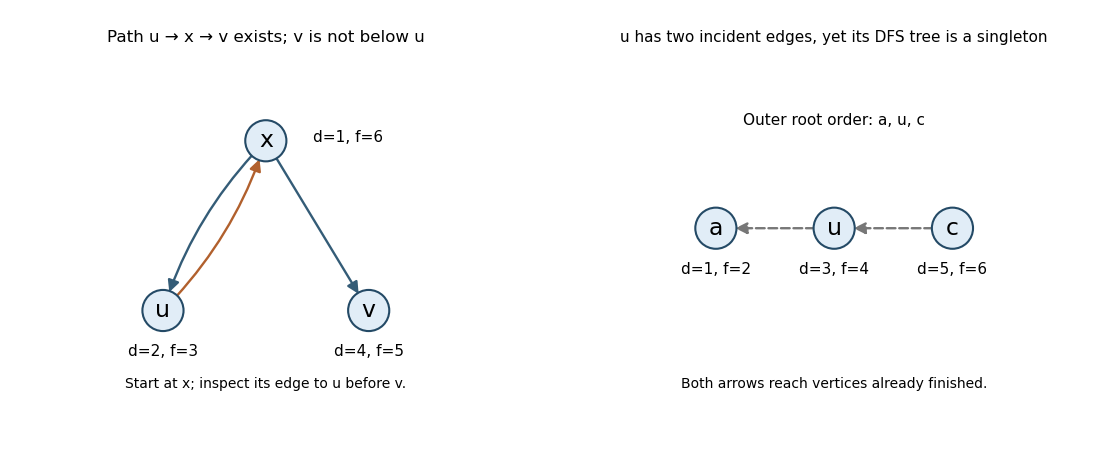
DFS counterexamples distinguish reachability from tree ancestry
. Left: the path from u through its ancestor x reaches a later sibling v, after u has finished. Right: root order a,u,c makes three singleton DFS trees, though u has an incoming and an outgoing edge. Details.
False. The same ordered traversal gives a path , butA path from can pass through an already discovered ancestor, whose remaining edges are scanned only after finishes. A reachability statement alone therefore does not impose the claimed finishing-time bound.
True for a directed cycle. Suppose there were no back edges. On examining an edge , its target would either be white, in which case its recursive call finishes before ; or black, in which case it has already finished. A gray target would be an active ancestor and hence give a back edge, contrary to the supposition. Therefore every edge would satisfy .
Applying those strict inequalities around a directed cycle would imply , a contradiction. Thus some back edge in depth-first search must exist in the search's edge classification. Such an edge is classified relative to the DFS forest; it is not one of the forest's tree edges.
False. Take edges and , and let the outer DFS loop try vertices in order . The first call finishes immediately. The next discovers , whose only outgoing edge reaches already black , so its tree contains only . Finally sees already black .
Vertex has both an incoming edge from and an outgoing edge to , yet is the sole vertex of its DFS tree. Nonzero incoming and outgoing degrees do not require either edge to become a tree edge in depth-first search.
Articles by others on the same topic
There are currently no matching articles.