Save the next pointer before redirecting it, then advance the two working heads. No node is allocated and the name/number fields are untouched.
def reverseBook(): Unit = {
  var prev: Node = null
  var cur = list
  while (cur != null) {
    val following = cur.next
    cur.next = prev
    prev = cur
    cur = following
  }
  list = prev
}
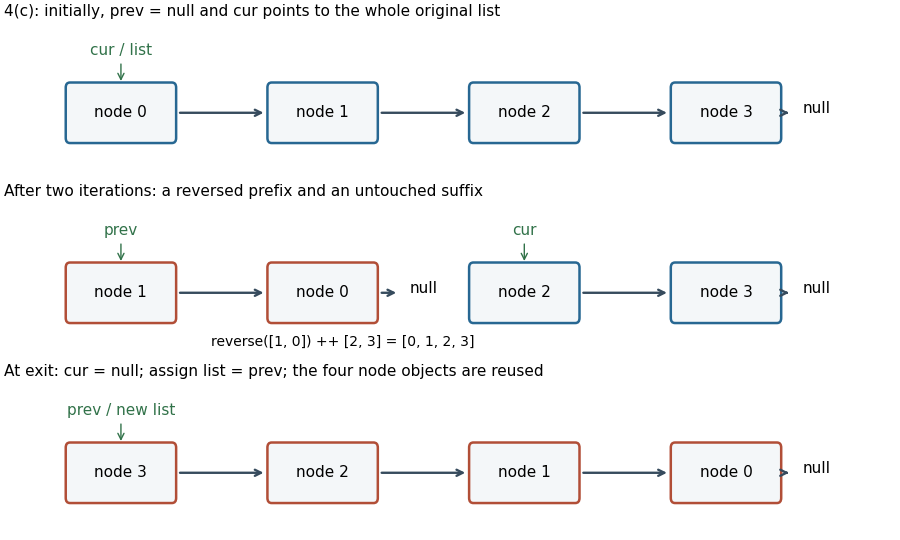
Let be the original sequence of node identities, not just their possibly equal field values. Write for the sequence currently headed by
prev and for that headed by cur. A suitable loop invariant for in-place linked-list reversal iswith both working lists finite, acyclic, disjoint, together containing exactly the original nodes, and with every name and number unchanged. Here ++ means concatenation. Initially and . One iteration takes from the front of and replaces by . Since , the equation is preserved. Saving following before changing cur.next retains access to .The loop variant is the length of , decreasing by one. At exit , so ; assigning the head establishes reversal. The empty and singleton cases work without a special branch. The abstraction function of the phone book ignores order, so it still maps every original name to its original number. All original node identities are reused, with running time and auxiliary space.

Articles by others on the same topic
There are currently no matching articles.