Worked solutions for the held Oxford preliminary examination of 14 June 2023. Source release: released examination PDF. All eight questions and all 42 answerable leaves are addressed below, without reproducing question statements. The three printed sections are retained as context within the question hierarchy.
Code uses the Scala 2 syntax of the paper. Array inputs described as sorted are assumed nondecreasing and stable during an operation. Unless explicitly discussing machine behavior, mathematical proofs state their arithmetic assumptions. In particular, the printed routines in Question 2 have genuine fixed-width arithmetic limitations, which are analyzed rather than silently attributed exact-integer behavior. Implementations below handle empty structures and document their sentinels, capacity bounds and invalid-input behavior.
Imperative Programming Part 1.
A loop invariant is a property of the program state that holds whenever control reaches the loop's condition, including the final failed test. Its main purpose is proving partial correctness: establish it initially, prove one guarded iteration preserves it, then combine it with the negated condition to obtain the postcondition. A separate loop variant or another progress argument proves algorithm termination and hence total correctness.
The proposed condition is not a loop invariant at the loop head. It holds initially and on entry to every executed body, but the iteration starting with
i == 10 finishes with i == 11. Control then returns to the condition with the proposed upper bound false. A suitable numerical loop invariant is . If the number of printed lines matters, strengthen it to “exactly lines have been printed.” At exit, this and i > 10 give exactly ten printed lines. The nonnegative loop variant decreases by one on every iteration.This is lower-bound search: return the first position whose value is at least the target, allowing the result to equal the array length. The notation for an empty suffix is vacuously true, so this also covers a target larger than every entry and the empty array. Assume a stable sorted array, ordered nondecreasingly.
def ternarySearch(a: Array[Int], x: Int): Int = {
  var lo = 0
  var hi = a.length
  while (lo < hi) {
    val third = (hi - lo) / 3
    val m1 = lo + third
    val m2 = hi - 1 - third
    if (a(m1) >= x) hi = m1
    else if (a(m2) < x) lo = m2 + 1
    else {
      lo = m1 + 1
      hi = m2
    }
  }
  lo
}
The loop invariant isInitially the excluded prefix and suffix are empty, so both quantified assertions hold. During an iteration, . If , sortedness makes every later value at least , so replacing
hi by m1 preserves the right assertion. If the first test failed and , every earlier value is below , so replacing lo by m2 + 1 preserves the left assertion. Otherwise ; both new exclusions are valid, and lo = m1 + 1; hi = m2 retains exactly the unresolved middle. In that branch , since a single value cannot satisfy both strict and nonstrict inequalities in opposite directions.The nonnegative loop variant
hi - lo strictly decreases. In fact, with old length and , the three possible new lengths are , with the middle branch feasible only when nonnegative; each is at most . At exit lo == hi, and the loop invariant is exactly the desired partition. The result is the unique lower-bound index, including the first equal entry when duplicates occur. This ternary lower-bound search uses comparisons and auxiliary space, in the Big O notation word-operation model. The index formulas also avoid computing an overflowing 2 * length.For the given sorted array, the complete lower-bound search behavior is for , for , for , and for . In particular, index is never the correct answer because the two equal entries share the same first insertion position.
These unit tests cover every value boundary, equality case and missing-value interval:
- Below all entries, including the smallest machine integer:
ternarySearch(a, Int.MinValue) == 0andternarySearch(a, 0) == 0. - Equality with the first entry:
ternarySearch(a, 1) == 0. - Values in the first gap:
ternarySearch(a, 2) == 1andternarySearch(a, 3) == 1. - Repeated equality must return the first duplicate:
ternarySearch(a, 4) == 1. - Values in the second gap:
ternarySearch(a, 5) == 3andternarySearch(a, 9) == 3. - Equality with the final entry:
ternarySearch(a, 10) == 3. - Beyond the final entry:
ternarySearch(a, 11) == 4andternarySearch(a, Int.MaxValue) == 4.
For every tested target, also assert that the array is unchanged, the result lies in , every entry before it is strictly smaller, and every entry from it onward is at least the target. These postconditions check the intended partition directly rather than merely accepting any equal occurrence.
Search only the suffix strictly after each candidate first index. This enforces distinct indices even when the target is twice an existing value. Compute the complement in
Long to prevent integer overflow: subtracting two Int values can require 33 signed bits.def twoSum(a: Array[Int], target: Int): (Int, Int) = {
def lowerBound(from: Int, wanted: Long): Int = {
var lo = from
var hi = a.length
while (lo < hi) {
val mid = lo + (hi - lo) / 2
if (a(mid).toLong < wanted) lo = mid + 1
else hi = mid
}
lo
}
var i = 0
while (i < a.length - 1) {
val wanted = target.toLong - a(i).toLong
val j = lowerBound(i + 1, wanted)
if (j < a.length && a(j).toLong == wanted) return (i, j)
i += 1
}
(0, 0)
}The outer loop invariant says that no solution has a smaller first index than
i, when a pair is written in increasing index order. A failed suffix binary search proves there is no partner for the current i, extending the excluded prefix by one. A successful return has and in exact integer arithmetic. At exhaustion, every possible ordered pair has been excluded, so the sentinel (0,0) means no solution. The inner loop invariant is the standard lower-bound partition, restricted to the suffix starting at i + 1.There are at most suffix searches, each taking running time, so the total is , customarily written for . Auxiliary space is . Empty and singleton arrays immediately return the sentinel. This is distinct-index two-sum by suffix lower bounds; a faster two-pointer technique is also possible on a sorted array, but the code here directly meets the requested search-based bound.
Repeated integer division by two generates the binary digits from least significant to most significant. Reverse the accumulated characters once, and treat zero separately.
def binaryCon(n: Int): String = {
  require(n >= 0, "n must be nonnegative")
  if (n == 0) return "0"
  var remaining = n
  val digits = new StringBuilder
  while (remaining > 0) {
    digits.append(if (remaining % 2 == 0) '0' else '1')
    remaining /= 2
  }
  digits.reverse.toString
}
Zero produces
"0"; positive inputs produce a binary number without leading zeros. No library routine performs the number-to-base conversion. Appending to the builder and reversing once gives linear work in the number of binary digits and uses that much output storage.Validate the complete input before doing the addition. The arrays use most-significant-digit-first positional notation. The result has one extra leading position, which contains either zero or the final carry.
def binaryAddition(x: Array[Int], y: Array[Int]): Array[Int] = {
  require(x != null && y != null, "arrays must not be null")
  require(x.length == y.length, "lengths must match")
  val n = x.length
  var k = 0
  while (k < n) {
    require((x(k) == 0 || x(k) == 1) &&
            (y(k) == 0 || y(k) == 1), "digits must be 0 or 1")
    k += 1
  }
  val answer = new Array[Int](n + 1)
  var carry = 0
  var j = n - 1
  while (j >= 0) {
    val column = x(j) + y(j) + carry
    answer(j + 1) = column % 2
    carry = column / 2
    j -= 1
  }
  answer(0) = carry
  answer
}
A failed
require throws IllegalArgumentException, covering mismatched lengths, invalid binary digits and null arrays. The largest column sum is three, so the carry always lies in . The binary-addition carry invariant says that the already processed input suffixes equal the written result suffix plus the carry shifted to the next column. After the final column, placing that carry at position zero proves the returned value is the sum. Neither input array is modified. Equal empty inputs are accepted as zero and return Array(0); the specification imposes no positive-length restriction. Running time and result storage are .Under exact integer arithmetic, the intended result is , using the ceiling function. A sufficient loop invariant isInitially , and the final disjunction is true. If the guard holds, the old value is below . Incrementing
i and doubling y therefore preserves and makes the new lower bound true. At exit . If , positivity of forces ; otherwise . Both cases establish the claimed postcondition. Doubling eventually reaches or exceeds any fixed positive , proving algorithm termination in this arithmetic model. This is the doubling-loop ceiling logarithm argument.The printed Scala implementation is not correct for its entire stated
Int domain. Its y is an Int. For , it reaches , wraps to on the next doubling, then becomes zero and stays zero. The guard remains true forever. The loop invariant above is valid for the printed code only when . Scala documents Int as a signed 32-bit value equivalent to Java's primitive int.[ref]A corrected implementation for every positive
Int input widens the doubling variable before any multiplication:def ceilingLog2(x: Int): Int = {
require(x > 0)
var i = 0
var y = 1L
while (y < x.toLong) {
i += 1
y *= 2L
}
i
}Now at most 31 iterations are needed and , safely within
Long. The same loop invariant proves total correctness without the overflow gap.The algorithmic intention is exponentiation by squaring to compute for . With exact arithmetic, its loop invariant isInitially
result = 1, y = x, and i = n. For an even integer , squaring y and replacing i by preserves the product. For an odd integer , first multiply result by y; then . The nonnegative loop variant i decreases by halving whenever positive. At exit , so the loop invariant yields result = x^n. There are multiplication steps.Two qualifications are essential for the actual source. There is no requirement that
n be nonnegative: for every n <= 0 the printed function simply returns 1.0. Also, var y = x infers Int, so y *= y uses wrapping integer arithmetic, while the accumulator uses floating-point arithmetic. For example, anotherfunc(50000, 2L) returns -1794967296.0, rather than 2500000000.0. An exact-power loop invariant cannot prove a false claim about that execution.More precisely, for positive
n, after iterations the remaining exponent is , and the Int base is the signed 32-bit representative of modulo . The accumulator multiplies those signed representatives for the set bits of n, in increasing bit order, with a floating-point rounding after each multiplication. This describes the actual code even when the intended power law fails. In an exact implementation, use a nonnegative-exponent precondition and arbitrary-precision integers, for example:def powerExact(x: Int, n: Long): BigInt = {
require(x > 0 && n >= 0)
var result = BigInt(1)
var y = BigInt(x)
var i = n
while (i > 0) {
if (i % 2 == 1) result *= y
y *= y
i /= 2
}
result
}The displayed loop invariant applies exactly to this version. It performs logarithmically many arbitrary-precision multiplications; their bit cost grows with operand size, so that statement is not an bit-complexity bound. Merely making the accumulator a
Double does not widen the separate Int base variable.To preserve the actual printed function, including its handling of nonpositive exponents and wrapping
Int bases, use a tail-recursive accumulator with the same multiplication order:def anotherfuncRec(x: Int, n: Long): Double = {
require(x > 0)
@scala.annotation.tailrec
def loop(y: Int, i: Long, result: Double): Double = {
if (i <= 0) result
else {
val nextResult = if (i % 2 == 1) result * y else result
loop(y * y, i / 2, nextResult)
}
}
loop(x, n, 1.0)
}Each recursive call corresponds to one source iteration and carries exactly its next program state. Hence it reproduces the printed numerical behavior, rather than silently repairing it. For positive
n, both routines use steps; for nonpositive n, both take constant time. The recursive call is in tail position, so Scala's tail-call optimization avoids a growing call stack; the annotation asks the compiler to check that condition.If the intended exact power is required instead, change the base and accumulator parameters of this same recurrence to
BigInt and require n >= 0, as in part (d). Its mathematical loop invariant becomes a recursion invariant, with the same logarithmic number of multiplication steps.Imperative Programming Part 2.
Use an abstract data type with two total count functions, , where and . counts incoming payments and outgoing payments. Initially for every valid user. A user without a stored record is therefore observable as two zero counts; no separate registration operation is necessary.
The explicit bound matches the source's
Int record fields. Increment operations require space in the relevant count, so no integer overflow is permitted. An unbounded mathematical counting abstract data type would instead require an arbitrary-precision representation or an explicit overflow policy. The large user domain does not require allocating a record for every user: a sparse map with a default value can realize these total functions.Every operation requires . The queries have postconditions “return ” and “return ” respectively, leaving both functions unchanged. An incoming increment additionally requires and hasThe outgoing increment analogously requires , increments only , and preserves . These frame conditions prevent an implementation from accidentally changing another user's count. Here a subscript zero denotes the old program state.
trait Payments {
  // All methods require 1 <= user && user <= 99999999.
  // Queries leave the abstract state unchanged.
  def incoming(user: Int): Int
  def outgoing(user: Int): Int

  // Require the corresponding old count < Int.MaxValue.
  // Increment only that user's named count by one.
  def recordIncoming(user: Int): Unit
  def recordOutgoing(user: Int): Unit
}
The preconditions and postconditions are part of the formal specification; the trait's type signatures alone cannot express all of them. The implementation below uses checked
require calls for the relevant invalid operations.With a directly indexed array, use two parallel count arrays, or one array of count records, at each user identity. Both queries and increments take running time, with no hash collision. However, reserving positions for each of two four-byte counters uses about million bytes, roughly MiB before object overhead, even when only a few users have payments. Index zero is unused and all valid positions initially contain zero.
With a linked list, store one node
(user, countIn, countOut, next) for each active user. A scan locates a record, returning zero counts if absent; an increment creates a missing record or updates its counter. Storage is for stored users, but a query or update can require running time. Nodes also carry pointer and allocation overhead and lack direct indexed access.With a hash table using separate chaining, compute a hash bucket from the user identity and store its record in that bucket's linked list. The same zero-default convention applies to a missing record. With buckets and a well-distributing hash function, the expected operation cost is in terms of the load factor of a hash table; worst-case cost remains under severe collisions. Storage is , but a permanently fixed cannot maintain constant expected cost as grows without bound. A good distribution and, where permitted, hash table resizing address that trade-off.
Inside the supplied
PaymentsHash class, scan until a matching node or the end of the chain. A null return means the user has no record in this bucket.private def find(user: Int, head: PaymentsHash.Node): PaymentsHash.Node = {
var p = head
while (p != null && p.user != user) p = p.next
p
}The loop invariant says that every node already passed has a different user identity and
p heads the unexamined suffix. Short-circuit evaluation of && prevents dereferencing null. The representation invariant supplies an acyclic finite chain, so each unsuccessful step shortens that suffix and proves algorithm termination. The code changes no node fields.The following method belongs inside the source class and uses the helper from part (d). It preserves the existing outgoing count, and a newly encountered user starts with exactly one incoming and zero outgoing payments.
def recordIncoming(user: Int): Unit = {
  require(1 <= user && user <= 99999999, "invalid user identity")
  val bucket = hash(user)
  val p = find(user, table(bucket))
  if (p == null) {
    table(bucket) = new PaymentsHash.Node(user, 1, 0, table(bucket))
  } else {
    require(p.countIn < Int.MaxValue, "incoming count is full")
    p.countIn += 1
  }
}
On a hit, exactly one field is incremented after the overflow check. On a miss, inserting at the bucket head preserves all existing records and gives precisely the required change from implicit zero to one. The given hash function must return an index in consistently for a given user. Its actual formula is not needed by this method. The nested private node class is accessible to its companion class in Scala, so retaining the source's
PaymentsHash.Node visibility is valid.[ref]Scala 2.13 classes and objects specification. Modifiers: private members are accessible to the enclosing template and its companion
For each table index , let be the set of non-null nodes reachable by following
next. A sufficient representation invariant is:- The array has exactly buckets, and every bucket heads a finite acyclic linked list.
- The sets are pairwise disjoint, so one physical node cannot belong to two buckets.
- Every reachable node has a valid user identity, lies in bucket
hash(node.user), and has both counters between zero andInt.MaxValue. - User identities are unique among all reachable nodes, not merely within a single chain.
The abstraction function maps these nodes to the total functions of part (a): if the unique node for exists, and are its fields; otherwise both are zero. A stored record with two zero counters is harmless and has the same observable meaning as an absent record. This intentionally permits multiple concrete representations of the same abstract program state.
Initially every bucket is null, so the representation invariant holds and the abstraction function yields all zeros. The successful-update branch preserves every structural condition; the insertion branch creates a fresh node with a previously absent identity in its correct bucket. Both branches realize exactly the incoming-increment postcondition, demonstrating correct operations through an abstraction function.
Let denote the non-null nodes reachable from the head. The representation invariant requires a finite acyclic null-terminated linked list and pairwise distinct names among its reachable nodes. Names and numbers retain the interface's string data type interpretation; no ordering of names is required.
The abstraction function is the finite partial functionName uniqueness makes this a function, rather than a relation assigning multiple numbers to one name. Initially
list == null, so and the abstract book is empty. Unreachable allocated nodes are outside this abstract state.Inside
LinkedListBook, traverse without modifying the head or any node:def printBook(): Unit = {
var p = list
while (p != null) {
println(p.name + ":" + p.number)
p = p.next
}
}The loop invariant is that precisely the prefix before
p has been printed, once per node, in list order; p heads the remaining suffix. The null-terminated linked list invariant proves termination and prevents duplicate output through cycles. An empty list prints nothing. The abstraction function is unchanged, and the traversal takes node visits for entries.Save the next pointer before redirecting it, then advance the two working heads. No node is allocated and the name/number fields are untouched.
def reverseBook(): Unit = {
  var prev: Node = null
  var cur = list
  while (cur != null) {
    val following = cur.next
    cur.next = prev
    prev = cur
    cur = following
  }
  list = prev
}
Let be the original sequence of node identities, not just their possibly equal field values. Write for the sequence currently headed by
prev and for that headed by cur. A suitable loop invariant for in-place linked-list reversal iswith both working lists finite, acyclic, disjoint, together containing exactly the original nodes, and with every name and number unchanged. Here ++ means concatenation. Initially and . One iteration takes from the front of and replaces by . Since , the equation is preserved. Saving following before changing cur.next retains access to .The loop variant is the length of , decreasing by one. At exit , so ; assigning the head establishes reversal. The empty and singleton cases work without a special branch. The abstraction function of the phone book ignores order, so it still maps every original name to its original number. All original node identities are reused, with running time and auxiliary space.
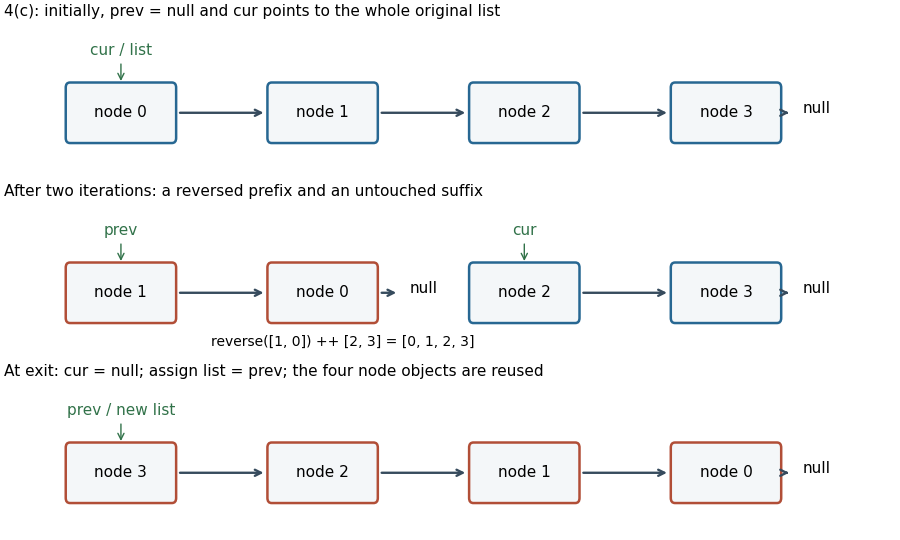
In-place reversal preserves node identities while moving nodes from an untouched suffix into a reversed prefix
. Details. 
private var last: Node = nullNull represents the empty book. In a nonempty book,
last.next is the first node, and following next makes one finite simple cycle containing last. Names are unique around that cycle. This representation makes appending a new entry constant-time once a failed name search has established absence. The abstraction function collects every name/number pair on one complete turn of the cycle, rather than following pointers until null.Starting at
last.next, visit each node once and stop when the traversal would return to its start. This helper is private so that callers do not receive writable nodes from the representation.private def find(name: String): Node = {
if (last == null) return null
val first = last.next
var p = first
do {
if (p.name == name) return p
p = p.next
} while (p ne first)
null
}Null means no entry has that name. The test
p ne first compares object identity, not the equality of name or number fields. At each iteration all previously visited nodes failed the name test. The finite simple cycle guarantees that either a match is found or the traversal returns to first after exactly one turn. A singleton cycle is inspected exactly once. Stopping at null instead would fail to terminate on this representation.Update an existing node, otherwise append one fresh node while preserving the cycle:
def store(name: String, number: String): Unit = {
  val p = find(name)
  if (p != null) p.number = number
  else {
    val fresh = new Node(name, number, null)
    if (last == null) {
      fresh.next = fresh
      last = fresh
    } else {
      fresh.next = last.next
      last.next = fresh
      last = fresh
    }
  }
}
For an existing name, changing only its number realizes replacement in the abstract partial function. On an empty book, the new node points to itself, establishing a singleton cycle. On a nonempty book, its successor becomes the old first node and the old last points to it; advancing
last leaves the first node unchanged and closes the enlarged cycle. Since a full search established absence, name uniqueness is preserved. Thus the postcondition is exactly the old book with this name mapped to the supplied number, and all other entries unchanged. A store takes running time for the name search and additional pointer work.Choose a fixed positive capacity and represent the abstract state by a finite partial function . Its domain of a partial function has at most members; each belongs to and is a fixed point:The blocks of a set partition are the nonempty fibres of
rep, and their shared values are their disjoint-set representatives. Initially , so . Representatives need not be the minimum members of their blocks.trait DisjointSets {
val capacity: Int
// State: rep is a finite idempotent map, |dom rep| <= capacity.
// Initially: rep is empty; capacity is fixed and positive.
// Pre: x is absent and |dom rep| < capacity.
// Post: add x -> x; leave every old mapping unchanged.
def makeSet(x: Int): Unit
// Pre: x belongs to dom rep.
// Post: state unchanged; return rep(x).
def find(x: Int): Int
// Pre: x and y belong to dom rep.
// Post: merge their blocks, retaining old rep(x).
def union(x: Int, y: Int): Unit
}Precisely,
makeSet(x) extends the domain of a partial function by with . For union(x,y), snapshot and , keep unchanged, and setThis merges the two blocks and keeps the representative of the first argument's block. If , it is an identity operation. This deterministic design choice satisfies disjoint set union without imposing minimum-element representatives. The capacity bound is explicit in the abstract data type so that the bounded implementation does not silently strengthen makeSet's precondition.override val capacity: Int = 1000
private val elements = new Array[Int](capacity)
private val representatives = new Array[Int](capacity)
private var used = 0The chosen bound is an explicit implementation parameter of the abstract data type; another a-priori positive bound works identically. The initial map is empty because
used == 0. Zero-filled unused cells are not members of the map, so zero and negative keys remain valid integers. Use DisjointSets consistently as the trait name; the source's prose variation DisjointSubsets does not change the declared interface.A sufficient representation invariant is:
The abstraction function isThe last two conditions ensure each representative is a genuine member of its own block and that the abstract function is idempotent function. Cells beyond
used are unconstrained and ignored. When used == 0, these conditions hold vacuously and the abstraction function yields the empty map. This is an explicit-key version of quick-find, rather than a parent-pointer disjoint-set forest.private def isInMap(x: Int): Int = {
var i = 0
while (i < used && elements(i) != x) i += 1
if (i < used) i else -1
}The loop invariant states that every index below
i has a key different from x. The scan ignores all inactive cells, and short-circuit evaluation protects the array access at the end of the active prefix. Key uniqueness makes a successful index unambiguous. Its running time is .Insert a singleton mapping, retrieve a stored representative, or relabel every occurrence of the second block's old representative:
def makeSet(x: Int): Unit = {
  require(isInMap(x) == -1, "element already present")
  require(used < capacity, "capacity exhausted")
  elements(used) = x
  representatives(used) = x
  used += 1
}

def find(x: Int): Int = {
  val i = isInMap(x)
  require(i >= 0, "unknown element")
  representatives(i)
}

def union(x: Int, y: Int): Unit = {
  val keep = find(x)
  val replace = find(y)
  if (keep != replace) {
    var i = 0
    while (i < used) {
      if (representatives(i) == replace) representatives(i) = keep
      i += 1
    }
  }
}
For
makeSet, the new key is absent, its representative is itself, and old mappings are unchanged. find is a read-only linear search. In union, snapshot both representatives before changing any cell: recomputing the representative of y during the scan could change the criterion halfway through. The loop invariant says that every processed index already has its specified final representative and every unprocessed index still has its old representative. The cached labels make this assertion stable.At exit the abstract postcondition in part (a) holds. The surviving representative was already a fixed point and belongs to its old block; every member of the replaced block, including its old representative key, now maps to it. Thus idempotence and key uniqueness are preserved. Duplicate insertions, absent-element operations and capacity overflow fail before changing the map. Each operation is in the worst case, except that a same-block union can skip the relabel scan after its lookups. Storage is . These bounds follow from the chosen parallel-array quick-find representation; no parent-pointer optimization is being assumed.
Imperative Programming Part 3.
Method overloading gives one name several parameter signatures, such as
show(A) and show(B). The compiler chooses an applicable signature using the receiver's static type and the argument expressions' static types, preferring a uniquely more specific applicable alternative. An argument whose type is a subtype of the parameter type is acceptable; ambiguous or inapplicable alternatives cause a compile-time error. The runtime type of an argument does not start a second overload search.Method overriding replaces an inherited implementation of the same method signature. After overload selection, ordinary instance calls use dynamic dispatch on the receiver's runtime type to select the most-derived implementation of that signature. A concrete inherited method requires the
override keyword in Scala; a super call invokes the corresponding superclass implementation instead of redispatching to the overriding body. In a trait stack, super follows the class's linearization.[ref]Scala 2.13 expressions specification. Overloading resolution: applicable alternatives and most-specific selection
[ref]Scala 2.13 classes and objects specification. Member lookup, overriding and override modifier
Permitted; returns
"AB". The receiver's static type is A, which offers show(A). The argument also has static type A, so that signature is selected. All three variables refer to the same object of runtime type C; the most-derived implementation of show(A) is inherited from B. Its super.show(o) calls A.show(A), producing "A", and it appends "B". C overrides show(B), not this selected signature.Permitted; returns
"AB". Through a receiver of static type A, only show(A) is visible. The argument's static type C is a subtype of A, so it can be passed to that method. Dynamic dispatch selects B.show(A) on the receiver object, exactly as in part (i). The argument's more specific type cannot expose overloads absent from the receiver's static type.Permitted; returns
"AB". A receiver of static type B exposes show(A) and show(B), but the argument's static type A is not a subtype of B. Only show(A) is applicable. Its effective implementation on the C receiver is B.show(A), which concatenates the superclass result "A" and "B".Permitted; returns
"BC". Through static type B, both show(A) and show(B) accept an argument of type C; method overloading selects the more specific show(B). The receiver's runtime type is C, so dynamic dispatch invokes C.show(B). Its super.show(o) calls B.show(B), returning "B", and the override appends "C". The show(C) overload is not visible through receiver type B.Permitted; returns
"BC". The receiver's static type is C, but the argument's static type is only B. Thus show(C) is inapplicable; among show(A) and show(B), the latter is more specific. Its implementation is C.show(B), whose superclass call returns "B" before "C" is appended. The argument happens to reference a C object, but method overloading uses its static type.Permitted; returns
"C". Both receiver and argument have static type C, so the most-specific applicable overload is show(C). That method is defined in C and returns its own one-letter result without calling super. The six results, in source order, are therefore AB, AB, AB, BC, BC, C.A mixin is reusable behavior supplied by a trait and composed into a class in object-oriented programming. Scala allows only one direct superclass, so mixins allow several independently reusable capabilities without multiple concrete-class inheritance. A trait can provide implemented methods and require abstract members from its host class.
trait Named {
  def name: String
}
trait Greeting extends Named {
  def greeting: String = "Welcome, " + name
}
class Account(val name: String)
class WelcomedAccount(name: String) extends Account(name) with Greeting

val example = new WelcomedAccount("reader")
assert(example.greeting == "Welcome, reader")
Here the single superclass supplies
name, and the mixin supplies the derived greeting. The same behavior can be mixed into another unrelated host that satisfies Named. Mixin composition uses a defined linearization and requires incompatible concrete member conflicts to be resolved; it does not make arbitrary combinations of concrete superclasses legal.[ref]Class Composition with Mixins in the Scala documentation. A class has one superclass and can include several traits
The Memento pattern supports saving and later restoring an object's state while preserving encapsulation. The originator creates a snapshot and knows how to restore it; the memento stores that snapshot; the caretaker retains mementos and decides when to request restoration, without depending on their representation. Undo history is a typical use.
Scala's nested class in object-oriented programming definitions, access qualifiers, immutable values and path-dependent types help keep snapshots opaque and associated with their originator. For example:
final class Editor {
  private var text = ""
  final class Snapshot private[Editor] (
    private[Editor] val saved: String
  )
  def current: String = text
  def edit(next: String): Unit = { text = next }
  def save(): Snapshot = new Snapshot(text)
  def restore(s: Snapshot): Unit = { text = s.saved }
}

val editor = new Editor
editor.edit("first version")
val saved: editor.Snapshot = editor.save()
editor.edit("later version")
editor.restore(saved)
assert(editor.current == "first version")
The caretaker can retain
saved but cannot inspect its private contents or construct an arbitrary snapshot. editor.Snapshot is a type tied to the stable editor value; a snapshot from a different Editor is not interchangeable without an explicit type escape. An immutable string is safe to share in this example. If the originator held mutable arrays or mutable nodes, storing only references to them would not freeze their contents; the memento would need a deep copy or a persistent immutable representation.[ref]Scala 2.13 classes and objects specification. Qualified private and constructor access
[ref]Scala 2.13 types specification. Paths, stable identifiers and path-dependent types
The design creates a separate concrete class in object-oriented programming for each selected platform combination. With independently selectable platforms, there are up to combinations. Adding a platform can therefore multiply the number of classes, even though each platform's send operation and per-message charge are simple independent behaviors.
Sending code and charges are duplicated across many classes; a changed charge must be updated consistently in every affected combination. A forgotten update can make billing and sending disagree. A customer's preferences are also tied to a concrete class, making recombination cumbersome. The repeated implementation has low modularity: it encodes a whole subset where a composition of independent capabilities would suffice. The Decorator pattern addresses exactly that structure.
Use a customer object with no selected platforms as the base component, and wrap it once for each selected channel. Each decorator object has the same interface, delegates existing work, adds one platform send, and adds that platform's per-message charge. The code below uses the
Customer and Comms interfaces from the question; every decorator receives the communication implementation explicitly.final class NoChannels(val name: String) extends Customer {
def spread(msg: String): Unit = ()
def cost: Double = 0.0
}
abstract class CustomerDecorator(protected val inner: Customer)
extends Customer {
final val name: String = inner.name
def spread(msg: String): Unit = inner.spread(msg)
def cost: Double = inner.cost
}
final class OnDiscord(c: Customer, out: Comms)
extends CustomerDecorator(c) {
override def spread(msg: String): Unit = {
super.spread(msg)
out.sendD(name, msg)
}
override def cost: Double = super.cost + 0.01
}
final class OnFacebook(c: Customer, out: Comms)
extends CustomerDecorator(c) {
override def spread(msg: String): Unit = {
super.spread(msg)
out.sendF(name, msg)
}
override def cost: Double = super.cost + 0.05
}
final class OnWhatsApp(c: Customer, out: Comms)
extends CustomerDecorator(c) {
override def spread(msg: String): Unit = {
super.spread(msg)
out.sendW(name, msg)
}
override def cost: Double = super.cost + 0.03
}
def customer(name: String, discord: Boolean, facebook: Boolean,
whatsapp: Boolean, out: Comms): Customer = {
var c: Customer = new NoChannels(name)
if (discord) c = new OnDiscord(c, out)
if (facebook) c = new OnFacebook(c, out)
if (whatsapp) c = new OnWhatsApp(c, out)
c
}The factory admits each platform at most once, matching a subset of preferences. For example,
customer("reader", true, false, true, out) sends once to Discord and once to WhatsApp and has cost per message, using the stipulated charges. The innermost wrapper executes first, giving deterministic Discord–Facebook–WhatsApp order for selected channels. The zero-platform case sends nothing and costs zero. Repeated messages reuse the same immutable choice of wrappers.By structural induction on the wrapper chain, the base sends to the empty subset with zero cost; one additional wrapper preserves all prior sends and adds exactly its channel and charge. Thus the sends and charge are composed from the same selected components. There are channel-specific classes instead of one class per subset, and a new channel needs one new wrapper. A direct manual construction containing the same wrapper twice would intentionally send and charge twice, so the factory prevents that configuration.
cost computes a per-message amount rather than charging by itself; a later payment mechanism can use it. The interface uses Double, so numerical tests should allow ordinary floating-point rounding.The maximally variant safe declarations are:
trait Rel1[+X, +Y] { val pairs: List[(X, Y)] }
trait Rel2[-X, +Y] { def relatives(x: X): List[Y] }
trait Rel3[-X, -Y] { def related(x: X, y: Y): Boolean }
Leaving one or both parameters invariant is also legal but admits fewer subtyping conversions. These are type variance annotations.
For
Rel1, both parameters occur only as outputs. Scala's immutable List and Tuple2 are covariant, so a list of pairs of narrower types can safely be read as pairs of broader types. Thus both may be covariant type parameters. A contravariant declaration would permit, for example, treating a Rel1[Any, Int] containing (7, 0) as a Rel1[String, Int], then reading its first component as a String. That would be unsound; the compiler rejects the negative annotation at this output position.For
Rel2, X occurs as a method argument and therefore may be a contravariant type parameter; Y is returned in an immutable list and may be a covariant type parameter. A function that accepts every Any is safe to use where only String queries are issued. The opposite direction would be unsafe: if X were covariant, the following hypothetical conversion could call a string-only implementation with an integer:val strings: Rel2[String, Int] = new Rel2[String, Int] {
def relatives(x: String): List[Int] = List(x.length)
}
// Unsafe if Rel2 were incorrectly covariant in X:
// val arbitrary: Rel2[Any, Int] = strings
// arbitrary.relatives(7)Making
Y contravariant would instead allow an integer-valued Rel2[String, Any] to be read as a string-valued Rel2[String, String], recreating the output error.For
Rel3, both generic values are consumed and only a Boolean function result is produced, so both may be contravariant type parameters. A predicate accepting all values of broad types can answer queries restricted to narrower types. Covariance in either parameter would allow passing an unsupported value to a specialized implementation. For example, treating a string-only first-argument predicate as accepting Any would permit related(7, y) even though its body might call x.length. These are applications of the variance-position rule: method inputs reverse variance, whereas immutable outputs preserve it.[ref]Scala 2.13 variance annotations specification. Variance annotations and the change of position in method parameter types
Join on equal middle components, produce the outer pair, and eliminate duplicate outputs. Using the variant declarations from part (a):
def compose1[X, Y, Z](r: Rel1[X, Y], s: Rel1[Y, Z]): Rel1[X, Z] = {
  val joined = (for {
    (x, y) <- r.pairs
    (middle, z) <- s.pairs
    if y == middle
  } yield (x, z)).distinct
  new Rel1[X, Z] {
    val pairs: List[(X, Z)] = joined
  }
}
Every produced pair has a witness
y with both required input pairs, proving soundness. Conversely, any witness for a composed pair occurs in the two input lists, so the nested traversal produces that pair; .distinct retains one occurrence, proving completeness. Thus the result represents , with each pair listed once, even if either input lists duplicates or several witnesses yield the same outer pair. Equality of middle values is assumed to implement the relation's intended key equality. The nested join examines candidate pairs before duplicate elimination.For each requested
x, enumerate its middle relatives and then each middle value's relatives in the second relation:def compose2[X, Y, Z](r: Rel2[X, Y], s: Rel2[Y, Z]): Rel2[X, Z] =
new Rel2[X, Z] {
def relatives(x: X): List[Z] =
r.relatives(x).flatMap(y => s.relatives(y)).distinct
}A returned
z is present exactly when some enumerated y witnesses the two relation memberships. Conversely, every such witness appears in r.relatives(x), and its z appears in s.relatives(y), so no composed relative is omitted. .distinct removes repeated endpoints, including repetitions produced through different witnesses. This is the same composition of relations as part (b), represented one queried row at a time. Neither the entire first carrier nor the entire result must be enumerated in advance. The relation operations must remain consistent while the returned view is used; changing their underlying state would make this a live view rather than a snapshot.A
Rel3 provides only a membership test for a supplied pair. It gives no way to enumerate the finite middle carrier Y, enumerate one element's relatives, or even obtain a first value of type Y. Finiteness alone supplies no generic enumeration operation. To answer the existential query for the composed relation, supply a complete finite enumeration of the middle carrier explicitly:def compose3[X, Y, Z](r: Rel3[X, Y], s: Rel3[Y, Z],
middleValues: List[Y]): Rel3[X, Z] = {
val witnesses = middleValues.distinct
new Rel3[X, Z] {
def related(x: X, z: Z): Boolean =
witnesses.exists(y => r.related(x, y) && s.related(y, z))
}
}The precondition is that
middleValues contains every admissible middle value, or at least every possible witness. Extra irrelevant values do not change the answer if the two membership tests are defined for them. The postcondition is precisely . .exists and && use short-circuit evaluation; with an empty middle carrier, the answer is false. Each query uses at most pairs of membership tests, apart from the one-time duplicate elimination.An alternative interface can expose
def rightDomain: List[Y] together with the first predicate, with an explicit completeness contract. Such an output position is incompatible with retaining a contravariant Y in that extended trait, so its variance must be reconsidered. Passing the enumeration separately leaves the safe base Rel3[-X,-Y] unchanged.The information gap is substantive. A black-box algorithm making finitely many membership queries cannot rule out a witness at an unexamined middle value: two relations can agree on every inspected pair while differing only by a fresh witness that makes the composition true. A finite but unenumerated carrier can be enlarged to include that witness. A complete explicit enumeration, a known traversable carrier, or an equivalent relatives-enumeration interface removes this obstruction. This is finite-domain composition from relation predicates, rather than a problem solvable merely by nesting the two Boolean-valued methods.
Articles by others on the same topic
There are currently no matching articles.