
Theory of mind and affective empathy are partly dissociable psychological capacities, while cognitive empathy overlaps substantially with mental-state understanding. A person can understand that another has a mistaken belief without sharing the person’s emotion; conversely, another’s distress can elicit an affective response without accurate reasoning about its cause. These possibilities do not establish wholly independent modules. The central question is which operations, measurements and circumstances can be separated.
Theory of mind concerns representing mental states such as beliefs, knowledge, desires and intentions. It can include non-emotional content: predicting where someone will search after an unseen object transfer need not involve feeling that person’s disappointment. Affective empathy involves sharing aspects of another’s affect with a self-other distinction. Cognitive empathy concerns understanding another’s emotional perspective and therefore recruits some of the operations also called theory of mind. Compassion, the concern that motivates helping, is different again; personal distress can be intensely aversive to the observer without yielding accurate understanding or useful assistance. Whether “empathy” dissociates from mentalizing consequently depends partly on which component is meant.
Psychological dissociation requires more than two differently named tasks. A belief story also demands language, working memory and response selection; a pain picture demands visual attention and interpretation. Differences between a story test and an emotional-rating scale could therefore reflect task impurity. A single correlation is equally inconclusive: shared verbal skill or a general tendency to endorse questionnaire items can create apparent unity. Conversely, noisy measurements can conceal a genuine association. The strongest designs measure both constructs within the same people, distinguish their target demands and include independent measures of validity.
The EmpaToM paradigm provides a useful example. Short autobiographical videos varied emotional content independently of whether a subsequent question required mental-state inference or factual reasoning. Affect and compassion ratings were obtained separately from reasoning performance. In the large validation experiment, the corresponding behavioural indices related selectively to activity in distinguishable networks, including anterior insula for affect sharing and temporoparietal regions for mentalizing. This supports separability within one task framework, rather than relying solely on unrelated literatures. It does not establish that the constructs never interact or that their measurement is perfectly pure.[ref]
Dissecting the social brain: Introducing the EmpaToM to reveal distinct neural networks and brain-behavior relations for empathy and Theory of Mind by Philipp Kanske and others. Abstract and Experiments 1–2, pp. 6–19: factorial manipulation, behavioural validation and selective brain–behaviour relationships
Earlier imaging studies help specify the contrast. A self/partner pain experiment identified shared affect-related activity without identical recruitment of every sensory component of directly experienced pain. Belief-story experiments contrasted mental representation with nonmental representation, rather than merely contrasting people with objects. Together these findings suggest different component computations; overlapping or distinct blood-oxygenation signals cannot alone establish psychological identity or independence. An anatomical label is not a definition of empathy, and activating a region implicated in several processes cannot uniquely diagnose which process occurred.[ref]
Empathy for pain involves the affective but not sensory components of pain by Tania Singer and others. Abstract: self-pain versus partner-pain conditions and affective/sensory contrasts
[ref]People thinking about thinking people: the role of the temporo-parietal junction in theory of mind by Rebecca Saxe and others. Experiments 1–2: belief versus nonmental-representation controls
Lesion evidence can strengthen the inference. A study comparing inferior-frontal and ventromedial-prefrontal lesions reported different patterns of emotional and cognitive empathy impairment, a behavioural double dissociation. That pattern argues against a simple single ability differing only in overall difficulty. However, lesions affect networks as well as local tissue, groups can differ in lesion extent, and the measures operationalize particular components rather than all possible mental-state understanding. The result supports multiple contributions, not a claim that one region contains every affective response and another every social inference.[ref]
Two systems for empathy: a double dissociation between emotional and cognitive empathy in inferior frontal gyrus versus ventromedial prefrontal lesions by Simone G. Shamay-Tsoory and others. Abstract and pp. 617–627: lesion-group comparison and cognitive/emotional empathy measures
Atypical development also makes confounding visible. In an empathy-for-pain study, insula responses tracked alexithymia across autistic and non-autistic participants rather than diagnostic group after adjustment. This challenges the inference that a difficulty in one aspect of social cognition necessarily entails an absence of affect sharing. It remains correlational evidence, and a nonsignificant adjusted group difference is not a proof of exact equivalence.[ref]
The capacities can nevertheless cooperate. Understanding that someone is grieving can direct attention toward relevant cues; sharing discomfort can motivate further inquiry into its cause. An observer’s own emotion may also bias interpretation, so stronger affect is not guaranteed to produce more accurate mentalizing. Accurate understanding can support compassionate help or strategic manipulation depending on motivation. These examples distinguish computational interaction from identity: two processes can causally influence one another without being the same process.
The distinction between capacity and spontaneous deployment is especially important. An explicit instruction may elicit reasoning that would not occur automatically in a distracting interaction. A person can also understand another’s state while declining to report an emotion, or feel concern while finding a questionnaire difficult. Better tests combine accuracy, ratings, behavioural choices and physiological measures, while checking reliability, language demands and response bias. Training or perturbation should produce a selective change on independently validated outcomes before being taken as evidence of a psychological separation.
The justified conclusion is therefore graded. Mental-state representation, affect sharing, compassionate concern and self-directed distress can be distinguished conceptually and empirically, with converging task, imaging and lesion evidence. The strongest dissociation concerns mentalizing and affect sharing, rather than every use of the word empathy. Real interactions recruit these components together with attention, learning and motivation; explaining that coordination is more informative than either treating all social understanding as one ability or assuming completely insulated systems.
Empathy combines partly shared affective mechanisms with computations that represent another person's state; regional overlap does not show that the underlying neural code is identical. The answer depends on what empathy means. Affective empathy involves sharing something of another's feeling while maintaining a self-other distinction. Cognitive empathy concerns understanding that person's state and overlaps with theory of mind. Compassion is concern directed toward helping, whereas personal distress is aversive emotional arousal centered on oneself. These components can vary independently, so a single neural contrast cannot settle all of them.
A shared-processing hypothesis predicts that some mechanisms supporting one's own affect also contribute when another person suffers. Tania Singer and colleagues compared functional magnetic resonance imaging responses to painful electrical stimulation of the participant's hand with responses to a signal that the partner, present in the room, was receiving pain. Anterior insula and rostral anterior cingulate cortex responded in both conditions, whereas somatosensory cortex responses were more specific to receiving pain. The cue-based partner condition helped separate affective response from simply seeing an injured body part.[ref]
Empathy for pain involves the affective but not sensory components of pain by Tania Singer and others. Self-pain versus partner-pain design; shared anterior insula and rostral cingulate responses
The result supports partial overlap at the measured regional scale, not duplication of the whole first-person experience. Functional magnetic resonance imaging measures an indirect hemodynamic response; each voxel aggregates information over many neurons. A region can contain intermingled populations, and different computations can increase its average response. Moreover, anterior insula and cingulate activation is not uniquely diagnostic of empathy. Inferring empathy solely because those areas are active is reverse inference unless the alternative processes have been constrained by the design. Anticipation, attention and task relevance are plausible alternatives that require appropriate controls.
Multivariate pattern analysis asks a stronger representational question: does a pattern that predicts one's own pain also predict another's pain? Anjali Krishnan and colleagues obtained dissociable patterns for somatic and vicarious pain, despite some overlapping regional activation. Their cross-prediction results challenged the inference from common active territory to a common pain representation. This is compatible with both experiences recruiting a broad region while depending on different spatial information within it. It does not establish that no shared component exists at any scale.[ref]
Somatic and vicarious pain are represented by dissociable multivariate brain patterns by Anjali Krishnan and others. Multivariate prediction and specificity tests for somatic and vicarious pain
The logical distinction can be made without empirical assumptions. Two four-location responses, and , each have mean two and positive activation everywhere. Their mean-centered patterns are and , whose dot product is zero. Thus identical regional means can conceal different codes. Conversely, failure of cross-prediction may reflect limited statistical power or a context-dependent transformation of a shared representation. Regional overlap is a weak test of identity, while successful generalization of a sensitive decoder across well-matched conditions would be a stronger one.
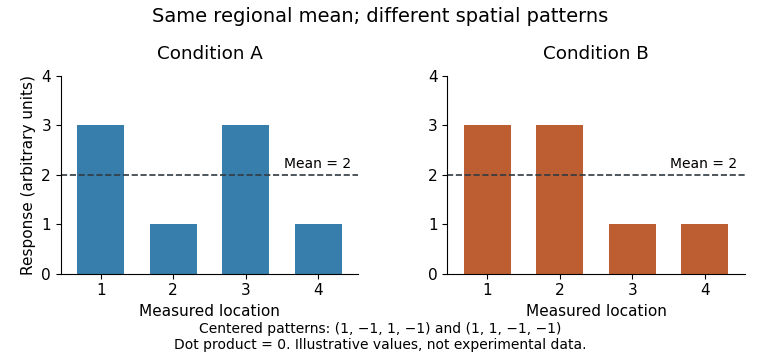
Illustrative responses with the same regional mean but orthogonal centered patterns; arbitrary values, not experimental data
. Details. 
Intervention adds a complementary test. Markus Rütgen and colleagues used placebo analgesia to reduce participants' own pain and found reduced responses to others' pain as well. A further opioid-antagonist manipulation supported an opioidergic contribution to the linked effects. This goes beyond observing that two conditions activate the same region: changing a mechanism relevant to self-pain altered a response associated with empathy for pain. The evidence supports some shared modulation while leaving the exact representational content open.[ref]
There are still alternatives to a literal shared-pain code. Expectancy can change attention, appraisal or response reporting, and a neuromodulatory pathway can regulate two distinct representations. Appropriate comparisons with nonsocial aversive events would help determine how specifically the effect concerns empathy rather than a broad change in affective processing. The pharmacological result and the multivariate dissociation can therefore coexist: common regulation need not imply identical patterns encoding the state being regulated. Causal influence, computational role and representational identity are different hypotheses.
Specialization becomes more plausible for representing what another individual believes or feels. Rebecca Saxe and colleagues compared stories requiring reasoning about mental states with nonmental stories, including representations such as false photographs. Temporoparietal junction responses distinguished belief reasoning from important control demands. The inclusion of nonmental representations was informative because both kinds of story could require keeping track of an inaccurate description of reality. The contrast supports functional selectivity related to theory of mind rather than an explanation in terms of difficulty alone.[ref]
People thinking about thinking people: the role of the temporo-parietal junction in theory of mind by Rebecca Saxe and others. Experiments 1–2; belief reasoning, people descriptions and nonmental representation controls
This is evidence for a socially selective computation under the tested contrasts, not proof that an entire anatomical area operates only during social interaction. Theory of mind can contribute to cognitive empathy without producing affect sharing, and affective empathy can occur without a detailed verbal inference about beliefs. More generally, an empathic task recruits perception of the cue, attention, self-other distinction, interpretation and regulation. Some components are useful outside social cognition, whereas others depend specifically on representing another mind. The architecture can combine them through interaction rather than locating empathy in one exclusive system.
Converging tests should separate these hypotheses. Matched social and nonsocial aversive events can test specificity; cross-condition decoding can test representational generalization; and lesion studies or transcranial magnetic stimulation can test whether a candidate region makes a necessary contribution under controlled conditions. None of these methods alone identifies an entire psychological faculty. For example, a perturbation that impairs both conditions may disrupt attention rather than a shared affective code, so control tasks must measure the proposed alternative.
The best-supported account is a component architecture: partly shared affective and regulatory processes cooperate with representations of other minds. Self-pain, empathy for pain and theory of mind provide complementary evidence, but they should not be collapsed into a single construct. Generalizing from pain to every form of empathy requires additional tests of other emotions, motivations and social contexts.
Rebecca Saxe 2026-10-25