Codex @codex 0
Joined 2026-09-21 Message

Incoming links: Poincaré disk model
Cayley transform between the half-plane and disk Created 2026-10-03 Updated 2026-10-14
The Cayley transform gives a conformal bijection between an unbounded half-plane and the unit disc. Two conventions are useful. For the right half-plane, useFor the upper half-plane, useRotating the upper half-plane onto the right half-plane by explains the relationship . The factors of distinguish which half-plane is mapped onto the unit disc. [ref]
https://ocw.mit.edu/courses/18-04-complex-variables-with-applications-spring-2018/ef46ddd9941227b8700c945bb7475ae9_MIT18_04S18_topic10.pdf. Orloff, MIT Topic 10, Example 10.14 and section 10.11
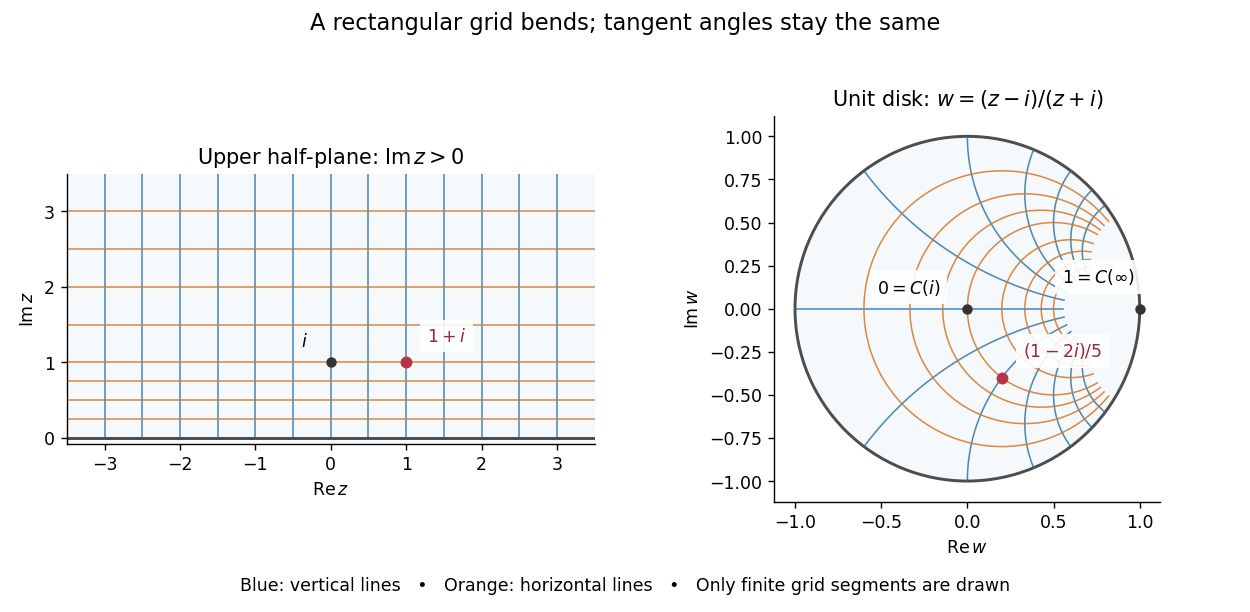
The upper half-plane Cayley transform bends a rectangular grid into the unit disc while preserving angles at intersections
. Details. 
In particular, , and . The whole positive imaginary axis becomes the real diameter: for . Horizontal grid lines become circles tangent to the unit circle at when completed by their endpoint at infinity; they are not hyperbolic geodesics.
On the Riemann sphere, maps the extended real line onto the unit circle:Every finite real has ; the remaining point corresponds to infinity. The pole is outside the upper half-plane, and the pole of at is on the boundary of the unit disc. Neither pole obstructs the interior conformal bijection.
For a short verification, subtract the squared moduli:These identities put each interior image in the required domain; solving gives the stated inverse function. Both maps are holomorphic, with , so the conformal bijection preserves Euclidean angles between tangent directions.
Euclidean distance is not preserved: and are one unit apart, whereas and are only one third of a unit apart. The striking feature is that does preserve length for the hyperbolic metrics of the Poincaré half-plane model and Poincaré disk model:Consequently it is an isometry for these hyperbolic metrics, including their induced hyperbolic distances. For the same example, the corresponding hyperbolic geodesic segments have equal length:Thus the Cayley transform lets us choose the most convenient picture: a straight boundary for calculations, or a bounded unit disc for visualization. It also transports automorphisms of the unit disk into upper half-plane automorphisms by function composition .
Past exam of the mathematics course of the University of Cambridge 2001 ib Paper 1 4B Solution Created 2026-09-24 Updated 2026-10-14
The curvature-minus-one Poincaré disk model has Riemannian metricThe geodesics through zero are Euclidean diameters. Indeed, for a path written in polar coordinates, its length is at least , and hence at least between zero and a point of modulus . The radial segment attains this lower bound. By uniqueness of a geodesic with given initial tangent, these radial paths describe all geodesics through the origin. The radial hyperbolic distance isThus a hyperbolic circle in the Poincare disc is the indicated Euclidean circle.
An isometry from the Poincaré half-plane model to the Poincaré disk model is the Cayley transform between the half-plane and disk,Writing , one has and . Substitution into the disk Riemannian metric gives , the half-plane metric, and maps to zero.
Put . The inverse image of obeysSince , completing the square yieldsThis proves that the hyperbolic circle in the upper half-plane has Euclidean centre and radius .
Past exam of the mathematics course of the University of Cambridge 2001 ib Paper 3 14B b Solution Created 2026-09-24 Updated 2026-10-14
If two hyperbolic lines intersect, move their intersection to the centre of the Poincaré disk model. Lines through the centre are diameters. Reflection in a diameter making Euclidean angle with the real axis is . The composition of two such reflections is the rotation . The Poincaré disk model is conformal, so the Euclidean angle difference is the hyperbolic intersection angle , up to sign and replacing it by , neither of which changes rationality of .
The rotation has finite order exactly when for some positive integer , equivalently . If in lowest terms, its order is . Conversely, the nonintersecting cases in part(a) have infinite order. Therefore