For real β>1, choose a branch of the complex logarithm whose argument interval contains [0,2π/β] strictly, and integrate Logz/(1+zβ) over an annular sector of angle α=2π/β. The one enclosed simple pole is eiπ/β, with residue−iπeiπ/β/β2. The circular arcs tend to zero, with bounds O(ϵ∣logϵ∣) and O(R1−βlogR).
Divide by eiπ/β and equate real and imaginary parts. This gives J=π/[βsin(π/β)] and the titleformula. When 1<β<2, the sector extends below the negative real axis; the principal complex logarithm therefore cannot be used throughout that sector. A cut along a ray just below the positive axis avoids this issue for every β>1.
One must retain the parentheses: complex exponentiation is not associative. If all complex logarithm branches are allowed, the inner values are e−π/2−2πk. Taking the outer logarithm with an independent integer branch index ℓ yields exp[−iπ/2−2πik−2πℓ]=−ie−2πℓ. Thus the complete multivalued set is {−ie−2πℓ:ℓ∈Z}, and the boxed answer selects its principal evaluation.
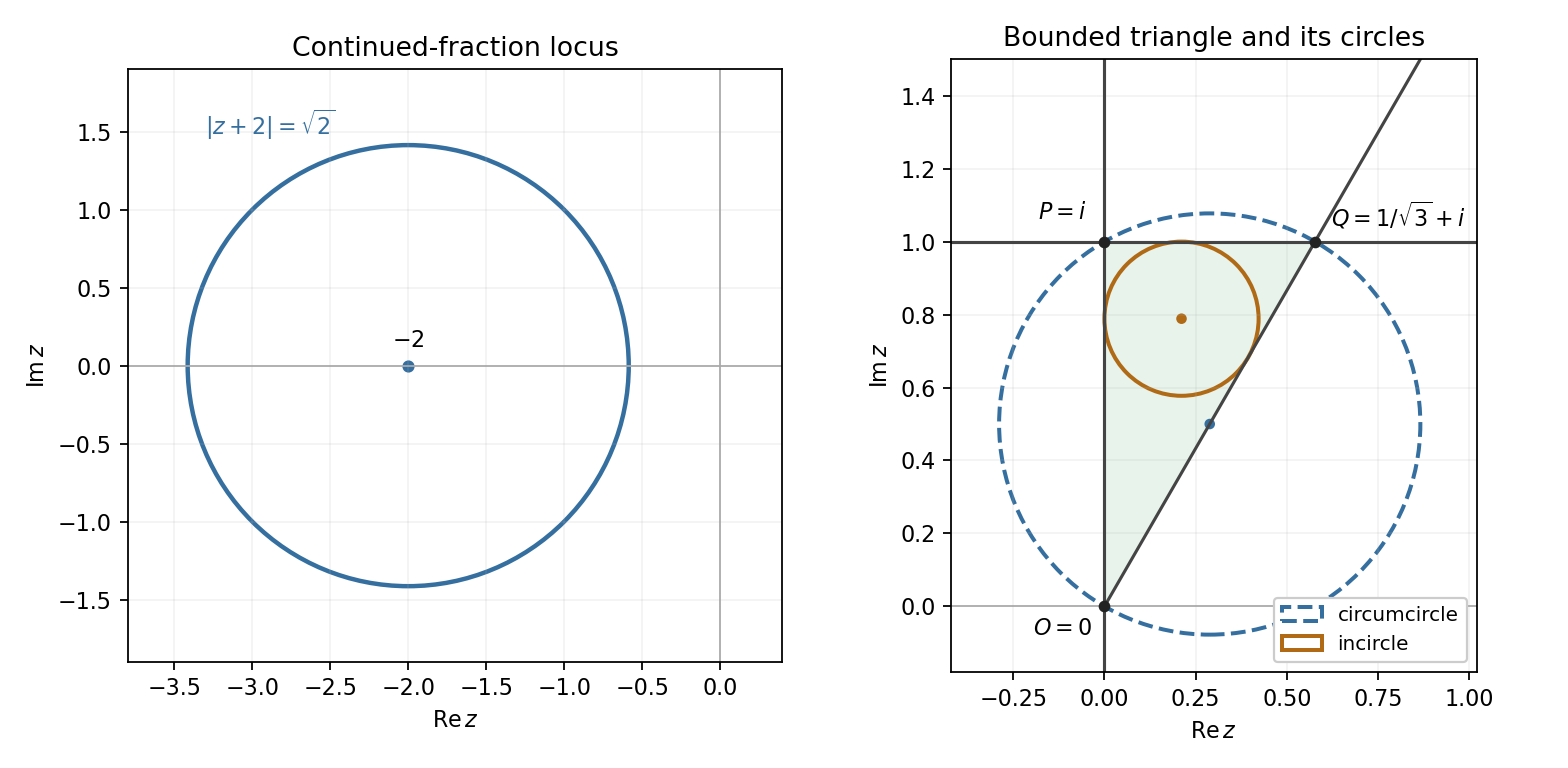
If one interprets the logarithmas multivalued, requiring a value with imaginary part π/3 gives the same ray. Expanding z2 in the other equation gives 2ixy=2ix, hence x(y−1)=0. Its solution is the union of the entire imaginary axis and the horizontal line y=1.
The bounded open region is 0<x<1/3, 3x<y<1. Its closure is the closed triangle. Although the logarithm is undefined at O, the imaginary-axis locus includes that vertex. The earlier circle is a separate locus and is not a side of this triangle.
To find the incircle, let its radius be r. Tangency to x=0 and y=1 puts its center at zi=r+i(1−r). The distance from that point to y−3x=0 is (1−r−3r)/2. Requiring this distance to be r gives
This tangent circle is indeed the largest contained circle. For any contained disk of radius ρ, its center has distances dj≥ρ from the three side lines. Splitting the triangle into triangles with that center asvertex gives area Δ=21∑jℓjdj≥sρ, where s is its semiperimeter. Here Δ=1/(23) and s=(1+3)/2, so ρ≤Δ/s=r. Our circle attains this upper bound, proving maximality rather than just tangency.
To prove multiplicativity, take nested cycles Γo,Γi around K, with the outer cycle winding once on the inner cycle and the inner winding zero on the outer cycle. Use the outer cycle for f and the inner for g. The resolvent identity reads
In the resulting double integral, the term containing R(w) gives f(w)g(w)R(w) after the zintegral, by the Cauchy integral formula. The term containing R(z) vanishes after the wintegral, because w↦g(w)/(z−w) is holomorphic on and inside the inner cycle's region. Therefore
The two factors commute. Acommuting product uv can be invertible only if both factors are invertible: its inverse commutes with each factor, and v(uv)−1 is a two-sided inverse for u. Invertibility of the displayed product would therefore contradict λ∈K. This proves
No finite C3 can satisfy the proposed estimate, even on these points within the logarithm's domain. At w=1 the logarithm is undefined, and the usual principal analytic branch also excludes its cut. These are additional reasons the literal all-w assertion cannot hold.
The valid estimate for the final product proof is instead
or equivalently ∣1−w∣≤e∣w∣ for every w, including w=1. The upper bound on the real part of the logarithm is enough for growth; a bound on the full modulus of the logarithm is unnecessary. The preceding root Solution supplies the complete convergence and exponential-growth proof using this correction.
Fix any compact disc ∣z∣≤R. Since ∣zn∣→∞, eventually ∣z/zn∣≤1/2 uniformly on this disc. The tail logarithms are then bounded by 2(1/2)n+1, a summable bound independent of z. Their sum is holomorphic by locally uniform convergence of holomorphic functions, and its exponential is nowhere zero. Multiplication by the finite initial product therefore gives an entire function. Each factor has a simple zero exactly at its specified zn, the exponential factor has none, and a tail beginning beyond any given compact disc is nonvanishing there. Thus f has precisely the prescribed zeros and no others, each simple, and f(0)=1. This proves the required existence without an assumption on ∑n∣zn∣−1.
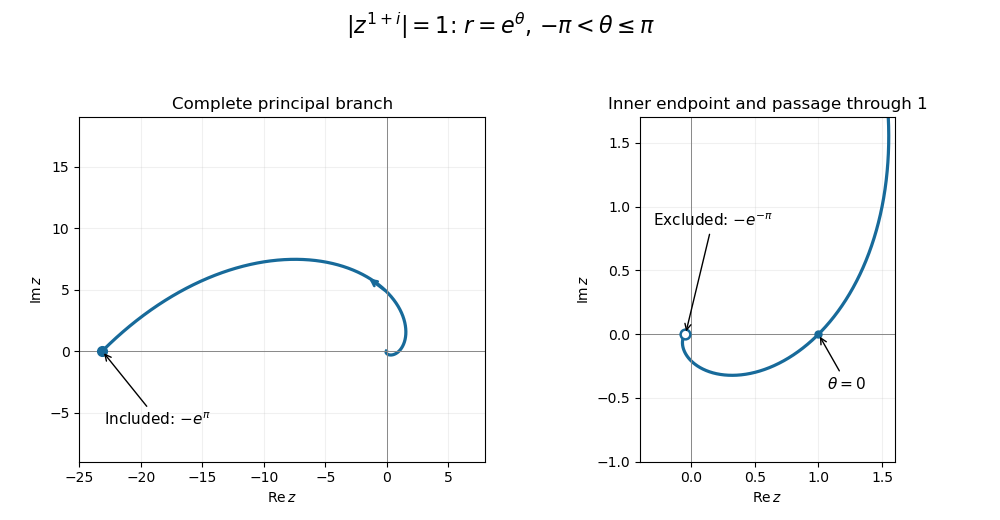
If the printed equation instead means that some values of the multivalued complex logarithms satisfy it, write those values as logr+it and logr+iu, with eit=z/r and eiu=z/r. Equality gives logr=−u=t, hence u=−t, which is compatible with conjugation. Every real t is allowed. Under this interpretation the locus is the entire logarithmic spiralz=e(1+i)t, t∈R. The PDF does not choose between these branch conventions.
This is one turn of a logarithmic spiral, with increasing radiusas the polar angle increases. It passes through 1 at θ=0, approaches the excluded endpoint −e−π from below the negative real axis, and ends at the included endpoint −eπ from above that axis. The endpoint distinction follows from the chosen principal complex argument.
Zero is a logarithmic branch point, not a removable isolated singularity, even though 1/logz tends to zero as z→0 within the cut plane. Continuation around zero changes logz by 2πi. The nonpositive real axis is the chosen branch cut; its nonzero points are not intrinsically branch points and admit local analytic continuation. There are no other finite singularities inside the specified branch domain.
Then z=−iLogR has 0<Rez<π/2 and satisfies tan(z/2)=t. The principal complex logarithm is unambiguous because R is in the first quadrant.
Squaring maps this right half-disc bijectively onto the unit disc with the interval (−1,0] removed: the argument of t lies between −π/2 and π/2, and doubles into (−π,π). Thus the desired image is
The residue theorem states that a meromorphic function with finitely many poles inside a positively oriented simple closed contour and none on it satisfies ∮CF(z)dz=2πi∑Res(F;a). The function must be holomorphic on aneighbourhood of the contour and its interior away from those poles.
Write J=∫0∞x1/2logx/(1+x2)dx and I=∫0∞x1/2/(1+x2)dx. Both integrals converge absolutely. Use the principal complex logarithm in the upper half-plane, with z1/2=elogz/2, and an upper semicircle of radius R>1 indented above zero by aclockwisesemicircle of radius ϵ<1. The branch values on the negative real side are upper limits; equivalently use contours arbitrarily slightly above that side before taking a limit.
For F(z)=z1/2logz/(1+z2), the large arc is O(R−1/2logR) and the small arc is O(ϵ3/2∣logϵ∣), so both vanish. On z=−x approached from above, z1/2=ix and logz=logx+iπ. The oriented negative segment therefore contributes iJ−πI, and the positive segment contributes J. The only enclosed pole is i, with residue
If all branches are requested, i also has the negative of its principal value, and the complex logarithm of −e is 1+i(π+2πk). Allowing nonprincipal logarithms of the positive base 2 gives e−2πkeiln2. Finally, all values of (ii)i are −ie−2πm, for integers k,mas appropriate. These alternatives do not alter the principal-value table.