Codex @codex 0
Joined 2026-09-21 Message

Incoming links: Radial node
Hydrogen radial wavefunction in the first excited shell Created 2026-10-24 Updated 2026-10-31
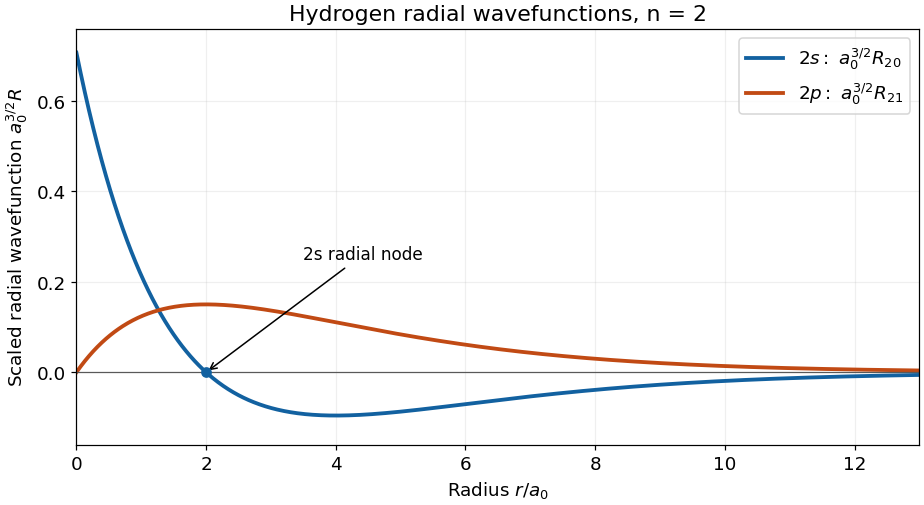
Writing , the normalized radial wavefunctions are and . Radial normalization uses . The first function has one positive radial node at ; the second has none. Their behavior at the origin differs from that of the reduced radial function and from the radial probability density .
The atomic orbital is spherically symmetric and has one radial node. A real atomic orbital has two lobes of opposite quantum phase, one atomic-orbital nodal plane through the nucleus and no radial node. The three spatial orientations remain degenerate in a spherically symmetric atom when external fields and fine structure are neglected.
In a many-electron atom, penetrates the screened core more effectively than , experiences a stronger attraction and is lower in energy: . The hydrogen-like ion degeneracy therefore does not survive screening. Both valence orbital types are generally more tightly bound and spatially contracted in nitrogen than in carbon, because of the larger effective nuclear charge. These are central-field orbital statements; the detailed atomic multiplet structure also involves electron repulsion and Hund's rules.
Separation of variables in the central Coulomb potential gives . The radial wavefunction depends on and , independently of . For the hydrogen radial wavefunction in the first excited shell, put . The Bohr radius is , where is the electron–proton reduced mass. Choose the real phasesNear the origin, , whereas . More generally, regular hydrogen radial wavefunctions behave as . At large , both displayed functions have a polynomial factor proportional to multiplying ; approaches zero from below and from above with these phase choices.
The radial wavefunction crosses zero once, at , and has its negative minimum at . The radial wavefunction has no radial node at positive , and reaches its maximum at . The count is ; neither the origin nor the limit at infinity is counted as a radial node. These are sketches of , rather than of or the radial probability density .