The laboratory frame is the reference frame in which an experiment's measuring apparatus is at rest. It need not be the centre-of-momentum frame: a target at rest in the laboratory can be struck by a projectile carrying nonzero total momentum.
An inertial force is an additional term used to express Newton's second law in an accelerating reference frame. For origin acceleration and axes with angular velocity , the apparent force on a particle isHere and are measured relative to that frame. The rotation terms are the Coriolis force, Euler force and centrifugal force. Their values depend on the frame rather than on an additional physical interaction.
If the origin of a nonrotating reference frame has inertial position and a particle has relative position , then . Newton's second law becomes . The effective inertial force is therefore . No rotation-dependent terms arise because the coordinate axes remain parallel to the inertial axes.
The rest frame of a massive particle is an inertial frame in which its spatial momentum is zero. Its four-momentum is then and its energy is . Such a frame exists for a future-directed timelike four-momentum: the Lorentz transformation with boost velocity makes the spatial momentum zero, and the mass shell relation implies . A massless particle has no rest frame, because would require a boost with speed .
A local inertial frame is a coordinate frame in which, at one chosen spacetime event, the metric tensor is Minkowskian and the Levi-Civita connection vanishes. Freely falling experiments confined to a sufficiently small neighbourhood therefore obey the laws of special relativity up to tidal corrections.
A planar quadratic saddle rotated at angular speed becomes linearly confining for the displayed strict inequality. Its rotating-frame mode frequencies obey . Equality has a zero-frequency secular mode and is not robust bounded-motion stability. This is a rotating potential model; a rolling ball on an actual surface has additional constraints.
In rapid rotation, both rotating-frame modes are nearly circular and counter-rotate relative to the axes at frequency near . Transforming back to the laboratory leaves a slow nearly harmonic oscillation and small rapid micromotion. For positive rotation the slow ellipse also has higher-order prograde precession at rate . These follow by expanding and combining the two laboratory circular components.[ref]
At radius in a ring rotating at rate , a walker with signed tangential speed relative to the ring has inertial speed . The normal reaction per mass is ; the curvature of the relative path matters as well as the centrifugal force and the Coriolis force.
Set the inertial cylindrical angle to . The Minkowski metric becomes . For a massive geodesic parametrized by proper time, its cyclic coordinates give conserved covariant four-momentum components , and . Their combination gives . The radial Euler-Lagrange equation gives the displayed coordinate acceleration, although the free worldline is straight in inertial coordinates. The conserved inertial energy is , and the inertial axial angular momentum is .
A mechanism in which rotating weights move outward as angular speed increases, allowing their displacement to indicate or regulate a machine's speed. The steady configuration follows the balance of actual applied forces and centripetal acceleration, or equivalently of applied forces and centrifugal force in a rotating reference frame. Geometry and the restoring mechanism determine the speed-displacement relation.
For total ball mass , arm length and imposed constant shaft speed , the reduced effective potential is . Its equilibrium equation is . The downward state is stable for and loses linear stability above it; nonzero stable openings then satisfy the displayed relation. Extending the angle to signed values gives a supercritical pitchfork bifurcation. Squared angular frequencies of small oscillations are at the downward state and at the open states. At threshold the quadratic term vanishes but the quartic potential is positive, so zero linear frequency does not imply finite-amplitude free motion.
Consider two equal balls of mass , four light rods each of length , a fixed upper pivot and a light sliding lower collar. Each upper and lower rod makes angle with the spindle. A spring of spring constant is uncompressed at and is compressed by collar motion. Its compression is . Collar balance gives , while vertical ball balance gives . Radial Newton's second law gives . Eliminating the rod tensions proves the displayed relation for nonzero .
For uniform angular velocity , potential , and additional forces doing no work in the rotating frame,The Coriolis force does no work; the centrifugal potential accounts for the remaining apparent force. This energy is conserved precisely when the potential has no explicit time dependence in the rotating coordinates. An inertial time-independent conservative force need not meet that condition unless its potential is also invariant under the frame's rotation. The balance prevents applying a rotating-frame conservation law to a nonaxisymmetric stationary inertial potential.
For a smooth plane at inclination rotating about a vertical axis at constant angular velocity , choose rotating coordinates horizontally and uphill, with their cross product the upward normal vector. A sliding particle under gravity satisfiesThe normal reaction is while contact is maintained. The Coriolis force does no work in the rotating frame, giving the conserved specific energyThe last term is the centrifugal potential; this quantity need not equal the inertial mechanical energy.
For a smooth horizontal circular hoop of radius , rotated at constant angular velocity about a vertical axis through a rim point, measure at that pivot from the diameter toward the bead. In rotating Cartesian coordinate system coordinates, . The tangential component of the centrifugal acceleration gives the displayed equation; the Coriolis acceleration is normal to the hoop. The farthest point is stable for , with small oscillation angular frequency . The pivot itself is unstable. This geometry differs from a vertical rotating hoop and has no tangential gravitational term.
If a frame rotates with angular velocity relative to an inertial frame, the derivatives of any vector satisfyApplying this formula twice to a position gives the Coriolis acceleration, Euler acceleration, and centrifugal acceleration terms.
The Coriolis force is the apparent force proportional to a particle's velocity relative to a rotating reference frame. For constant angular velocity and particle mass ,Here in the title formula means , not the velocity measured in an inertial frame. The Coriolis force belongs to the chosen reference frame: a particle stationary in that rotating reference frame has no Coriolis force, even though it can have a nonzero velocity in the laboratory. Other reference frames assign different angular velocities and relative velocities, and hence different Coriolis forces to the same motion.
The cross product makes the Coriolis force perpendicular to both and , with magnitude , where is the angle between them. Apply the right-hand rule to and then reverse its direction. Motion parallel to the rotation axis gives zero Coriolis force; reversing the relative velocity reverses the Coriolis force.
The appeal of this description is practical: axes attached to the Earth or a turning apparatus can be kept fixed on the page, provided Newton's second law includes the extra terms. A free particle in rotating coordinates shows exactly how a straight laboratory trajectory can become curved, while Coriolis acceleration in local Earth coordinates gives a useful terrestrial scale. The rotating-table demonstration of Coriolis deflection makes the two viewpoints visible in one experiment.
For a locally eastward aircraft velocity at northern latitude , the horizontal Coriolis acceleration is southward with magnitude . Banking to direct part of the lift northward cancels this acceleration. If vertical lift balances weight, the force ratio gives the displayed angle. Including vertical Coriolis acceleration replaces by . This is a local rotational correction, not a full navigation model of motion along a curved latitude circle.
In a flat uniform-gravity model at the North pole, Earth's rotation is vertical. To first order in angular speed, the horizontal component gives constant transverse Coriolis acceleration toward the right of the aiming direction. The return flight time is , proving the displayed miss distance. At the maximum unperturbed range, , it becomes . curvature, varying gravity, air drag and second-order rotational terms are excluded.
A projectile thrown across a rotating disk's diameter at speed relative to the thrower inherits the thrower's tangential velocity. During its approximate flight time , a receiver at the opposite rim moves tangentially in the opposite direction. The relative sideways displacement is consequently to leading order in . Integrating the Coriolis force in the disk's frame gives the same result.
In a leading meridional-track approximation, an aircraft starts southward from the equator at constant speed , with latitude . If lateral steering applies the Coriolis force rather than its negative, the two eastward effects add: . With zero initial cross-track velocity and displacement, double integration gives the displayed local-plane offset at southern latitude . For small , it is . This assumes steering is a force transverse to the actual velocity while thrust and drag balance along it. It is not compatible with a literally fixed velocity vector. A spherical calculation also includes the transport of the local east and north basis, changing finite-latitude corrections.
The instantaneous power of the Coriolis force, evaluated with the velocity in the same rotating reference frame, vanishes:This follows from the perpendicularity of the cross product and the dot product definition of power. The Coriolis force alone does no work and cannot change the rotating-frame kinetic energy . It can change the direction of the relative velocity. Actual forces and the centrifugal force can still change that kinetic energy, as the free particle in rotating coordinates illustrates. Conservation of an appropriate total energy has the additional conditions stated under energy balance in a uniformly rotating frame.
The Coriolis acceleration is the Coriolis force divided by the particle's mass:It is therefore independent of mass for a specified relative velocity and angular velocity. This is one contribution to the acceleration measured in a rotating reference frame. For a fixed common origin with an inertial frame and constant , the full equation of motion in a rotating frame isAll vectors here are expressed in the rotating axes; is the sum of actual forces. An accelerating origin adds a translational apparent force, and time-dependent angular velocity also adds the Euler acceleration.
The factor two follows directly from the rotating-frame derivative formula. First . Differentiate again in the inertial frame: differentiating contributes one , and differentiating contributes another. Move both terms to the rotating side of Newton's second law to obtain the minus sign and the factor two. The centrifugal acceleration comes from the remaining double cross product.
Consider a ball moving horizontally with no net horizontal force in the laboratory. Treat its horizontal motion as that of a free particle: with constant . Axes rotating counterclockwise at constant angular velocity about the launch point assign it the positionThis is an exact rotation matrix transformation, with the axes coinciding at . Taking , , and gives the two views below. At , the laboratory position is , but the rotating position is approximately . Both assign the same distance from the origin.
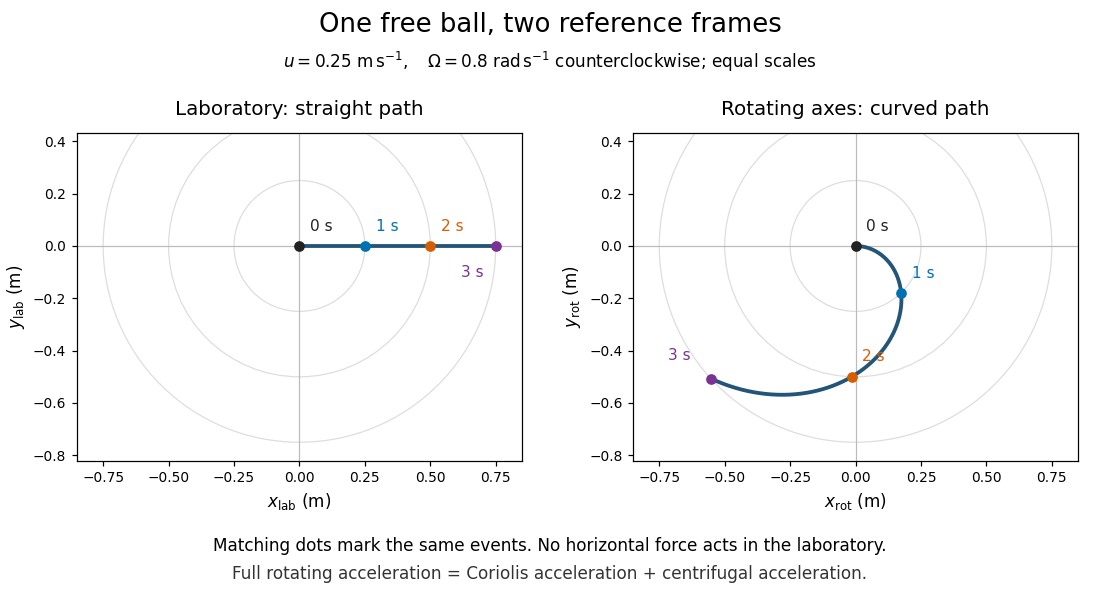

The entire rotating acceleration must include the centrifugal acceleration as well as the Coriolis acceleration. To see the balance explicitly, write and . Direct differentiation givesThe two apparent contributions areAt launch , so only the Coriolis acceleration contributes to the initial bending. Later the centrifugal acceleration also contributes; the full curved trajectory cannot be explained by keeping only the Coriolis force. In particular, grows even though the Coriolis force does no work: the rotating-frame kinetic energy increase is supplied by work from the centrifugal force. The laboratory kinetic energy remains .
Use local east, north, and up unit vectors , with . In a spherical-Earth approximation at geographical latitude , the angular velocity has components . Expanding the cross product for relative velocity givesThese are Coriolis acceleration components, not the total acceleration. For horizontal motion, the horizontal part is , where the Coriolis parameter is . Thus northward motion in the northern hemisphere has an eastward Coriolis acceleration, to the right of its velocity; in the southern hemisphere the horizontal turning is to the left. At the equator , but the full Coriolis acceleration need not vanish: vertical or eastward motion still couples through .
For a numerical example, take the Earth rotation rate , geographical latitude , and an initially northward relative velocity . Then
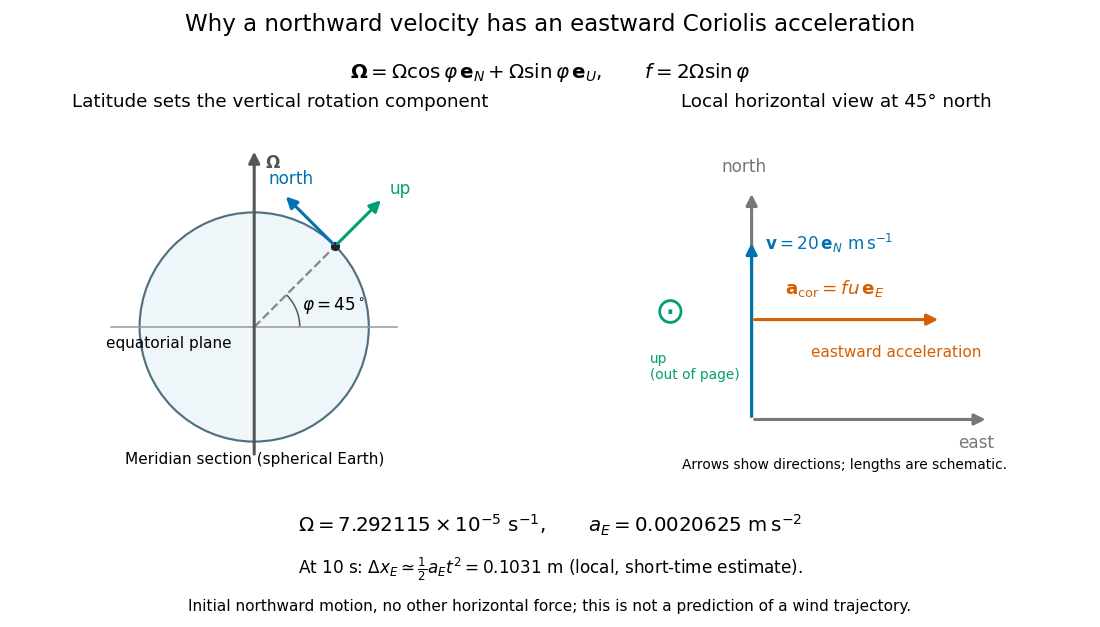
Latitude, local rotation geometry, and the scale of eastward Coriolis acceleration for northward motion
. Details. 
For a local, short-time estimate with no other horizontal force and zero initial eastward velocity, hold the initial northward velocity in the leading term: . At this gives about eastward. It assumes nearly fixed local axes and geographical latitude, negligible changes of height, and . It is not a complete wind trajectory: pressure gradients, friction, and evolving velocity must enter an atmospheric equation of motion. The effective gravity in a rotating frame already combines ordinary gravity with the steady terrestrial centrifugal acceleration.
At first order in Earth's rotation, vertical velocity gives east acceleration . A launch returning to its initial height lands westward, while a drop from the launch's maximum height lands eastward with one quarter the displacement magnitude. These results assume constant effective gravity, no air drag and no horizontal velocity in the Coriolis term. The northern component vanishes at this order.
At colatitude , ignore terms quadratic in Earth angular speed and use uniform vertical gravity. A vertically launched particle has zeroth-order height . Its eastward Coriolis acceleration is , so its horizontal velocity is . Integrating over the flight time gives the westward displacement displayed above. Descent reverses the horizontal acceleration but does not cancel the accumulated displacement.
The Technische Universität Darmstadt demonstration uses a steel ball launched outward from the centre of a rotating disc. A fixed lecture-room camera records a straight path, while a camera carried above the disc records a curved path. The instructions specify launching toward the fixed camera so that the laboratory motion is clearly visible. The rotating iPod transmits its view wirelessly through Apple TV; two vertical support rods of length are specified for the slow-motion arrangement. The paired video views are the readout: one physical motion is represented in two reference frames.[ref]
Coriolis-Kraft at Technische Universität Darmstadt. Coriolis-Kraft, demonstration M C 13 2: Info; Beschreibung, Hinweis zur Durchführung and Hinweis zum Aufbau
A useful preparation control appears in the Universität Freiburg instructions: with the disc stationary, check that the ball travels radially toward its edge. A camera is mounted on supports attached to the disc; turn the disc by hand as the ball leaves its centre and observe the camera view.[ref]
Kugel auf rotierender Scheibe at Universität Freiburg. Kugel auf rotierender Scheibe: Durchführung, Material, Aufbau and Durchführung
The inference is a dependence of the observed trajectory on the rotating axes; a curved camera trace alone does not isolate the Coriolis force. To compare with the constant-angular velocity free particle in rotating coordinates, measure the disc angular velocity, calibrate lengths in the camera image, and compare launches at rest and with opposite rotation directions. These are checks of the ideal model, not reported measurements from the manuals. A rolling ball can exchange forces with the surface through friction, and hand rotation need not have constant angular velocity; an Euler acceleration then enters too. The ideal free-ball drawing deliberately omits those effects. Neither manual supplies a numerical uncertainty or a precision measurement of the Coriolis acceleration.
A mass in a rotating reference frame with varying angular velocity experiences this apparent force. Dividing it by gives the Euler acceleration.
When a reference frame has time-dependent angular velocity , a particle at position has apparent Euler acceleration .
In a rotating reference frame, this apparent force acts away from the rotation axis. The corresponding centrifugal acceleration is the force per unit mass.
In a uniformly rotating frame, centrifugal acceleration points away from the rotation axis and equals .
For uniform rotation about an axis, centrifugal acceleration is the negative gradient of the potential , where is distance from the rotation axis.
A pendulum of length whose pivot rotates at radius can remain at angle from the downward vertical whenIf the connector is a spring of extension , replace in the radius by and use vertical balance to determine .
For a smooth circular hoop of radius rotating about its vertical diameter at angular speed , a bead at angle from the downward vertical obeys
At , the stable downward equilibrium of a rotating-hoop bead loses stability and two stable equilibria withemerge symmetrically.
Articles by others on the same topic
There are currently no matching articles.