The polynomial remainder is the polynomial in polynomial division . Division by has a constant polynomial remainder , as expressed by the factor theorem.
For any identity , polynomial evaluation at a root of a polynomial of givesThis substitution requires no division by . In the worked example, polynomial factorization gives , so its two roots of a polynomial are and . The cubic polynomial and its linear polynomial remainder agree there:A cubic expression has been compressed into a straight line carrying exactly these two values.
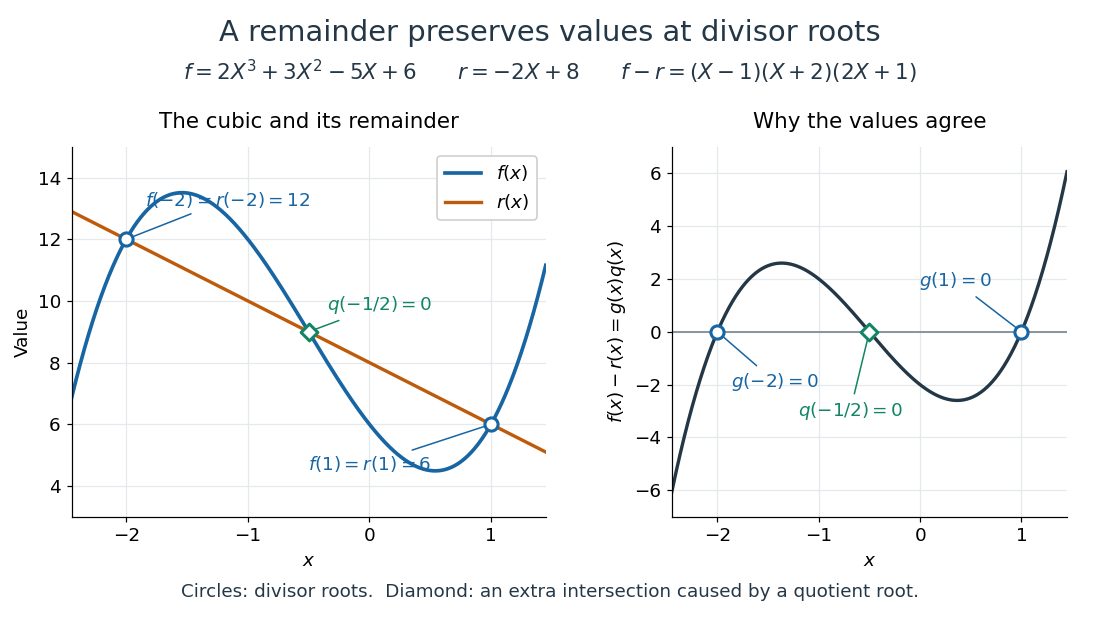
The original polynomial and its polynomial remainder agree at both polynomial roots of because vanishes there
. Details. 
Conversely, those two values determine the linear polynomial remainder by polynomial interpolation. Write ; then and , giving and . The polynomial degree bound is essential: adding any multiple of preserves the two values, but generally raises the polynomial degree. The plot also shows agreement at , where rather than . Agreement of and at a point therefore does not imply that the point is a root of a polynomial of the divisor.
Dividing a polynomial by leaves the constant polynomial remainder . Polynomial division makes the polynomial remainder constant because its polynomial degree must be below one; polynomial evaluation at identifies that constant. In particular, it is zero exactly when is a root of a polynomial of , which is the factor theorem.[ref]
Fields and Galois Theory by James S. Milne. Fields and Galois Theory, version 5.10, Chapter 1, p. 10, §1.7: division by X−a and evaluation of the constant remainder
In the worked example, division by leaves and division by leaves . Division by their product leaves , a polynomial remainder that stores both values at once. The argument also holds over a commutative ring for in that ring, because is a monic polynomial.
Articles by others on the same topic
There are currently no matching articles.