A binary repetition code represents one bit by repeating it times, using codewords and . Their Hamming distance is , and the code rate is . For odd , the majority function recovers the input whenever fewer than half the positions have flipped. Even allows a tied vote, so a decoder must specify how it handles that case.
For , the received words decode to zero; decode to one. The decoder therefore corrects every single flip. This guarantee concerns the number of flipped positions, independent of any probabilistic model.
If each position passes independently through a binary symmetric channel with crossover probability , a decoded error requires at least two flips. The binomial distribution givesAt , the uncoded error probability is , while the three-bit code's decoded error probability is . This improvement costs three transmitted bits per message bit. For , ; for , one should first exploit the known tendency to invert symbols rather than applying the same majority rule blindly.
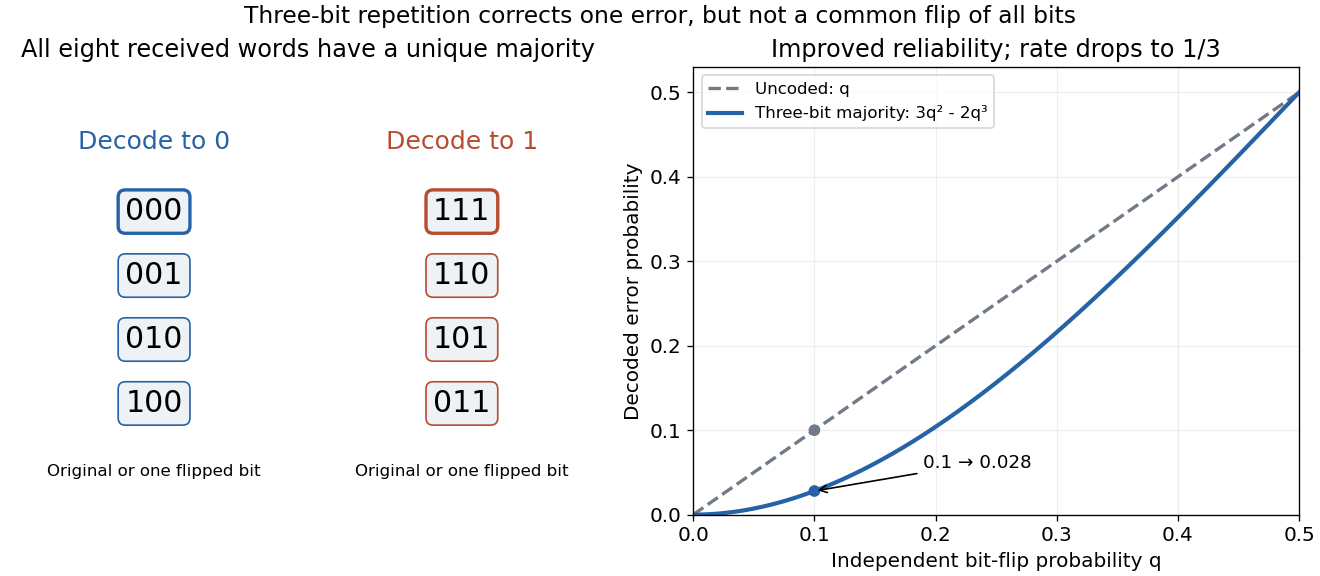
Independent flips are an essential assumption for the displayed formula. If a single common disturbance flips all three positions together with probability , repetition provides no improvement. More efficient error-correcting codes distribute redundancy across larger message blocks; repetition is useful as a transparent example of the geometry and the reliability–rate tradeoff.
Articles by others on the same topic


Repetition code is a simple form of error correction used in coding theory to transmit data robustly over noisy communication channels. The fundamental idea of repetition code is to enhance the reliability of a single bit of information by transmitting it multiple times. ### Basic Concept: In a repetition code, a single bit of data (0 or 1) is repeated several times.