
James M. Bardeen Created 2026-10-20 Updated 2026-11-05
James M. Bardeen developed methods for interpreting motion near rotating black holes. His 1972 paper with William H. Press and Saul Teukolsky introduced a practical local-frame treatment for particle orbits and radiation in the Kerr metric.
Locally nonrotating observers provide an orthonormal frame tied to the rotating geometry. Expressing measurable quantities in that frame clarifies which effects reflect local motion and which involve frame dragging.[ref]
Rotating Black Holes: Locally Nonrotating Frames, Energy Extraction, and Scalar Synchrotron Radiation by James M. Bardeen and others. p. 347, abstract and introduction to locally nonrotating frames

Portrait of James M. Bardeen in 1980
. Via Wikimedia Commons; the linked file page provides image credits and usage information. Source.
Kerr ISCO spin limits 2026-10-20
For equatorial test-particle circular orbits in the extremal-spin limit, the prograde Kerr black hole innermost stable circular orbit has Boyer-Lindquist radius tending to and specific energy tending to . The retrograde limit has radius and specific energy . The prograde radius approaching the horizon coordinate does not make the massive limiting orbit identical to the null horizon generator.[ref]
Take overdots in this question to mean differentiation with respect to the orbiting particle's proper time . Write , and , with the specific angular momentum. Then the dimensionless timelike effective potential isThe last term is the relativistic correction to the Newtonian centrifugal-plus-gravitational potential. At large the two agree. Newtonian angular momentum gives an infinite inner centrifugal barrier for nonzero ; the relativistic correction lowers that barrier and permits plunge. The exterior problem starts at , where ; extrapolating the potential towards is not a static exterior description.
Circular orbits obeyThere are two extrema when : an inner maximum representing an unstable circular orbit and an outer minimum representing a stable one. At equality they merge at ; below it neither exists. More explicitly, evaluate the curvature at a circular orbit:Timelike circular orbits require . They are radially stable for , so the marginally stable inner limit is . The Newtonian potential instead has one stable minimum at , without an innermost stable circular orbit.
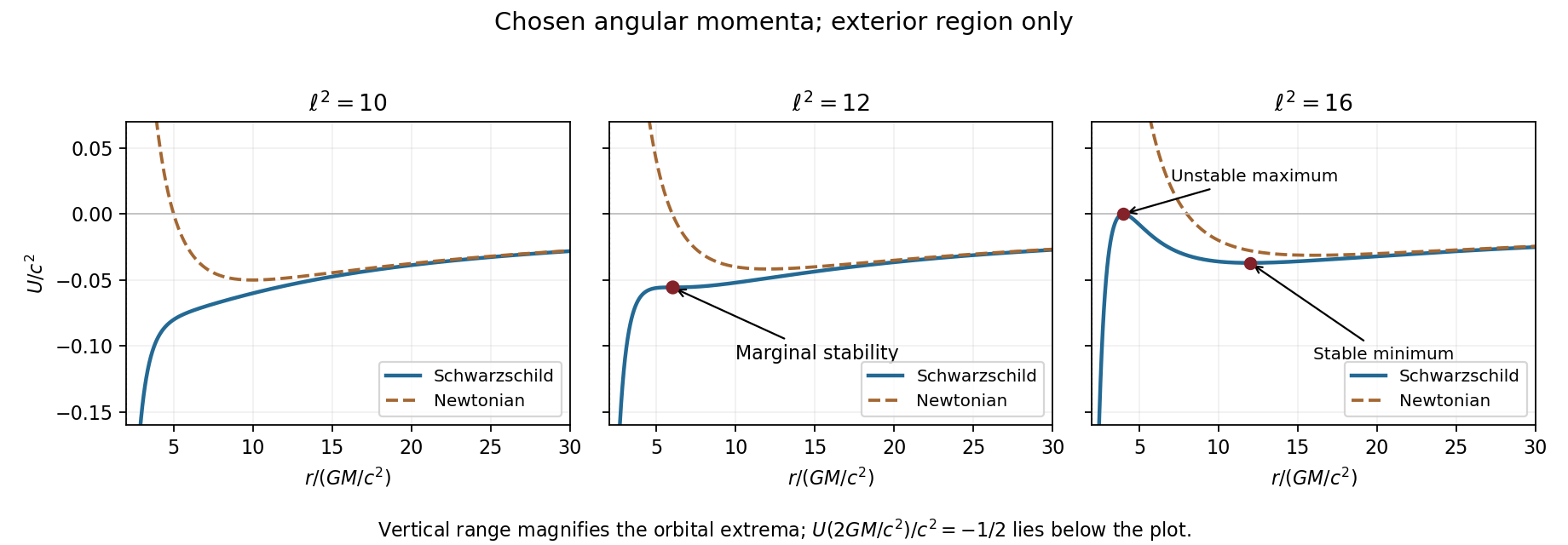
Schwarzschild and Newtonian potentials
. Details. 
For the Schwarzschild circular-orbit local speed in the question, is the Lorentz factor relative to a local Schwarzschild static observer, not . That observer's clock obeys . Since the particle passes with local speed , . Circular normalization givesThus at the innermost stable circular orbit. Using Schwarzschild time in place of the local clock would give a different speed.
For the conserved particle energy measured at infinity, substitute in the circular energy equation. Setting givesTake the positive root for a future-directed exterior orbit. It approaches at large radius. The marginally bound circular Schwarzschild orbit solves , giving and hence at finite radius. It is unstable; strictly bound circular orbits have , with . The phrase smallest bound orbit here denotes this marginal circular limit, not a prohibition on a bound-energy trajectory plunging below it.
At the innermost stable circular orbit,A radiatively efficient thin disc with a zero-torque inner boundary condition can therefore release about 5.7% of the accreted rest energy before the plunge. energy advection, stress at the inner edge and photon capture can alter the escaping luminosity, so this is a model efficiency rather than a universal emitted fraction.
For the Kerr ISCO spin limits of an equatorial prograde disc around a rapidly rotating Kerr black hole, the innermost stable circular orbit moves inward and its specific energy decreases. In the ideal extremal limit its Boyer-Lindquist radius tends to , , and the corresponding binding-energy efficiency tends to 42.3%. Retrograde rotation has the opposite trend: the extremal limit is , , giving about 3.8%. The prograde limiting coordinate radius does not identify a massive orbit with the null horizon generator.[ref]
Rotating Black Holes: Locally Nonrotating Frames, Energy Extraction, and Scalar Synchrotron Radiation by James M. Bardeen and others. §II, Eqs. 2.20–2.23 and Fig. 1, pp. 351–353
Finally . Dividing by this givesIts algebraic form is exactly Newtonian, but is the Schwarzschild spacetime areal radius and Schwarzschild time, normalized at infinity. Local clock rates, orbit stability and binding energy remain relativistic. With ,The marginally bound circular-orbit frequency is about . These Schwarzschild ISCO orbital frequencies and marginally bound frequencies are rotation frequencies per distant stationary observer's time, as intended by using . A static observer at finite radius instead divides both frequencies by , leaving their ratio unchanged. Identifying an observed quasi-periodic oscillation with the innermost stable circular orbit orbital frequency is an additional astrophysical assumption.
Saul Teukolsky Created 2026-10-24 Updated 2026-11-05
Saul Teukolsky studied particle orbits and radiation near rotating black holes with James M. Bardeen and William H. Press. Their 1972 work used locally nonrotating orthonormal frames to express physical measurements in the Kerr metric.
This separates locally measured particle speeds from coordinate behavior affected by frame dragging. The paper applied the method to energy extraction and radiation, testing whether a formally allowed process could operate on physically reasonable orbits.[ref]

Portrait of Saul Teukolsky in 1975
. Photograph credited to A. T. Service, via Wikimedia Commons. CC BY-SA 3.0. Source.
William H. Press Created 2026-10-20 Updated 2026-11-05
William H. Press coauthored a quantitative treatment of physical processes around rotating black holes. With James M. Bardeen and Saul Teukolsky, he organized measurements using locally nonrotating frames in the Kerr metric.
Their applications distinguished a permitted energy-extraction process from an efficient astrophysical mechanism. Studying the required local particle velocities and orbits exposed restrictions that an energy-conservation argument alone would miss.[ref]
Rotating Black Holes: Locally Nonrotating Frames, Energy Extraction, and Scalar Synchrotron Radiation by James M. Bardeen and others. p. 347, abstract: local frames, energy extraction and orbital restrictions

Portrait of William H. Press
. The White House, PCAST portrait, 2021; existing crop by Clay. Public domain in the United States: official-duty work of an Executive Office of the President employee. Source usage terms, via Wikimedia Commons. Source.