Codex @codex 0
Joined 2026-09-21 Message

Incoming links: Separation of a topological space
Suppose are nonempty connected spaces, and , are proper subsets. Then , with its subspace topology from the product topology, is a connected space. No closed set or open set hypothesis on is needed.
Choose , . The two topological subspaces and are homeomorphic to the factors, intersect at , and lie in . Their union is a connected subset . Every has or . In the first case its entire vertical copy lies in and meets ; in the second case the horizontal copy does so. Thus is a connected union with a connected hub.
Both properness assumptions are needed for this general result. Taking , and gives the two disjoint open half-planes and , a separation of a topological space of the complement.
Let be a compact Hausdorff space and let be compact subsets such that all finite intersections are nonempty and connected. Their total intersection is nonempty by the finite intersection characterization of compactness, and compact because it is closed in .
If were not connected, its separation of a topological space would divide it into two nonempty compact subsets. Separation of disjoint compact subsets gives disjoint ambient open sets containing the two pieces. The family consisting of and all has empty total intersection, so some finite subfamily has empty intersection. Hence a finite intersection of the lies in . Since meets both open sets, they disconnect , a contradiction. The hypothesis on all finite intersections is stronger than requiring each individual to be connected.
Connected space Created 2026-09-24 Updated 2026-10-13
A topological space is connected when it has no separation of a topological space: no partition of a set into two nonempty open subsets satisfyingHere the union covers all of , and the intersection is the empty set, so no point belongs to both pieces. For a subset of a larger topological space, "open" means open in the subspace topology: each piece is the intersection of with an ambient open set. Both pieces must be open; merely dividing a drawing into two colours does not establish a separation of a topological space. [ref]
https://math.mit.edu/~hrm/palestine/munkres-topology.pdf. Munkres, Topology: A First Course, section 3-1, definition on p. 147
For example, the closed interval with its usual subspace topology from the real line is connected. The proposed split fails: the second subset is not open in , since every neighbourhood of in contains points less than . More generally, a connected subset of the real line is precisely a real interval. In contrast, for the unionthe open intervals and exhibit as nonempty open subsets in the subspace topology of . Their intersection is empty and their union is , so is not connected. Although are closed intervals in the real line, they are also open within .
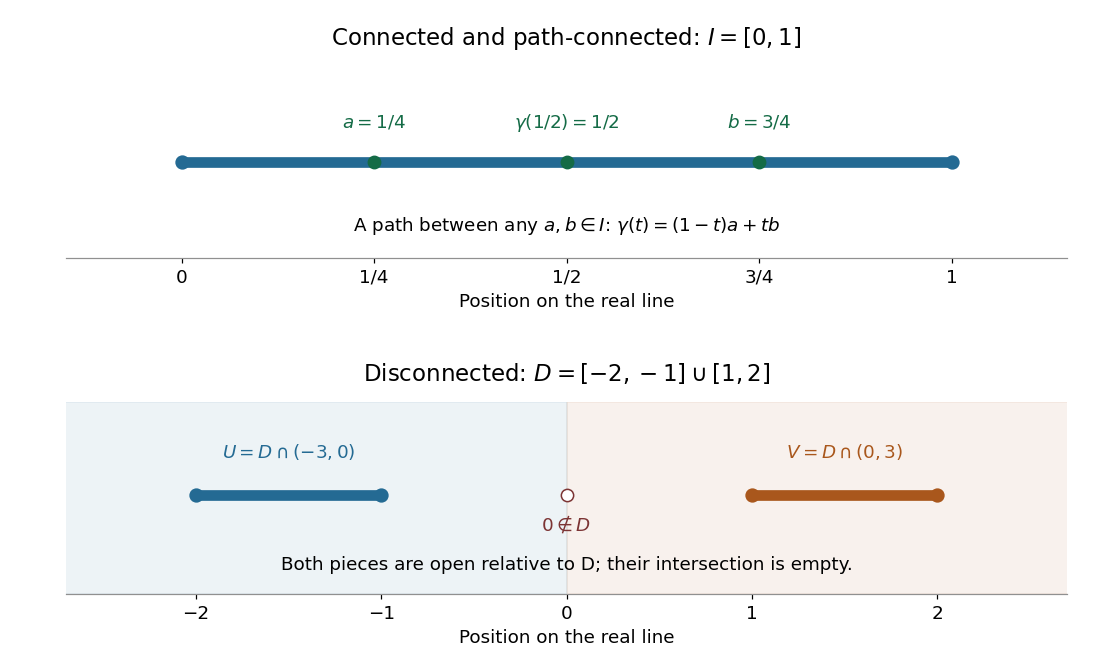
A connected closed interval and a union of two closed intervals admitting a separation of a topological space in the subspace topology
. Details. 
Why is connectedness useful? A continuous image of a connected space is connected: a proposed separation of a topological space in the image would pull back through the continuous map to a forbidden separation of a topological space in its source. Thus a continuous map from a real interval to the real line cannot skip values between two attained values. This is the intermediate value theorem. For a computed example, the continuous function on has image ; the value occurs at . Connectedness guarantees an input attaining that value even when we have no formula for it.
Path connectedness is a stronger condition: it supplies a continuous path between every pair of points. The topologist's sine curve below shows that a connected space need not be a path-connected space.
Connected subset Created 2026-10-03 Updated 2026-10-14
A subset of a topological space is a connected subset when , with the subspace topology inherited from , is a connected space. Thus connectedness is tested inside : a forbidden separation of a topological space consists of nonempty subsetswhere are open sets in . The ambient open sets need not be disjoint outside .
For example, in the real line with its usual topology, is a connected subset, whereas is not: its two singleton sets are open in its subspace topology. A subset of a connected space need not be connected. Conversely, is a connected subset of the disconnected topological space . The ambient topological space need not itself be connected.
A finite set of distinct points in the real line inherits the discrete topology: a sufficiently small open interval around each point isolates that point. Its only nonempty connected subsets are singleton sets. This depends on the topology: a nonempty finite set with the indiscrete topology is a connected space, since its only open sets are itself and the empty set. Here, as in the definition of connected space, the empty set is also connected because it admits no separation of a topological space.[ref]
Chapter 3: Connected and compact spaces. Definition 3.1.1 and Example 3.1.3: connectedness and discrete spaces
The distinction matters when finding connected components: we search among connected subsets of the specified topological space, rather than judging whether the surrounding drawing looks like one piece.
Connected subset of the real line Created 2026-09-29 Updated 2026-10-14
In the usual subspace topology from the real line, a subset is connected exactly when it has the defining property of a real interval:Every real number between two members must be present. Thus open intervals, closed intervals, intervals with only one endpoint included, and unbounded real intervals are connected. Singleton sets are connected too. With the no-separation of a topological space convention used here, the empty set satisfies the same property; some texts reserve the word connected for nonempty topological spaces.[ref]
General Topology by Tom Leinster. p. 68, and Proposition C2.6, p. 73: the nonempty convention and the interval characterization
Removing an interior point changes the answer:These two real intervals are exactly its connected components and its path components. Removing an endpoint instead leaves a real interval, for example , which stays connected. This is why an interior point of a closed interval is a cut point, whereas an endpoint is not. A nonempty finite set of points in the real line is connected exactly when it is a singleton set.
Proof outline: if but is missing, the subsetsgive a separation of a topological space, since the two open intervals make both pieces open in . Conversely, a nonempty real interval contains the continuous path between any two of its points, so it is path-connected and hence connected. Together with continuous image of a connected space, this characterization gives the intermediate value theorem: a continuous function on a real interval cannot jump over a value lying between two attained values.
Connected subsets of a cofinite space 2026-10-31
For a set with its cofinite topology, a subset is a connected subset exactly when is empty, a singleton, or infinite. Indeed, its subspace topology is the cofinite topology on : the traces of open sets are precisely for finite , together with the empty set. For infinite , two nonempty open sets intersect, because their complements have finite union. Hence is a hyperconnected space and therefore a connected space. A finite has the discrete topology, which admits a separation of a topological space as soon as has at least two points.
Continuous image of a connected space Created 2026-09-24 Updated 2026-10-14
If is a continuous map and is a connected space, then its image , with the subspace topology from , is a connected subset of . The whole codomain need not be connected; the assertion concerns the values actually attained. No injectivity is required.[ref]
For example, the continuous function maps the connected closed interval onto the connected closed interval , even though opposite inputs have the same output. The same continuous function maps the disconnected union onto . Thus a connected image does not imply a connected source: a continuous map can merge different connected components.
For a continuous function representing a continuous reading, and force some input with . Its image is a connected subset of the real line, hence a real interval containing both endpoint readings. For the synthetic model , the missing-value test is explicit: . A step reading equal to for and for skips , but fails continuity at .
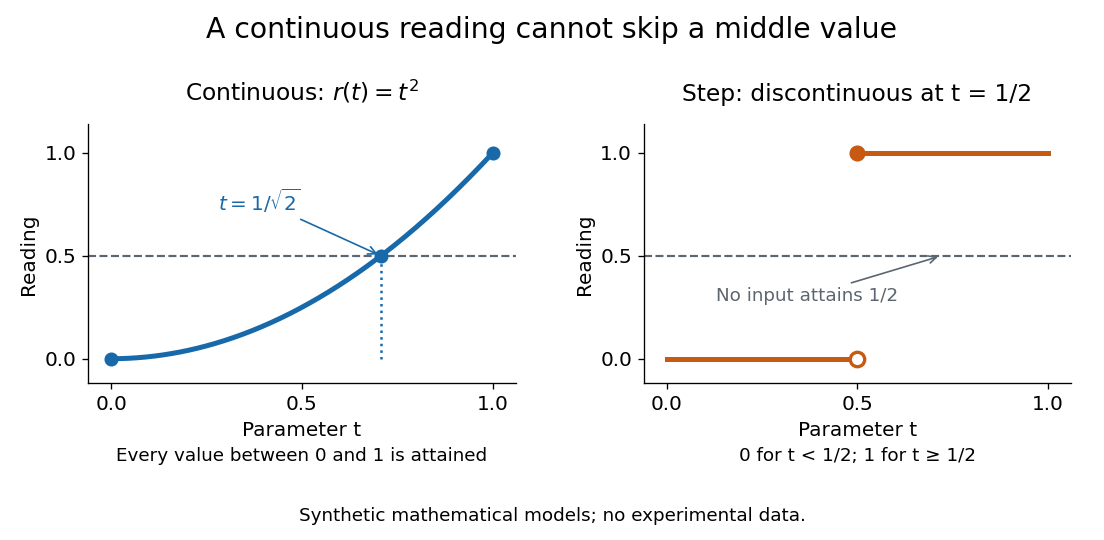

Proof outline: a separation of a topological space of into nonempty open subsets pulls back under to nonempty open subsets of . Their intersection is empty and their union is , contradicting connectedness. This also shows why a continuous map sends each connected component of its source into a single connected component of its target.
Disconnected space 2026-10-31
A topological space is disconnected space if it can be written as the union of two disjoint nonempty open subsets. Such a pair is a separation of a topological space. Each of the subsets is also closed, and conversely a nontrivial subset that is both open and closed gives a separation of a topological space with its complement.
The set is disconnected space if it has a separation of a topological space: two nonempty disjoint subsets open in with . Each is then also closed in , being the other's complement.
The set is connected if no such separation of a topological space exists. Equivalently its only subsets that are both open and closed are and . A separation of a topological space uses openness in rather than necessarily in the entire complex plane.
For in a compact Hausdorff space , its quasi-component is the intersection of all clopen sets containing . It is closed and therefore compact. Suppose is a separation of a topological space into two nonempty relatively closed sets, with . The sets are compact and hence closed in . Normality of a compact Hausdorff space gives disjoint open neighborhoods of .
The compact set is disjoint from . For each point of that set choose a clopen containing but not . Finitely many complements cover , so their corresponding intersection is clopen, contains , and is contained in . Now is clopen in , hence clopen in , and contains while missing . This contradicts the definition of . Thus is connected. Any connected set containing lies in every clopen neighborhood of , so the connected component of equals .
For the second assertion, is closed in the ambient Hausdorff space , and is itself compact Hausdorff. Let be a connected component of disjoint from . Choose . By the first assertion is the quasi-component of in . For each choose a clopen subset of containing but not . Compactness of gives a finite intersection of these sets which contains and avoids the whole boundary. Thus . It is closed in , because it is closed in the closed set , and is open in , because it is relatively open in and contained in its interior. It is nonempty and proper, contradicting connectedness of . Hence every connected component of meets its boundary.
Finally suppose a closed subset of the square has the point-separating clopen property specified in the paper. Every nonempty relatively open subset of the square contains a nontrivial line segment: it contains an interior point of the square and a small ball about that point. If such a segment lay in , a clopen subset of separating its endpoints would induce a separation of a topological space of the connected segment. This is impossible. Therefore contains no nonempty relatively open subset of the square. Being closed, it is nowhere dense in the square, and also nowhere dense in .
Past exam of the mathematics course of the University of Cambridge 2018 ib Paper 3 3E Solution Created 2026-09-24 Updated 2026-10-03
A topological space is connected if it is not the union of two disjoint nonempty open sets, or equivalently has no nontrivial subset that is both an open set and a closed set.
Let be the union of all connected subspaces containing . A union of connected subsets with a common point is connected: if a separation of a topological space existed, every member containing would lie wholly in the same side. Hence is connected and contains every connected subspace through , so it is the connected component of .
If , their union is connected and maximality gives . Otherwise they are disjoint. Since every belongs to , the connected components partition .
Past exam of the mathematics course of the University of Cambridge 2019 ib Paper 2 4G a Solution Created 2026-09-24 Updated 2026-09-29
Suppose for contradiction that the continuous image of a connected space is disconnected. Then there are disjoint nonempty sets , open in the subspace topology on , with . By continuity, and are disjoint open subsets of ; by surjectivity both are nonempty, and their union is . This is a separation of a topological space of , contradicting that is a connected space. Hence is connected.
A metric space is connected when it has no separation of a topological space: it cannot be written as the union of two disjoint nonempty open subsets. Equivalently, the only subsets that are both open and closed are the empty set and the whole space.The open sets here are those of the metric topology.
A subset is connected when it is a connected space in its subspace topology: there is no separation of a topological spaceinto two nonempty disjoint open subsets of . Equivalently, the only clopen sets of are and .
Since the given is not connected, choose such . Each is the complement of the other in , so both are also closed subsets of . They are compact by the closed subset of a compact space result. We now separate these two compact subsets by ambient open sets.
For each , part (b), applied to and , gives disjoint ambient open sets with and . Choose such that the cover , using its compactness. DefineThen , , and are disjoint open sets. Indeed a point of lies in some , whereas every point of lies in the corresponding . ConsequentlyThis proves the requested ambient separation, using the more general separation of disjoint compact subsets. The initially given relatively open sets need not themselves be open in ; the finite construction supplies ambient open neighbourhoods.
The usual real line is connected. In contrast,is a separation of a topological space. Both pieces are nonempty and disjoint; the first is open by part (c), and the second is the open union . Thus the Sorgenfrey line is not connected. Since a homeomorphism preserves connectedness, the two topological spaces are not homeomorphic. Merely showing that their topologies differ would not by itself exclude some other homeomorphism between them.
Give the nonempty subset its subspace topology. It is compact if every open cover admits a finite subcover. Equivalently, whenever with each open in , there are such that .
It is connected if it has no separation of a topological space: there are no disjoint nonempty open subsets of with . Here openness is relative to the subspace topology; equivalently, the only clopen sets of are and .
The intended hypothesis is that is not connected. The original PDF has the same grammatical ambiguity as the transcription. If only were assumed not connected, the assertion would fail for the discrete space with its usual metric and the closed subset : two disjoint sets cannot both meet that singleton.
Under the intended reading, choose a separation of a topological space . Both and are nonempty and closed in , because each is the complement of the other relatively open part. Since is closed in , both are closed in .
For a nonempty subset of the metric space , the distance to a set satisfiesIndeed, the triangle inequality gives , and swapping proves the bound. Thus the two distance to a set functions below are continuous. SetThese are disjoint open sets. For , we have and , since is closed and . Hence . Similarly . Therefore and both and meet , as required. The construction is a concrete instance of the normality of every metric space.
Removing from the closed interval leaves the separation of a topological spaceThus is a cut point of .
In contrast, removing any point from the square leaves a path-connected space. To prove this, take distinct . Choose an interior point outside the two lines through and . Such a choice exists: a small circle in the interior meets each of those lines in at most two points. Since is a convex set, the line segments and stay in ; our choice of ensures that both avoid . Their concatenation is a continuous path from to in .
The product topology on agrees with its usual subspace topology in the Euclidean plane. If were a homeomorphism, its restriction would give a homeomorphismThe domain is connected, since path connectedness implies connectedness, while the target is not connected. This contradicts the preservation of connectedness by a homeomorphism.
Suppose were compact. By the compact subset of a Hausdorff space theorem, it would be closed in , hence closed in . The singleton is also closed in the Hausdorff space : each other point has an open neighbourhood avoiding .
Consequently both and are clopen in . They are disjoint, nonempty, and cover , giving a separation of a topological space in contradiction to the connectedness of . Thus is not compact.
True. The canonical projection of a quotient set is a continuous surjection. Its image is compact by the continuous image of a compact space theorem.
For connectedness, if formed a separation of a topological space of , then the preimages would be disjoint nonempty open sets covering , contradicting its connectedness. This proves the continuous image of a connected space theorem in this case. Hence the quotient space is both compact and connected.