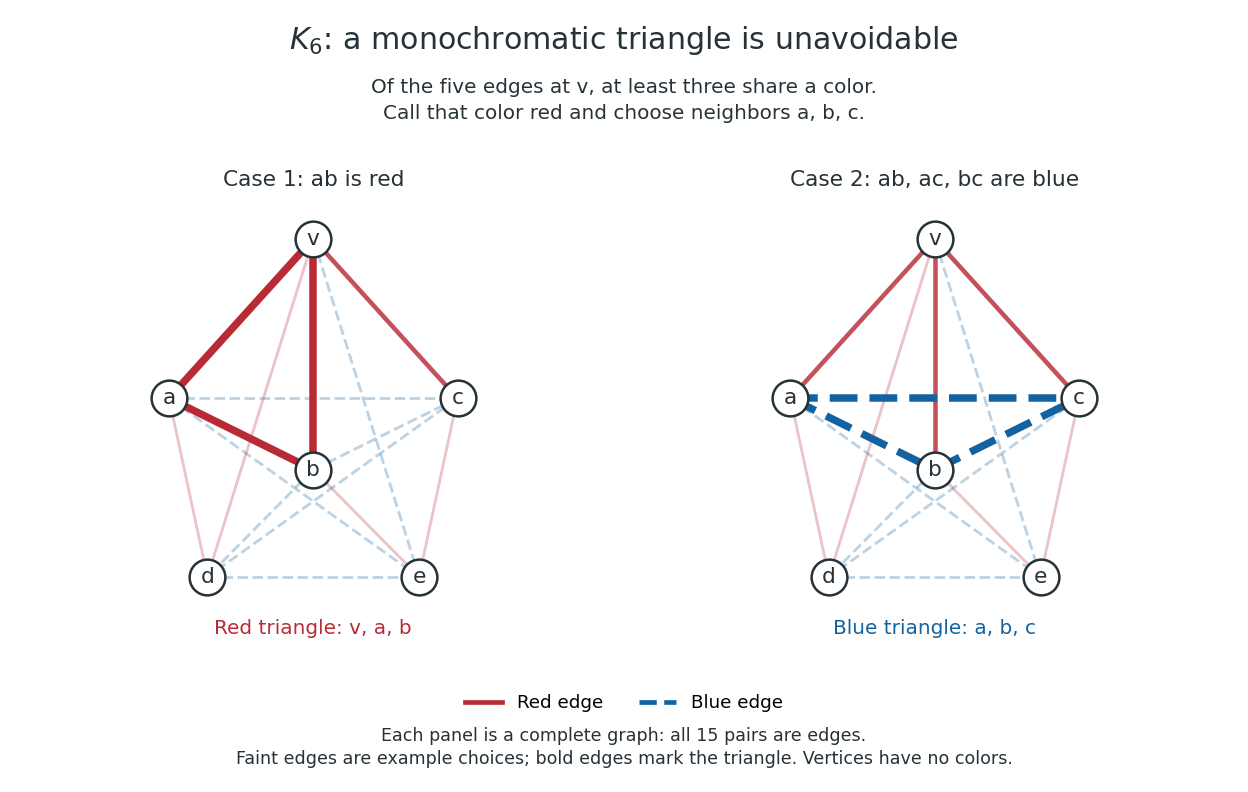
Choose any vertex of a red-blue colored complete graph . Its five incident edges go to the other five vertices. By the pigeonhole principle, at least three have the same color. Call their other endpoints and, after swapping color names if needed, suppose are red.
If any of is red, it completes a red triangle in a graph with . If none is red, all three are blue, so themselves form a blue triangle in a graph. Both possibilities force a monochromatic triangle in a graph. This proves the upper bound for the Ramsey number for triangles using only five incident edges and the three pairs among the selected neighbors; the colors of the other edges cannot defeat the argument.

Articles by others on the same topic
There are currently no matching articles.