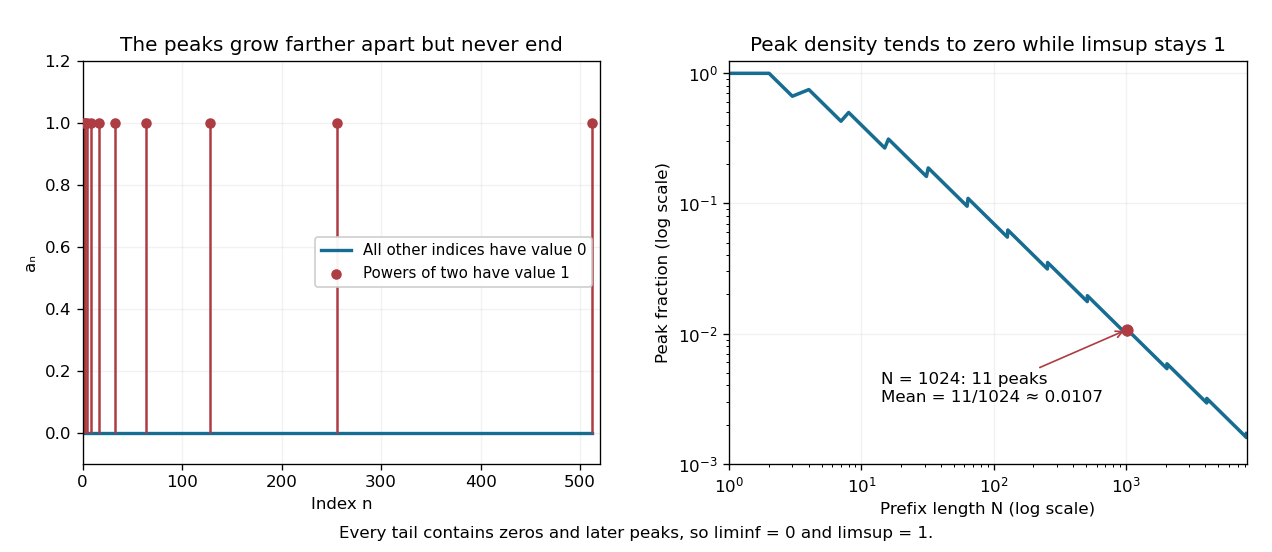
Define a sequence by when is a power of two, including , and otherwise. Every tail of a sequence contains both a later power of two and a later nonpower. Therefore and , and the sequence does not converge. Its peak indices become increasingly sparse, yet never stop appearing.
Through index , the number of peaks is , so their fraction isThe set of powers of two has natural density zero. The same fraction is the Cesàro mean of the first terms, which tends to zero even though the limit superior stays one. At , eleven peaks give mean . An average and a long-run upper edge answer different questions about the same sequence.

Articles by others on the same topic
There are currently no matching articles.