
Geometric distribution Created 2026-09-24 Updated 2026-10-18
Consider successive independent Bernoulli trials with the same success probability . A geometric distribution models waiting for their first success. Two conventions coexist, so always say what is counted. Let count all trials up to and including the successful trial, and let count preceding failures. Their probability mass functions areThe factors describe failures followed by one success; independence permits multiplication. Summing the geometric series verifies that each law has total mass one. Their expected values differ by one, while shifting by a constant leaves the variance unchanged:The positive convention and these moments are also given by Penn State STAT 414.[ref]
11 Geometric and Negative Binomial Distributions. STAT 414: Introduction to Probability Theory at Pennsylvania State University; §11.1, Definition 11.1; §11.2, mean and variance theorems
For a constructed retry mechanism with independent attempts and , success on attempt four has probability . More than four attempts are needed precisely when the first four fail: . The expected values are and , and the common variance is . The large spread explains why the average waiting count is not a deadline.
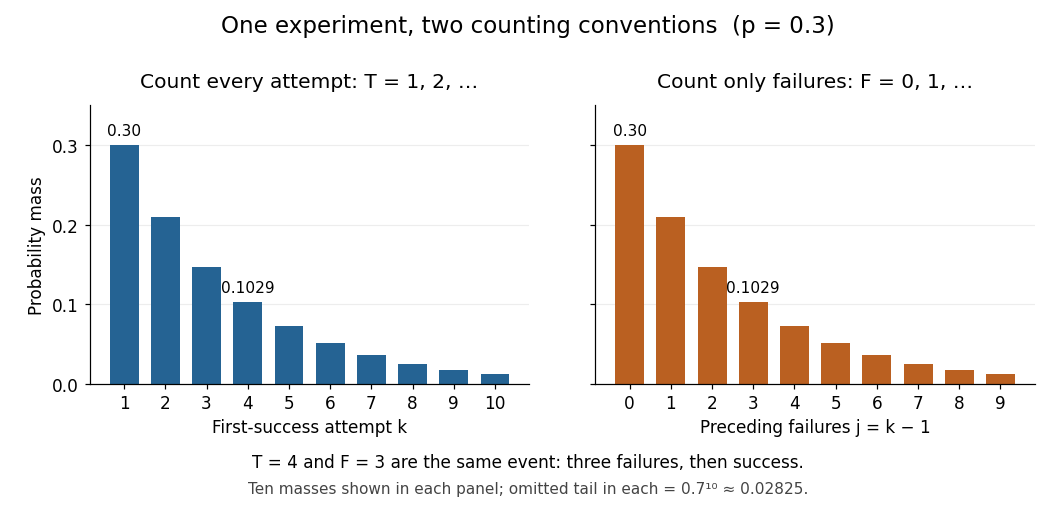
First-success trial versus preceding failures: the same probability masses shifted by one
. Details. 
The two probability mass functions have identical heights with different labels: and describe the same event. For , consecutive masses have ratio , explaining the name geometric distribution. The support of a probability distribution is the positive integers for and the nonnegative integers for . At , it collapses to and , both with variance zero; interpret an empty product, including , as one. These counts concern attempts; converting them into elapsed time requires specifying the time spent per attempt.
The survival function makes the counting convention especially visible. Put . For nonnegative integers , and for ,The event requires failures, whereas requires only when . For the constructed mechanism, differs from . The geometric success deadline uses the latter tail to control the chance of still waiting.
The striking memorylessness of the geometric distribution says that, for nonnegative integers with ,After five failures, the conditional probability of requiring more than two additional attempts is still . The analogous zero-based identity uses ; keeping the inequalities straight avoids an off-by-one error. This property follows from fresh independent trials with unchanged ; learning or changing conditions can destroy it. At , success never occurs, so there is no proper finite waiting-count law.