Take the four-point setthe vertices of a polygon of a rectangle whose side lengths are four and two. Three choices of structure give three different symmetry groups on these same points.
As an unstructured set, has all permutations as symmetries, forming the symmetric group . If Euclidean distance is part of the data, the allowed maps are only the identity, a half-turn rotation, and the reflections across the two coordinate axes. They form a Klein four-group of group order four. To see that nothing is missing, fix the image of one vertex of a polygon: its three other distances, , , and , are distinct, so they uniquely determine the images of the remaining vertices.
Preserving affine structure permits more. The affine mapcycles all four points of . It sends a horizontal side of length four to a vertical side of length two, so it is not an isometry. Yet it preserves the rectangle's vertex set and all affine combinations among those points.
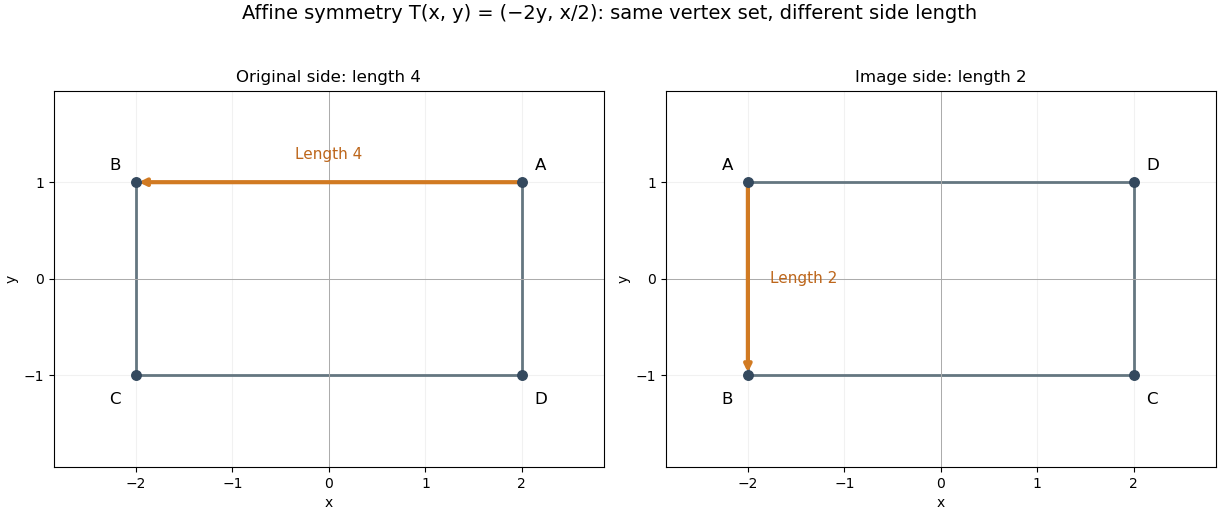

Let and let be the square's quarter-turn rotation. ThenConjugating every square symmetry by gives eight affine maps preserving . This group isomorphism makes the affine symmetry group a dihedral group, although some of its maps do not preserve the original Euclidean distances. There are no further affine symmetries: an affine map preserves the common midpoint of the diagonals, so it must preserve opposite pairs. The image of one vertex has four choices and the image of an adjacent vertex has two; those choices determine the map through three noncollinear points.
ThusAn arbitrary permutation need not be an affine map. For example, exchanging the two top vertices while fixing the two bottom vertices sends the common diagonal midpoint to two different points, which no single affine map can do. The phrase "the symmetry of these points" becomes unambiguous only after stating which structure matters.
Articles by others on the same topic
There are currently no matching articles.