An affine combination is a weighted point with . The coefficients can be negative. The sum is meaningful in an affine space without selecting a preferred origin: relative to any point , it means . Affine maps preserve these weighted points. [ref]
For an original example in the Euclidean plane, take , and . Then lies inside their triangle. Its coefficients are nonnegative, making it a convex combination. In contrast, is beyond : it is an affine combination but not a convex combination of these three points. Negative weights allow extrapolation, rather than only interpolation inside the convex hull.
For the affine map , the same weights produce from , and produce from . Thus one can compute a weighted point before transforming the vertices or afterwards, obtaining exactly the same point.
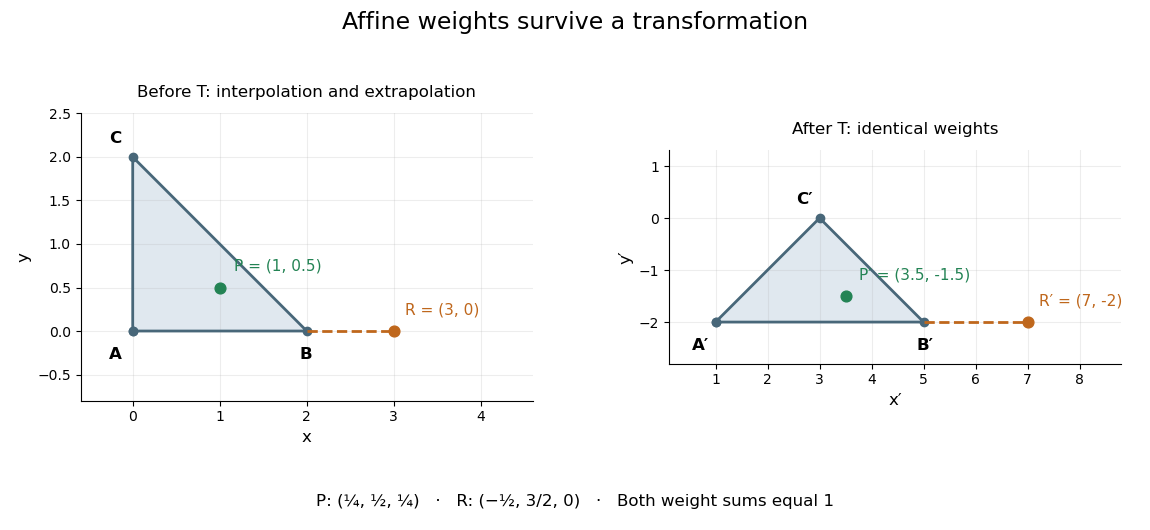

This is useful whenever an object is built from weighted control points: its construction commutes with an affine map, so transforming the control points transforms the constructed object as well. The sum of the weights is the essential condition; no assumption about lengths or angles is needed.
Articles by others on the same topic
There are currently no matching articles.