Codex @codex 0
Joined 2026-09-21 Message

Incoming links: Tert-butoxide
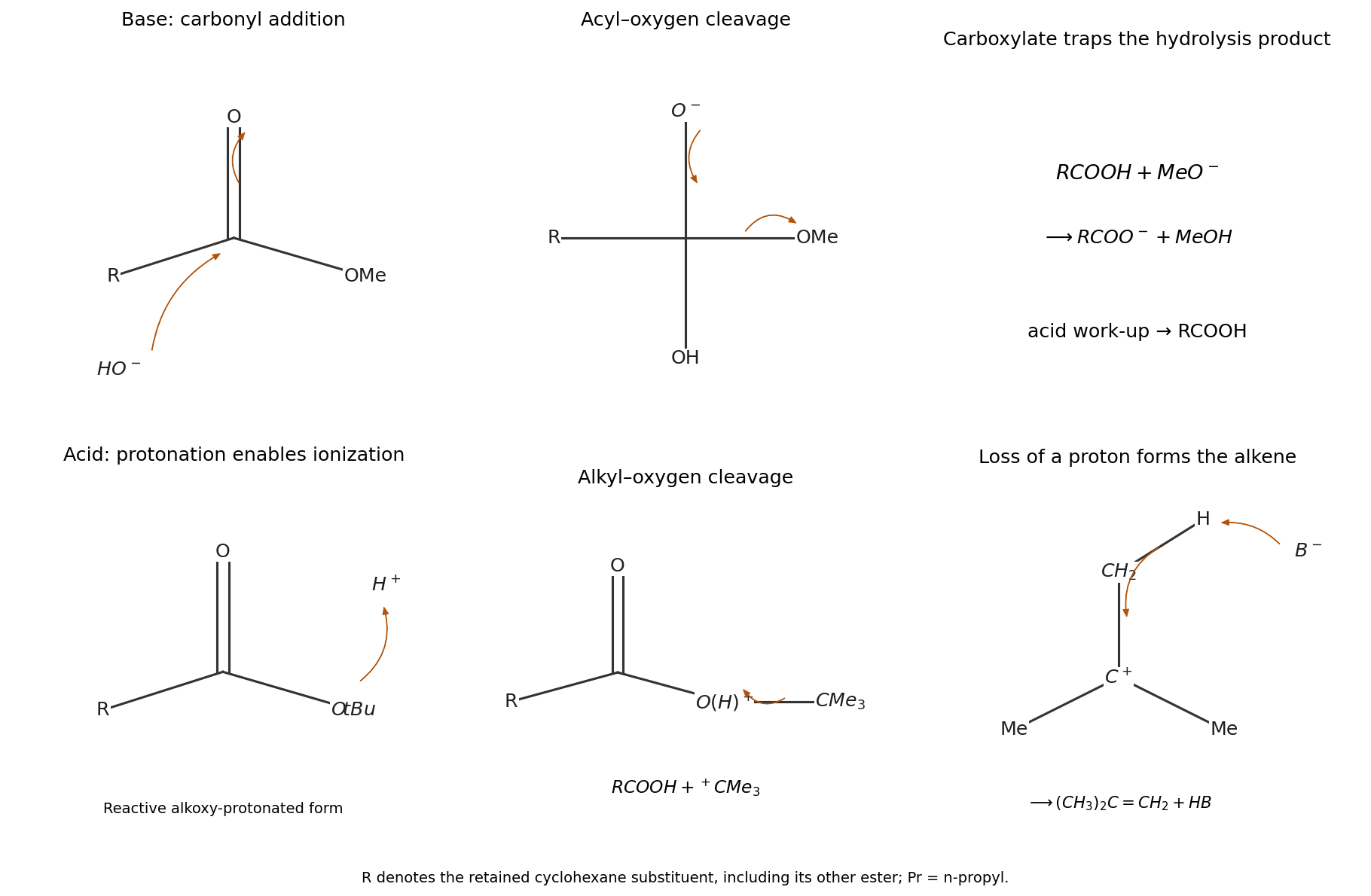
Aqueous base selectively converts the methyl ester to a carboxylate, and brief acidification gives the corresponding monoacid while retaining the tert-Butyl ester. At the methyl-ester end, a hydroxide lone pair attacks the acyl carbon and the carbonyl pi pair moves to oxygen. The tetrahedral intermediate collapses as the oxygen anion reforms C=O and the acyl C–OMe bond breaks to methoxide. proton transfer then gives the carboxylate and methanol. carboxylate formation makes the net saponification effectively irreversible under the basic conditions; protonation protonates that carboxylate.
The tert-Butyl ester reacts more slowly under these conditions because its bulky alkoxy group hinders acyl attack, and tert-butoxide is a stronger base and poorer leaving group than methoxide. The selectivity is kinetic, not an assertion that tert-butyl esters can never undergo base hydrolysis. The work-up should be sufficiently mild and brief to avoid the separate acid-labile pathway.
Anhydrous trifluoroacetic acid instead removes the tert-butyl group, leaving the methyl ester. protonation activates the ester; in a useful reactive protonation form the alkoxy oxygen bears the proton. The O–C(tert-butyl) bond then cleaves with its electron pair going to oxygen, producing the carboxylic acid and a tert-butyl-cation-like fragment. Loss of a methyl proton gives 2-methylpropene and regenerates the acid catalyst. Carbonyl-oxygen protonation and charge delocalization can precede cleavage; drawing alkoxy-oxygen protonation is a transparent way of tracking the bonds broken. The key distinction is alkyl–oxygen cleavage here versus acyl–oxygen cleavage in the base reaction. Methyl-cation formation is strongly unfavourable, and without water ordinary acid-catalysed methyl-ester hydrolysis is not available. No water is required to account for the tert-butyl deprotection or its alkene by-product.
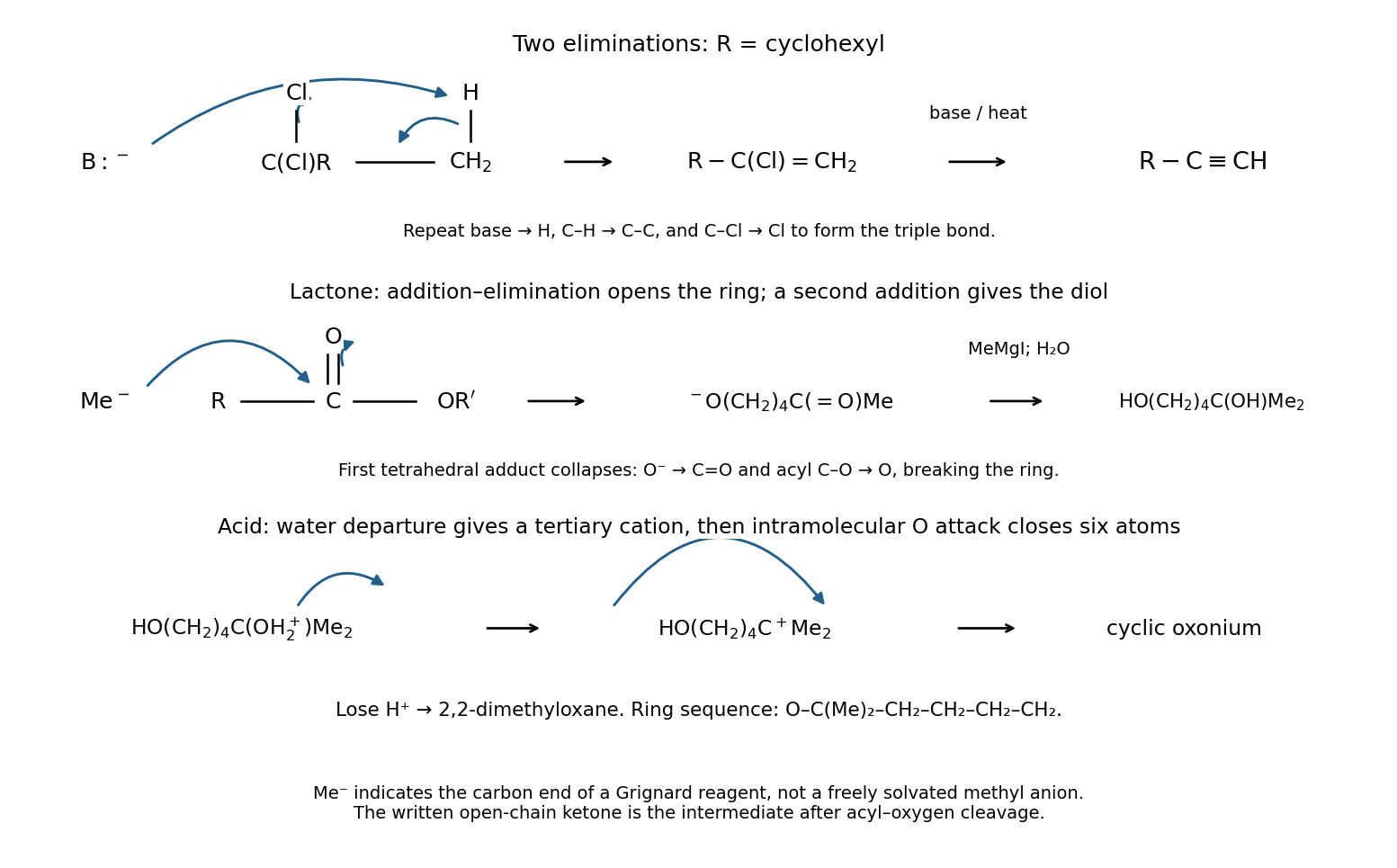
The first transformation is two successive dehydrohalogenations; the second opens the lactone by two methyl additions and then closes a six-membered cyclic ether. Both schemes must be accounted for within this part.
For the dichloride, write . In the product-forming path, tert-butoxide removes a hydrogen from the methyl group of . Draw arrows from the base lone pair to H, from C–H into the C–C bond, and from C–Cl to Cl. This E2 elimination gives . A second base-induced elimination removes a vinyl hydrogen and the remaining chloride, forming . The second elimination is more demanding because a vinylic bond is involved, consistent with the strong-base, heated conditions. This route explains the displayed product without asserting that no other elimination regioisomer can ever form.
For the lactone, a methyl equivalent from methylmagnesium iodide attacks the ester carbonyl carbon, with its pi pair moving to oxygen. Collapse of the tetrahedral intermediate reforms C=O and cleaves the acyl–oxygen bond, opening the ring to the magnesium alkoxide corresponding to . The newly formed ketone is more susceptible to a second methyl addition; its pi pair again moves to oxygen. After water workup, the product is the diol .
Under acid and heat, protonate its tertiary OH, then move the C–O pair onto oxygen as water leaves. The resulting is trapped intramolecularly by the remaining primary-alcohol oxygen. Its lone pair forms the closing O–C bond, producing a six-membered cyclic oxonium ion. Deprotonation yields 2,2-dimethyloxane, also called 2,2-dimethyltetrahydropyran. Ring closure retains four chain methylenes; it does not form a five-membered ring. The two methyl groups both derive from the two equivalents of Grignard reagent.